


 Unity
 Unreal
 Godot

 Mobile
 PC
 Console

 Full-Cycle
 Co-Development
 Outstaffing



-
 Game Co-Development
 Oct 30th, 2026
- Share:
Table of Contents
- TL;DR
- When should you choose co-development over outsourcing? Answer these 4 questions
- Game co-development vs outsourcing: where is the line?
- Co-development pros and cons, and where outsourcing fits
- What drives the cost of co-development vs outsourcing?
- How do you hold quality in a co-development setup?
- Who owns the IP and the know-how in each model?
- Can you switch models mid-project?
- How do you plan the timeline and choose a partner?
- Conclusion: decide by what you can specify
Two messages we got this year sounded almost the same. One small studio had its code, production, QA, and audio covered and wanted a few artists for about 200 pieces of background art. Another team wanted a partner to sit alongside its own engineers on a product that would keep changing. Both asked for a development partner, but they needed different deals.
The first is outsourcing: you hand over a set piece of work and check it when it comes back. The second is co-development: the partner works inside your project and makes decisions with you as the game changes.Game co-development vs outsourcing starts with one question: can you write down exactly what needs delivering, or will the answer change as you build? Pick the wrong one and it can show up as rework or slow decisions.
These two teams aren’t real clients. They’re composites of messages US teams have sent us. A common risk in co-development vs outsourcing decisions is comparing price and headcount instead of who decides how the work gets done, so the four questions below start with the work itself.
TL;DR
- Outsource work you can specify and accept at a milestone. Co-develop work that keeps changing as you build and depends on your tools, builds, and decisions.
- In game co-development vs outsourcing, the real difference is who decides how the work gets done. Team size and hourly rate matter less.
- Cost depends mostly on how clear your scope is and how much of your team’s time the partner needs. The hourly rate is only one part.
- Quality in co-development comes from shared definitions of done, shared source control and build access, and continuous review.
- Agree IP terms and transition terms before work starts, so you can change models mid-project.
When should you choose co-development over outsourcing? Answer these 4 questions
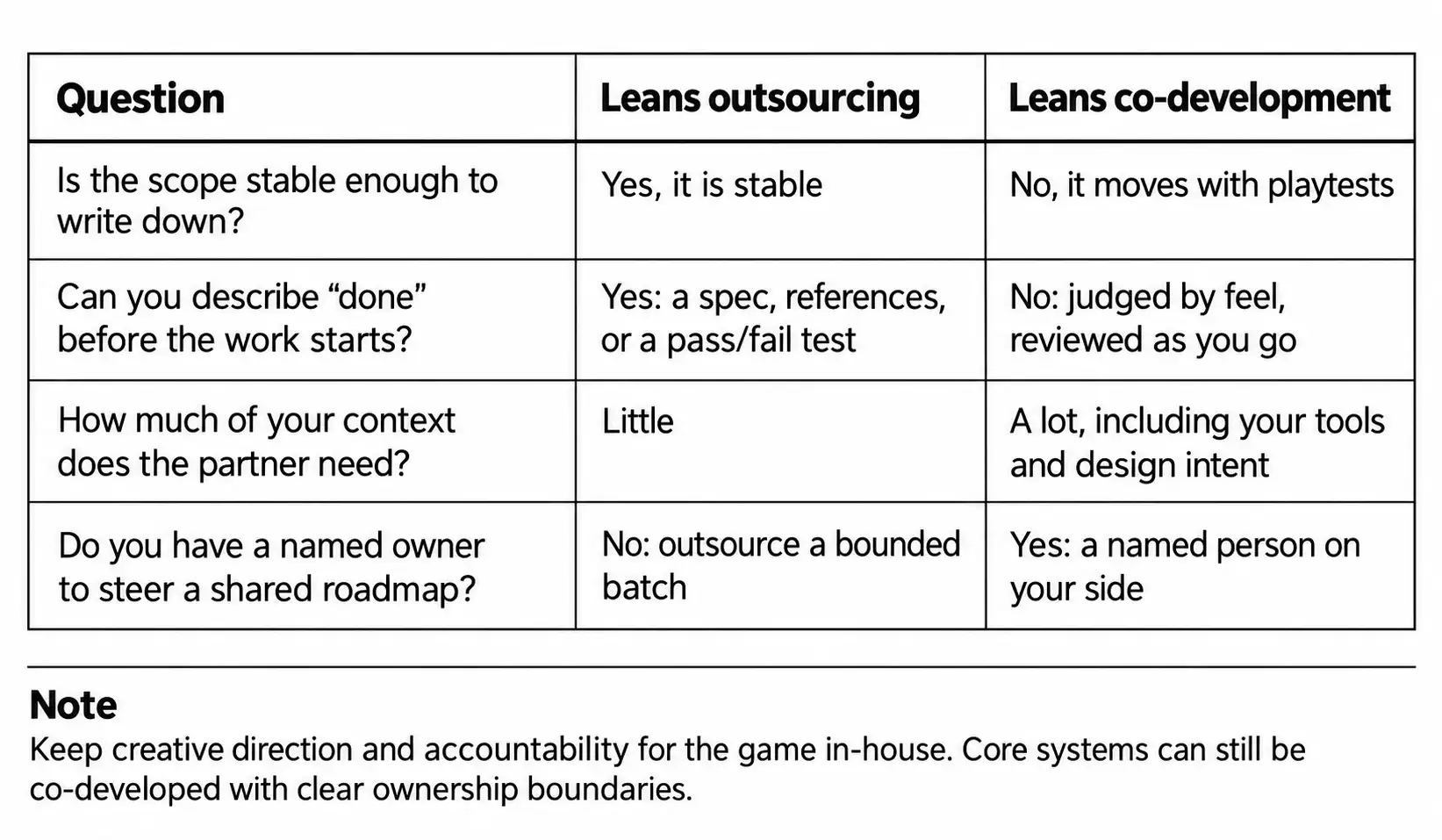
When to choose co-development over outsourcing depends on one thing: whether the work will keep changing as you build and your partner has to change with it. If it will, choose co-development. If you can write the work down up front, outsourcing is easier to price and check.
-
- Is the scope stable enough to write down? If yes, lean outsourcing. If it will move with playtests, lean co-development.
- Can you describe ‘done’ before the work starts? If you can hand over a spec, reference images, or a pass/fail test, lean outsourcing. If you’ll judge it by how it feels in the game, such as combat or level pacing, lean co-development, because you’ll review it as you go. Either way, agree the technical limits, such as frame rate and build size, in writing.
- How much of your context does the partner need? The more design intent and internal tooling they need to understand, the more they need to sit inside your pipeline.
- Do you have someone with the time to steer a shared roadmap? Co-development needs a named owner on your side. Without one, outsource a bounded batch instead.
Neither model may be the answer. A small one-off task, such as one character or a quick prototype, may suit a freelancer better. A whole game built from scratch is full-cycle outsourcing, which our game development outsourcing page covers.
When does a partner need deeper access to your pipeline?
Four situations usually call for it, though the exact setup varies by task.
- Shared gameplay or engine code. Engineers changing systems that other systems depend on need access to your repository, build checks, and code review, so changes are seen before they can break a build.
- Tech art and animation integration. Rigs, shaders, and performance budgets live in your engine project, so artists need current, representative builds and a reliable way to test their work in the engine.
- Live-service content on your release cadence. A partner shipping events or updates needs the release calendar, the relevant backend tooling, and a clear process for getting content into a build.
- Embedded QA. Testers working in your sprint need your builds, issue tracker, and triage rules to log bugs your team can act on.
The first two scenarios are composites of messages US teams have sent us. The third is a made-up example.
Scenario 1: a big batch of 2D art
A small studio has its code, production, QA, and audio in-house and needs about 200 pieces of background art. The scope is clear, and each piece can be checked against a reference. Outsource it. A good art brief has a style sheet, a few approved reference pieces, file naming rules, and the sizes you need. Start with a small first batch to lock the style before the full run, and agree up front how many review rounds each piece gets. You’ll still need one person on your side to approve each batch, but the rest of your team keeps working on the game.
Scenario 2: engineers alongside yours on a game that keeps changing
A studio has its own engineers and a live game whose systems change after every playtest. A fixed spec would be out of date within weeks. Co-develop. Week one should look like this: the partner gets repo access, the first build runs on their machines, and they ship one small fix to prove the setup works. After that, agree who owns which systems, who reviews what, and who breaks ties.
Scenario 3: a fixed ship date and a vague first six months
A publisher-backed team has a locked ship date but a design that is still settling. Start with co-development to find out what the game needs, then move the workstreams that have stabilized to outsourcing. Sequencing is one option. Running both at once also works when each workstream has one owner, a defined interface, and its own acceptance rules. Trouble starts when two arrangements claim the same code with different rules for who decides and who accepts.
What if you build the work in-house instead?
Build in-house when the work is central to your game and your workload is steady enough to keep people busy. Bring in an external team when the workload spikes or you need a skill you won’t need after launch. Comparing in-house, freelance, outsourced, and dedicated-team hiring is a separate decision.
Game co-development vs outsourcing: where is the line?
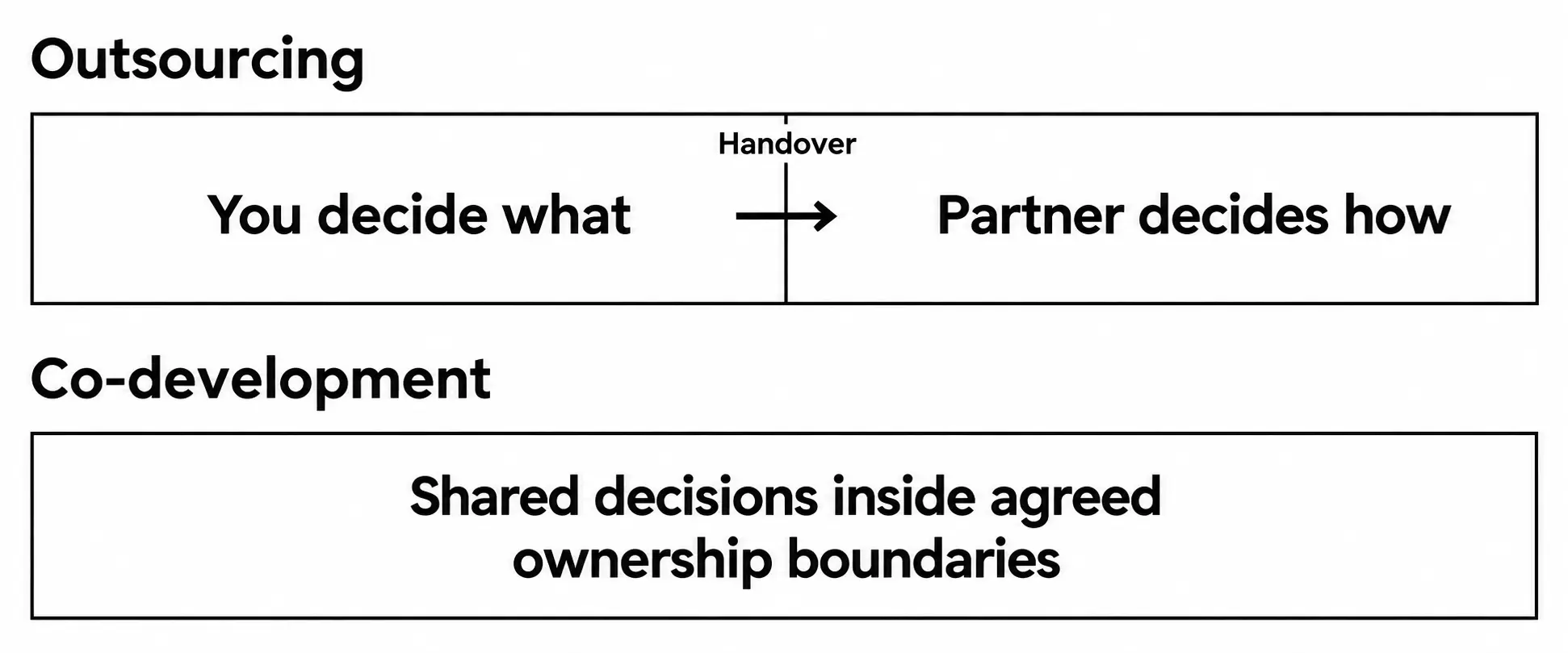
In outsourcing, you decide what gets made and the partner decides how, usually in its own pipeline, then hands the work back for you to check. The full sequence is in how outsourcing engagements usually run. In co-development, the partner’s people work inside your tools and routines, share decisions with you, and answer to the same roadmap. How co-development scales a team covers the model in more depth. Many real engagements sit between the two. Headcount, price, and location don’t separate them: a 40-person outsourced art team and a four-person embedded engineering pod are both “external”, but they need completely different management.
Co-development vs outsourcing, side-by-side
Seven criteria separate the two models in practice.
| Criterion | Co-development | Outsourcing |
|---|---|---|
| Integration | Partner works inside your pipeline, repo, standups, and tools | Partner usually works in its own pipeline, sometimes with limited access to yours, and hands over defined deliverables |
| Who decides | Shared with the partner inside agreed ownership boundaries. You set up front who decides, who builds, and who reviews | The partner decides how, inside your spec. You decide what |
| Reporting | Continuous: shared board, regular syncs, build reviews | Milestone or batch reports with formal acceptance |
| Tooling and access | Shared source control, build pipeline, and issue tracker | Delivery through agreed branches or files, narrower access |
| Cost | Often a monthly rate for an embedded team, or milestone-based for a defined piece of work | Often milestone-based against a defined scope |
| Risk | Unclear who decides, slow onboarding | Rework from missing context, change requests |
| IP and know-how | You can own 100% of the code and art if the contract assigns it to you. Know-how builds up in shared code and docs. | You can own 100% of the code and art if the contract assigns it to you. Know-how stays with the vendor unless you require documentation and source. |
How you collaborate and how you pay are separate choices. Agree on the commercial terms explicitly rather than assuming them from the model’s name.
Communication overtook delivery and security as the top challenge in external partnerships for the first time in the XDS 2026 Insights Report, rising by roughly 15 points year over year on both sides, for developers and publishers as well as service providers. The report draws on more than 250 submissions from industry professionals worldwide, and Side, a co-author, describes the increase in points. Co-development depends on more day-to-day communication than outsourcing, so a communication problem is likely to show up there first.
Co-development pros and cons, and where outsourcing fits
The co-development pros and cons are a trade between control and your team’s time. Co-development can give you more control and faster fixes, but it takes more of your team’s time. Outsourcing takes less of your time day to day, but you give up some control over how the work gets done.
Where co-development pays off
Course correction can be faster when a partner’s engineers attend your standups, read the same design documents, and work in your repository. Playtest findings can reach the people responsible for fixing them sooner. Changes that affect scope, budget, or deadlines still need agreement. Context also carries over: the partner learns why decisions were made, not only what shipped. That matters most for engineering and other work that depends on your code and builds. How AAA teams split work across external partners shows the same trade-offs at larger scale.
What co-development costs you
Co-development costs you management time. Someone on your side has to onboard the partner, set decision boundaries, and keep them current. It also creates a tighter dependency: people who know your codebase aren’t easy to swap out mid-sprint, so a weak partner is harder to walk away from. And without clear ownership boundaries, shared decisions turn into slow ones.
Where outsourcing wins
Outsourcing is more predictable. A defined scope is easier to estimate and review, whichever way it’s priced. You accept work against written criteria, and bounded jobs such as asset batches, porting passes, localization, or test cycles can need less day-to-day coordination, depending on the task and the partner. You can also run more than one vendor at once without any of them needing access to your core systems.
Where outsourcing bites
Outsourcing bites when the partner is missing context. If the brief says ‘match the rest of the game’ and gives no references, the first delivery comes back wrong. A fixed quote won’t protect you here, because the fix turns into an argument about what was in scope.
Which model works for a small indie team?
Most indie teams do better outsourcing a defined batch of work, such as art, porting, or QA. Co-development only works if one person on your team can review the partner’s work every week, and its starting budgets are higher than many indie budgets (see the cost section below).
What drives the cost of co-development vs outsourcing?
Six things move the cost in either model, and the hourly rate is only one of them.
| Driver | How it moves the cost |
| Scope clarity | A written spec lets you price up front. Scope that moves becomes change orders or extra capacity. |
| Type of work | Engineering, art, animation, QA, and LiveOps require different skills and staffing levels. The access and coordination needed depend on the assignment. |
| Art style and detail level | Style (stylized or realistic), asset type, required detail, and revision rounds drive effort in either model. Asset-level detail is covered in the game art outsourcing guide. |
| Game type and technical difficulty | Multiplayer and netcode, open worlds, live-service backends, and multiple platform targets add engineering, test, and optimization work. |
| Seniority and location | Senior people cost more per hour but need less steering, and rates vary by region. |
| Your team’s time, plus rework | Onboarding, internal coordination, review cycles, integration, and rework add to total cost in either model. Some of these costs may sit outside the vendor’s quote. |
With full-cycle outsourcing, every driver applies at once. Ask for the quote broken out by workstream, such as engineering, art, and QA. A single all-in number hides where the cost sits and makes change requests harder to price.
For a rough sense of scale, here are typical starting points from Juego’s own service pages.
| What you’re buying | Starting point |
| Single-discipline co-development pod, such as a 3D art batch or embedded sprint QA | From around $50,000 |
| Multi-discipline engineering, gameplay systems, or porting milestones | From around $100,000, rising with team size, duration, and platform count |
| Longer embedded co-development team | Billed monthly, from around $60K to $200K+ per month |
| Full-cycle outsourcing, mid-core mobile build | $200K to $600K typical |
| Full-cycle outsourcing, AA or AAA console production | $500K to $2M+ |
Use them as a guide and expect a scoped quote to differ. If your budget is well under these, a freelancer or a small outsourced batch is usually the better fit, and how much indie game development costs shows smaller line-item budgets.
How do you hold quality in a co-development setup?
A shared definition of done
Write down what “done” means for each system before work starts: performance targets, test coverage, review sign-off, and how bugs are triaged. Both sides use the same definition, so acceptance becomes continuous instead of a milestone surprise.
Code review, builds, and source control
Put source control in place before anyone touches the project. Epic’s guidance on scaling an Unreal team says version control should be set up before anyone starts working on assets or code and notes that Epic primarily uses Perforce, with Git (using Git LFS), Subversion, and Diversion also supported. For a co-development partner, that means the same depot or repository as your team, the same automated builds and code review that run in both directions. The same guide documents Horde for continuous integration and Unreal Game Sync for syncing working builds.
Reporting cadence and KPIs
Agree on a small set of numbers both sides can see: build stability, defect counts by severity, and progress on the shared board. Review them weekly. At Juego Studios, co-development means an embedded team working in your source control and sprints, delivering a playable build every sprint, and held to the KPIs you set at the start. We’ve worked this way on titles including Ghostbusters: Spirits Unleashed. Co-development isn’t the right fit for every job. A bounded batch of work, such as a set of art assets or a port, is usually simpler to outsource as a batch. Before you sign with any partner, check the common mistakes when choosing a co-development partner.
Who owns the IP and the know-how in each model?
You can own all of the code and art in either model. What decides it is the IP assignment clause in your contract, not who wrote the code. The vendor’s own pre-existing tools and any third-party or open-source parts keep their own licenses, so ask for a list of them. Ask for an IP assignment clause, delivery of all source files, a documentation handover, and clear exit terms. The linked guide covers contracts and security in more depth.
Having repository access doesn’t give you ownership or the knowledge behind the code, so agree what the partner will document and explain to your team.
Can you switch models mid-project?
Yes, if you plan for it from day one. Switching late, with no documentation and no repo access, is where projects lose momentum.
Signs you picked the wrong model
On an outsourced scope, watch for rising change requests, repeated rework, and a partner who keeps asking questions the brief should have answered. On a co-development engagement, a scope that has settled into a defined backlog is a cue to review whether part of it could move to a bounded hand-off. Also watch for in-house capacity coming back or costs drifting away from the value delivered.
How to switch without slowing down
Document the architecture and the decision log. Confirm repo and asset access. Agree on acceptance criteria for the new mode, and move one workstream first. Overlap the old and new mode for the handover window so knowledge transfers, then close the old one.
A founder came to us with her source code and a mobile game that the previous company had not finished. She wanted to move the remaining work to a new team. Because she held the code, she could.
What to set up on day one
Put a transition clause in the contract, use shared source control from the start, agree on a documentation standard, and name a decision owner on each side. Write the review points into the contract: a date or milestone to reassess the model, a notice period, and what each side hands over if you switch.
How do you plan the timeline and choose a partner?
Your timeline depends on what has to be in place before work starts, and a good partner can tell you what that is. Outsourcing needs a solid brief before work begins. Co-development needs onboarding, access, and decision boundaries before output appears. In either model, start with a small paid test of one batch or one system before you sign the big contract.
| Outsourcing | Co-development | |
| Before work starts | A written brief with references, acceptance criteria, and a quality bar | Repo, build, and tool access; named decision owners; a shared definition of done |
| What the first stretch tests | Whether the first delivery matches the brief | Whether the team becomes productive inside your pipeline |
| Pilot scope | One bounded batch or feature | One system with clear ownership boundaries |
| Signal to expand | First delivery accepted with little rework | Your team spends less time steering and reviewing |
In the first call with any partner, ask three questions.
- Who makes which decisions?
- What access do you need from us?
- How is quality accepted, and by whom?
Vague answers to any of the three are a warning sign worth probing before you sign. For a longer vendor checklist, what studios outsource and how to vet vendors goes further.
Conclusion: decide by what you can specify
Back to the two teams from the start. The studio that needs about 200 pieces of art can outsource it as a batch and check each delivery against the brief. The team with engineers of its own and a game that keeps changing is better off with a partner working inside its project. If you can’t tell yet which team you are, a short pilot with a game co-development partner will show what the game needs.
Frequently Asked Questions
Yes, if the contract assigns it to you. Ask for an IP assignment clause, delivery of all source files, and a list of any third-party or open-source parts and their licenses. Revenue share is a separate commercial term and doesn’t change who owns the IP unless the contract says so.
Yes, for example when two studios co-fund a game, though it’s less common for studios hiring a partner. It needs written terms on who can ship, license, make sequels, and enforce, and default rules vary by country, so take legal advice before signing.
Neither is cheaper by default. A clear scope makes the cost easier to predict, while a changing roadmap makes flexibility worth more. The cost section above shows what moves the price.
Yes. It’s a low-risk way to test a partner. Put a switch clause in the contract up front, and ask for documentation and source handover at each milestone so a change of model doesn’t mean starting over.
A short brief with your genre and platforms, what you need built (or a list of assets with sizes and styles), reference images or a build, your target dates, and who on your team makes decisions. The more concrete the brief, the tighter the estimate. Juego scoped estimates usually come back within one business day after you share the production stage and target platforms. Get in touch with us.
Access, documentation, and a clear owner for decisions usually decide it. If the repo, builds, and a named decision owner are in place on day one, a partner can start on a small, well-bounded system quickly. If they aren’t, the first weeks go to waiting.
Yes, as long as each part of the project has its own owner. Problems start when two sets of rules cover the same system. If you can’t draw that line yet, run the models one after the other.
Related Posts
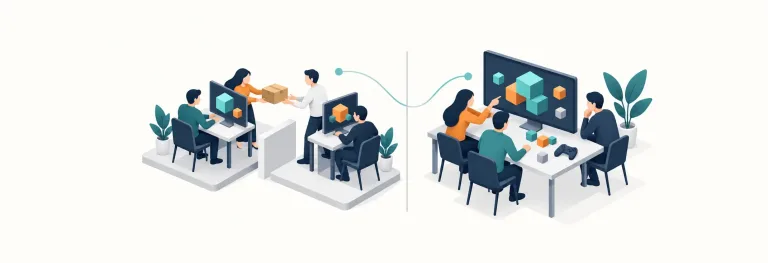
Game Co-Development vs Outsourcing: 4 Questions to Choose the Right Model
Two messages we got this year sounded almost the same. One small studio had its code, production, QA, and audio covered and wanted a few artists for about 200 pieces of background art. Another team wanted a partner to sit alongside its own engineers on a product that would keep changing. Both asked for a development partner, but they needed different deals.
Game Development Outsourcing Works in 2026
This blog explores how game development outsourcing has evolved into a strategic production decision in 2026 rather than a simple cost-saving tactic, outlining the engagement models, execution risks, cost structures, and best practices studios must understand to scale without losing technical or creative control. It breaks down project-based, dedicated team, co-development, and hybrid models; examines average outsourcing costs across features, art, full-cycle production, and milestones; and provides a practical, end-to-end framework covering scoping, onboarding, sprint governance, QA, LiveOps, and IP protection. The article also compares leading outsourcing companies, explains how to evaluate vendor fit based on pipeline maturity and engine alignment, and positions outsourcing as a long-term production system where ownership, milestone validation, and architectural control determine ROI more than hourly rates.

8 Common Mistakes When Choosing the Right Co-Development Partner for Your Game
Your next game holds incredible potential. It could be a massive success or a costly failure. The key? Choosing the right co-development partner for your game. This blog helps you avoid critical mistakes. Successful collaboration ensures your game’s vision thrives. Let’s make your next game a winner.