


 Unity
Unity Unreal
 Godot
Godot
 Mobile
 PC
PC Console
 Full-Cycle
 Co-Development
 Outstaffing






-
 Game Development
 Apr 7th, 2026
- Share:
Table of Contents
- Understanding Game Development Costs in the Netherlands
- TL;DR — Key Numbers at a Glance
- The Netherlands Gaming Market: A 2026 Snapshot
- What Drives Game Development Costs in the Netherlands?
- Dutch Developer Salaries and Hiring Costs (2026 Benchmarks)
- Game Development Cost Breakdown by Project Type (2026 Estimates)
- Development Timeframes by Project Scope
- How to Estimate Your Game Development Budget (The Formula)
- Phase-by-Phase Budget Breakdown
- Team Composition and Role-Based Cost Planning
- Operational and Hidden Costs Dutch Studios Often Miss
- Marketing Budget Planning for Dutch Game Studios
- Leveraging Dutch Tax Incentives and Funding Programs
- The Hybrid Development Model: What Dutch Studios Are Actually Doing
- Engagement Models and How They Affect Your Budget
- MVP and Phased Development: Budget-Smart Production Strategy
- Budget Planning for Specific Game Types
- Common Budget Mistakes Dutch Studios Make
- How to Select the Right Development Partner for Your Budget
- Conclusion
You have the concept. You have the team. You might even have the funding. But the moment you start mapping out what it actually costs to build your game in the Netherlands in 2026, the numbers start to blur.
Is €80,000 a reasonable salary for a senior Unity developer in Amsterdam? Should you factor GDPR compliance into your pre-production budget? What does it really cost to certify and ship to PlayStation from Utrecht? And where does the WBSO tax credit actually fit into your cash flow plan?
These are not hypothetical questions. They are the exact calculations that determine whether a studio hits its gold master date or quietly runs out of runway at month 14 of a projected 12-month build.
The Dutch gaming industry is one of Europe’s most creative and respected, home to acclaimed studios in Utrecht, Amsterdam, and Eindhoven. But it is also one of the most expensive environments in the world to build a game. This guide exists to give you the real numbers, the hidden cost lines, and the strategic frameworks to build a budget that holds up.
Understanding Game Development Costs in the Netherlands
The game development cost in the Netherlands is shaped by a unique combination of factors that do not apply in the same way anywhere else. High living costs, mandatory employer contributions, GDPR obligations, and a talent market where senior engineers command €90,000–€100,000+ per year create a production environment that rewards careful planning and punishes assumption-based budgeting.
At the same time, the Netherlands offers structural advantages that smart studios leverage: the WBSO R&D tax credit, cultural subsidies for innovative game projects, a world-class talent pipeline from institutions like Breda University of Applied Sciences and Utrecht School of the Arts, and an established network of co-development partners, incubators, and international publishers.
The cost of game development in the Netherlands in 2026 ranges from €10,000 for simple mobile games to over €2 million for mid-size PC/console titles. Most studios budget €120,000–€180,000 for a mid-complexity game. Personnel accounts for 70–90% of the total budget, and high salaries, mandatory employer taxes, and operational overhead make the Netherlands one of Europe’s most expensive development markets — but also one of its most capable.
This 2026 guide is built for the people who actually hold the budget: Executive Producers, Technical Directors, Founders, and Studio Heads. It is not a roundup of global averages. It is a breakdown of the video game development cost in the Netherlands, from a simple 2D mobile title all the way to a mid-core PC game with LiveOps — with actionable budget planning frameworks at every level.
TL;DR — Key Numbers at a Glance
- A simple 2D or hyper-casual mobile game in the Netherlands will typically cost between €10,000 and €50,000, taking two to four months with a team of one to four people.
- Mid-level 3D and casual games sit in the €50,000–€250,000 range, generally requiring six to twelve months of production with a team of four to ten.
- A mid-size indie title targeting PC or console demands serious capital — budgets of €250,000 to €2 million are realistic for a twelve to twenty-four month production.
- Senior developers in the Netherlands earn €90,000–€100,000+ gross annually, but the true employer cost once mandatory contributions are factored in is closer to €121,500–€145,000 per hire.
- Studios working with Juego Studios as a co-development partner can access dedicated teams that integrate into their Jira, Perforce, and Slack pipelines within 72 hours, helping control costs without sacrificing sprint velocity.
- The WBSO R&D tax credit is one of the most underused tools in the Dutch market — qualifying studios can reduce effective developer costs by up to 36% on the first €350,000 of eligible R&D labour.
- Marketing is almost always the largest invisible budget line: plan for 50–100% of your production budget on top just to reach a viable launch audience.
- Always build a 15–20% contingency reserve into your baseline estimate — game development in the Netherlands has too many structural variables to budget without a buffer.
The Netherlands Gaming Market: A 2026 Snapshot
The Netherlands gaming market reached USD 2.53 billion in 2025 and is projected to grow to USD 5.2 billion by 2034 at an 8.38% CAGR. The Dutch gaming industry includes roughly 4,291 companies—mostly small or self-employed—making co-development essential for scaling games made in Netherlands. As mid-tier budgets (€5M–€20M) fade due to rising costs and lower publisher risk tolerance, Dutch studios now operate on a hybrid model: core leadership in-house, production outsourced at scale.
What Drives Game Development Costs in the Netherlands?
The average cost of game development in the Netherlands is not simply a function of team size and timeline. It is a compound of five distinct cost drivers, each of which can independently push a budget 20–40% over initial estimates if not accounted for during pre-production.
Driver 1: Personnel Costs — 70–90% of Budget
The single largest line item in any Dutch studio’s production plan.
- Senior developer gross salary: €90,000–€100,000+
- True employer cost (incl. mandatory contributions): €121,500–€145,000+
- Mandatory employer overhead: +30–45% on top of gross salary — covering unemployment insurance, disability, healthcare contribution (6.52%), pension, and holiday pay.
- Recruitment agency fee (if used): +15–25% of first-year salary, one-time
Impact: The largest and most predictable contributor to budget overruns. Every unplanned hire mid-production costs 2–3x more than a hire planned from day one.
Driver 2: Scope and Complexity — The Silent Multiplier
Each feature layer compounds costs across every discipline simultaneously.
- Real-time multiplayer: adds backend infrastructure, netcode engineering, and QA load
- Destructible environments / advanced AI: multiplies optimization cycles
- Cross-platform targets: adds per-platform porting and certification passes
- Unplanned scope additions post-GDD: typically cost 2–3x their pre-production equivalent
Impact: Studios that allow scope creep routinely see 30–50% cost overruns. Every feature added after the Game Design Document is locked is a budget risk, not just a design choice.
Driver 3: Platform and Engine Choice — Upfront and Hidden
The platform you target shapes your cost structure from day one.
- Unity Pro license: $2,400 per seat/year
- Unreal Engine: 5% royalty on revenue above $1M (free below)
- Console certification (TRC/TCR): €5,000–€25,000 in specialist time per platform, per submission cycle
- Cross-platform porting: adds 20–40% of base development cost per additional platform
For studios exploring game development outsourcing services, engine alignment with the partner’s core expertise is a non-negotiable evaluation criterion — mismatched stacks introduce ramp-up time that erodes budget before a line of production code is written.
Impact: Engine and platform decisions made in week one echo through every sprint for the next 18 months.
Driver 4: Operational Infrastructure — The Overhead Studios Undercount
Running a studio in the Netherlands costs more than most international comparisons suggest.
- Amsterdam office space: €350–€600/m² annually; a 20-person studio runs €105,000–€240,000/year in space alone
- GDPR compliance setup: €5,000–€20,000 initial; €2,000–€8,000/year ongoing
- Remote-first tooling and coordination overhead: €10,000–€30,000/year
- Software licenses across the stack: €15,000–€40,000/year for a mid-size team
Impact: Operational costs are the line most often omitted from early-stage budgets — and the one that makes month-12 burn rates confusing to reconcile.
Driver 5: Post-Launch and LiveOps — The Budget That Comes After
The cost to build a video game in the Netherlands does not end with a gold master.
- LiveOps operations (mid-core mobile): €15,000–€40,000/month for a Netherlands-based team
- Server infrastructure at scale: €5,000–€30,000/month depending on concurrent user load
- Bug fix and patch cycles: €5,000–€15,000/month during the first 90 days post-launch
- New content and seasonal events: variable; typically 10–20% of original production cost annually
Impact: Studios that budget only for development and not for the first 12 months of live operation routinely undercapitalise their titles — and lose their player base before word-of-mouth can build.
Dutch Developer Salaries and Hiring Costs (2026 Benchmarks)
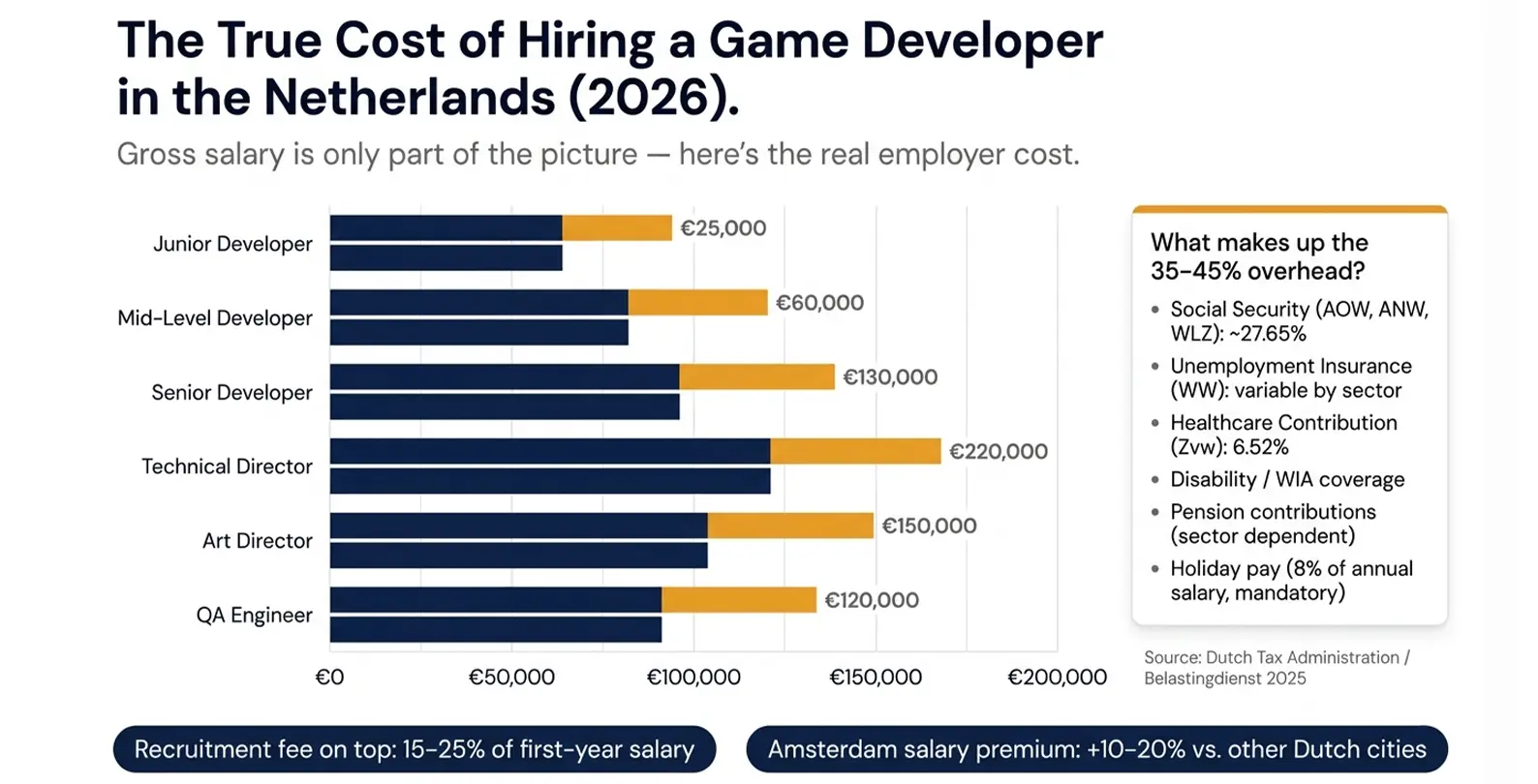
Personnel costs are where most Dutch studio budgets either hold or break. The following benchmarks reflect 2026 market rates for the Netherlands, including Amsterdam premium effects and the true employer cost once mandatory contributions are applied.
Game developers in the Netherlands earn an average of approximately €50,560 per year, with a range of €25,940 to €83,020 depending on seniority and specialisation. Senior roles at studios working on AAA or co-development projects consistently sit at the upper end or above this range, particularly in Amsterdam.
| Role | Gross Annual Salary | True Employer Cost (incl. 35–45% overhead) |
| Junior Game Developer | €55,000–€60,000 | €74,000–€87,000 |
| Mid-Level Developer | €65,000–€85,000 | €88,000–€123,000 |
| Senior Game Developer | €90,000–€100,000+ | €121,500–€145,000+ |
| Technical Director / Lead | €100,000–€130,000 | €135,000–€188,500 |
| Art Director / Senior Artist | €75,000–€95,000 | €101,000–€137,750 |
| Game Designer (Senior) | €65,000–€85,000 | €88,000–€123,000 |
| QA Engineer | €45,000–€65,000 | €60,750–€94,250 |
| Producer / Project Manager | €70,000–€90,000 | €94,500–€130,500 |
Recruitment Fees
Agency recruitment fees in the Netherlands typically run 15–25% of the first-year salary. For a senior developer at €95,000, that is a one-time recruitment cost of €14,250–€23,750 before the person produces a single line of code. Internal referral programmes and direct sourcing via LinkedIn and Dutch industry events can reduce this substantially.
Freelancer and Contractor Rates
Freelancers and contractors command €70–€120 per hour for generalist roles, with specialist rates — Houdini VFX, multiplayer networking, platform certification expertise — running €130–€200 per hour. For short-duration specialist work such as platform porting, technical art optimization, or narrative implementation, freelancers often deliver better ROI than full-time hires.
Amsterdam vs. Other Dutch Cities
Amsterdam developers typically command a 10–20% salary premium over equivalent roles in Eindhoven, Utrecht, or Breda. For a 10-person studio, hiring outside Amsterdam can save €100,000–€200,000 annually in salary overhead alone — a meaningful input when modelling the game development budget in the Netherlands.
Game Development Cost Breakdown by Project Type (2026 Estimates)
How much does it cost to develop a game in the Netherlands? The honest answer is that the range is wide, but the drivers within each tier are predictable. The table below reflects 2026 estimates calibrated to Dutch market rates, not global averages. Studios considering game development partnerships should use these ranges as baseline inputs, not final quotes.
| Project Type | Estimated Cost (Netherlands) | Timeline | Typical Team Size |
| Simple 2D / Hyper-Casual Mobile | €10,000–€50,000 | 2–4 months | 1–4 people |
| Mid-Level 3D / Casual Mobile | €50,000–€250,000 | 6–12 months | 4–10 people |
| Mid-Size Indie (PC/Console) | €250,000–€2 million | 12–24 months | 10–30 people |
| Multiplayer / Live-Service Game | €200,000–€1.5 million+ | 12–24 months | 10–40 people |
| High-End / AAA-Lite Production | €1 million+ | 24–48 months | 30–100+ people |
| VR / AR / Serious Game | €80,000–€500,000 | 6–18 months | 5–20 people |
| Enterprise Gamification / XR | €50,000–€300,000 | 3–12 months | 3–15 people |
Important notes on these estimates:
- These ranges assume a Netherlands-based core team. Hybrid models with outsourced art or QA can shift these estimates downward by 20–40%.
- Marketing, platform certification, and post-launch LiveOps are not included — budget for these separately.
- Multiplayer games carry backend infrastructure costs that scale with concurrent users; a live-service title can accumulate €5,000–€30,000/month in server costs at scale.
- A contingency buffer of 15–20% should be added to any estimate before presenting to stakeholders.
Development Timeframes by Project Scope
Timeline and cost are directly coupled in game development. Every additional month of development at a 10-person Dutch studio — with true employer costs factored in — represents approximately €75,000–€120,000 in personnel spend alone. Timeline overruns are not just schedule problems; they are budget emergencies.
| Project Scope | Typical Timeline | Primary Risk Factors |
| Simple 2D / Hyper-Casual Game | 2–4 months | Scope creep, art asset volume |
| Mid-Level 3D / Casual Game | 6–12 months | Technical complexity, platform requirements |
| Mid-Size / Indie Title (PC/Console) | 12–24 months | Engine issues, team scaling, and feature addition |
| Enterprise / Serious Game | 3–12 months | Client feedback loops, compliance requirements |
| AAA-Scale Production | 24–48 months | Talent attrition, technology changes, and publisher review cycles |
What Causes Timeline Overruns
- Scope additions post-GDD: Every feature added after the Game Design Document is locked costs 2–3x what it would have cost if planned from the start.
- Platform certification failures: A rejected Sony or Nintendo submission can add 4–8 weeks to your timeline. Budget for at least one rejection cycle.
- Key person dependency: Dutch studios with fewer than 15 staff are highly vulnerable to single-engineer bottlenecks. Redundancy planning is a budget line, not a luxury.
- Third-party SDK integration delays: Analytics, monetization, and attribution SDKs introduce compliance and compatibility overhead that is rarely accounted for in initial estimates.
How to Estimate Your Game Development Budget (The Formula)
This section is what most budget guides skip entirely. They give you ranges — but not a calculation framework. Here is how experienced producers in the Netherlands actually build a budget number from scratch.
The Formula
Use this formula to estimate your real budget — not just development cost:
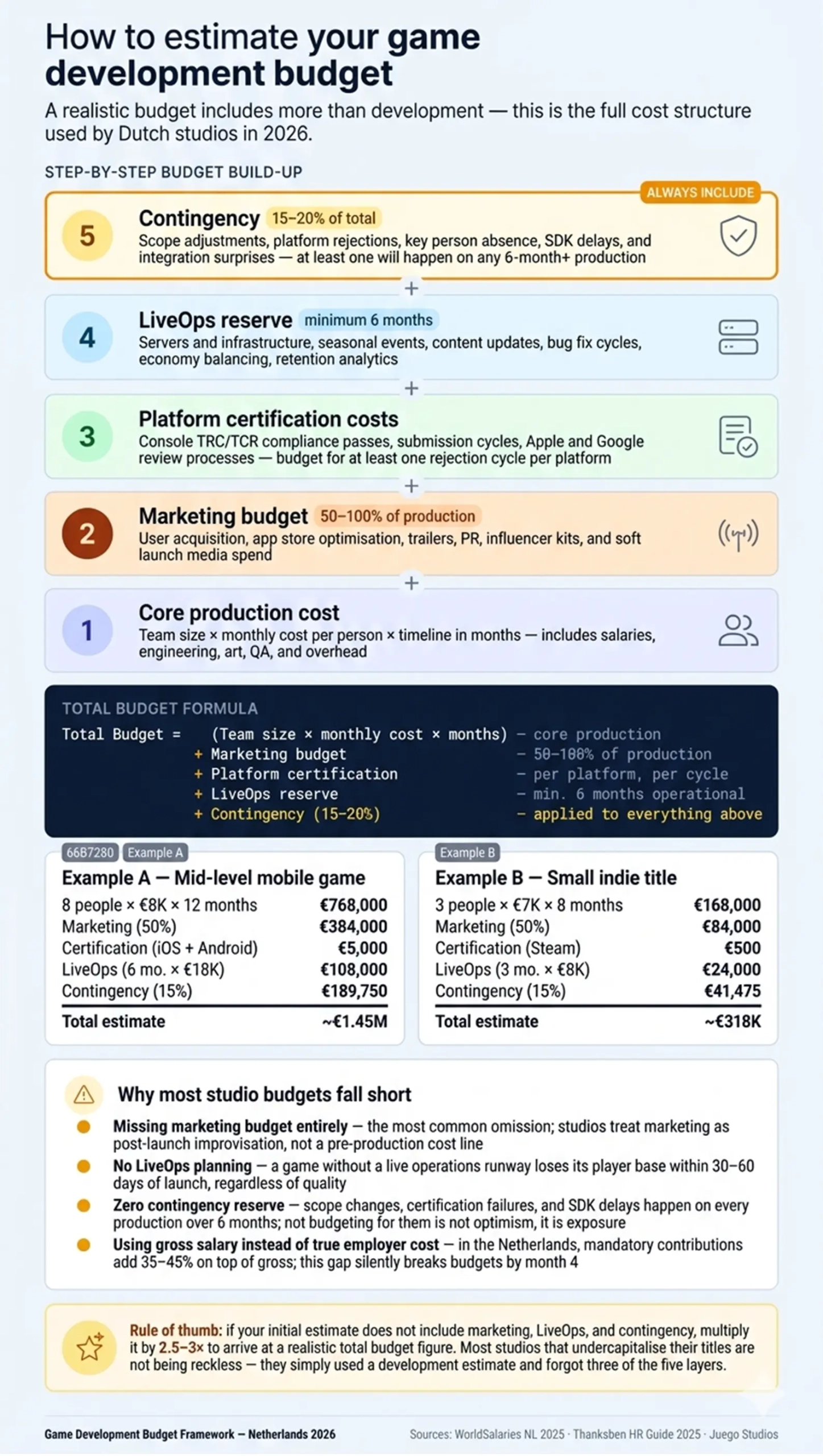
Phase-by-Phase Budget Breakdown
Most budget guides present game development as a single cost line. The most effective Dutch studios break it into four phases, each with its own budget envelope and approval gate. This structure prevents the most common failure mode: spending 80% of the budget on production before realizing the core loop does not work.
Phase 1: Pre-Production (10–15% of Total Budget)
Pre-production is where the money is best spent and most often skipped. A proper pre-production phase includes Game Design Documentation, technical feasibility assessment, vertical slice prototyping, competitive analysis, and milestone mapping. A studio that invests €25,000 in pre-production on a €250,000 project is protecting the other €225,000 from structural risks.
- GDD authoring and design workshops
- Technical architecture review and engine selection
- Vertical slice (playable prototype of core loop)
- Competitive landscape and monetization analysis
- Risk assessment and contingency planning
Phase 2: Full Production (60–70% of Total Budget)
This is where the majority of the budget and team effort is concentrated. Art production, engineering, audio, and QA cycles all run in parallel. For Dutch studios, the key risk in this phase is team scaling — ramping from a core team of five to a production team of twenty is expensive and disruptive if not planned. Sprint-based delivery with milestone gates protects quality and provides natural budget checkpoints.
Phase 3: Post-Production and Certification (10–15% of Total Budget)
The final mile is often the most expensive per unit of progress. Performance optimization, platform certification compliance (TRC/TCR for console), store submission preparation, and QA regression cycles all require dedicated specialist time. Budget for a minimum of one certification rejection per platform — and for the fix cycle that follows.
Phase 4: Launch and Post-Launch LiveOps (Ongoing)
Post-launch costs are the most underestimated line in the average game development budget in the Netherlands. For any game with a live-service component, budget for a dedicated operational envelope: bug-fix cycles, seasonal content drops, server scaling, analytics reviews, and economy balancing. A well-resourced LiveOps function for a mid-core mobile title typically costs €15,000–€40,000 per month in a Netherlands-based team context.
Team Composition and Role-Based Cost Planning
One of the most practical questions a studio head faces is: who do I actually need, and when? The answer depends entirely on project scope. Below are recommended team structures for the most common project types encountered by game development companies in the Netherlands.
Minimum Viable Team: Simple Mobile Game
- 1 Unity Developer: Core gameplay systems, UI integration
- 1 Game Designer / Artist: Level design, 2D art, UX
- 1 QA / PM (part-time): Testing, milestone tracking
Estimated monthly burn rate: €12,000–€18,000 (Netherlands true employer cost)
Core Team: Mid-Level 3D Game
- 1 Technical Lead / Senior Engineer
- 2–3 Game Developers (Unity/Unreal)
- 1–2 3D Artists / Technical Artists
- 1 Game Designer
- 1 QA Engineer
- 1 Producer / Project Manager
Estimated monthly burn rate: €55,000–€85,000
When to Hire Full-Time vs. Contract vs. Outsource
| Function | Recommended Model | Rationale |
| Core engine engineering | Full-time/dedicated team | Institutional knowledge critical; high ramp cost |
| 2D/3D art production at scale | Outsource | Volume work; quality controllable via style guide |
| QA and regression testing | Contract / outsource | Surge-based need; specialist firms are more efficient |
| Audio design and music | Contract / freelance | Discrete deliverables; not a long-term need |
| Platform certification | Specialist contract | Highly specific expertise; infrequent need |
| LiveOps management | Dedicated team or outsource | Depends on the game’s live-service maturity |
Marketing Budget Planning for Dutch Game Studios
The rule of thumb is direct: plan for your marketing budget to equal 50–100% of your production budget. A €200,000 production budget should have €100,000–€200,000 in marketing and user acquisition reserves. Studios that ship without this are betting their commercial success on organic discovery — a bet with very poor odds in 2026.
App Store Optimization (ASO)
ASO for a mobile title — covering icon testing, screenshot creative testing, keyword research, and rating strategy — costs €3,000–€10,000 for initial setup and €1,000–€3,000/month in ongoing management. For Dutch studios releasing globally, ASO must be conducted separately for each key market, as keyword strategies and creative preferences differ significantly between the US, UK, Germany, and Southeast Asia.
User Acquisition (UA) — Mobile
UA spend for a competitive mobile launch in 2026 typically requires a minimum test budget of €20,000–€50,000 to generate statistically valid creative and audience data. Scaling to a profitable UA funnel requires €100,000–€500,000+, depending on category competitiveness. Casual puzzle, match-3, and hyper-casual categories have extremely high UA efficiency requirements.
Trailer Production and Press Materials
A professionally produced gameplay trailer for a mid-size title costs €8,000–€25,000. A full press kit — screenshots, B-roll, review copy preparation, and press release distribution — adds €3,000–€8,000. For titles targeting GDC or Gamescom media coverage, budget for developer showcase presence and associated travel costs.
Soft Launch and Regional Rollout
Soft-launching in the Netherlands before a global rollout is a cost-effective strategy due to the market’s high smartphone penetration, relatively small player base, and English language proficiency. A structured soft launch covering CPI testing, Day-7 retention analysis, and monetization flow validation typically costs €15,000–€40,000 in media spend over 4–6 weeks.
Leveraging Dutch Tax Incentives and Funding Programs
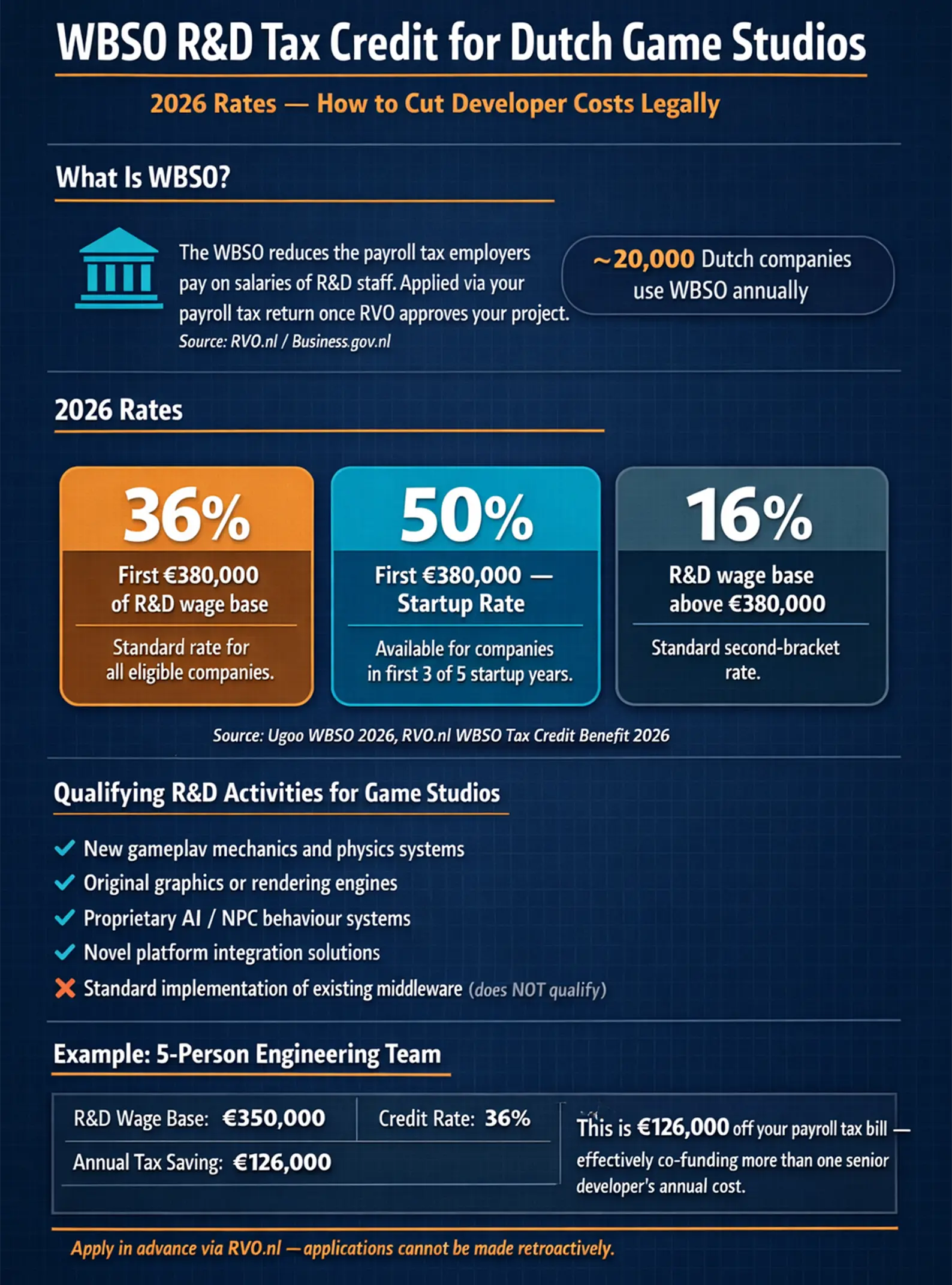 This is the section most game development budget guides ignore entirely — and it is where sophisticated Dutch studios gain a structural cost advantage. The WBSO (Wet Bevordering Speur- en Ontwikkelingswerk) R&D tax credit is one of the most impactful financial tools available to any studio building original game technology in the Netherlands.
WBSO R&D Tax Credit
The WBSO reduces the wage tax employers pay on the salaries of developers working on qualifying R&D activities. In 2026, the credit applies at 36% on the first €350,000 of R&D labour costs, and 16% above that threshold. For a five-person engineering team focused on core gameplay systems or proprietary engine technology, this can reduce effective developer costs by €40,000–€80,000 per year.
Qualifying activities include: development of new gameplay mechanics, original graphics engines, proprietary AI/ML systems, custom physics implementations, and novel platform integration solutions. Standard implementation of existing tools and middleware does not qualify.
Cultural Subsidies
The Dutch government’s cultural funding agencies — including the Creative Industries Fund NL — provide subsidies for video game projects with artistic, educational, or cultural merit. Grants typically range from €10,000 to €200,000 for qualifying projects. Applied games for healthcare, education, or social impact tend to have the highest success rates.
Dutch Game Garden and Incubation Programs
Dutch Game Garden in Utrecht provides incubation support, mentorship, office space, and access to co-investment networks for early-stage studios. The programme is particularly valuable for studios at the concept-to-prototype stage, offering a structured path to first funding without requiring a full production team.
European and Creative Europe Programs
The European Games Fund and Creative Europe’s MEDIA programme both offer grant funding for game development and interactive narrative projects. Applications require partnership with studios from multiple EU member states, but the funding envelope — €50,000–€500,000 per project — makes the application effort worthwhile for qualifying projects.
Layering Multiple Funding Sources
The highest-performing Dutch indie studios do not rely on a single funding source. A common approach: combine WBSO to reduce ongoing developer costs, a creative subsidy to fund pre-production, and publisher advance funding to cover full production. This layered model can reduce equity capital requirements by 30–50%, materially improving studio financial sustainability.
The Hybrid Development Model: What Dutch Studios Are Actually Doing
The most common question senior producers at Dutch studios ask is not whether to outsource — it is what to outsource, to whom, and how to maintain quality control across a distributed production.
For most Dutch studios, a hybrid model is not optional — it is the only way to stay within budget while maintaining production quality. A fully local team in the Netherlands is often financially unsustainable for any project under €1.5 million. The hybrid model is not a compromise; it is the professional standard.
Why Hybrid Works: The Three Advantages
Cost reduction of 20–40% on total production budget: Outsourcing art production and QA to specialist partners in Eastern Europe or India — while keeping engineering and creative leadership local — reduces total production costs by 20–40% compared to a fully Dutch team, without sacrificing art quality when managed correctly.
Speed advantage: 1–2 week ramp vs. 4–12 week local hire: Dedicated team partners can integrate into your Jira and Slack pipelines within 48–72 hours. Local recruitment in the Netherlands takes 4–12 weeks from job post to first productive sprint. When you are behind schedule, that delta is the difference between recovering a milestone and missing a launch window.
Risk reduction through elastic scaling: A hybrid model lets you scale from 5 to 50 artists in 10 days for a DLC crunch, then scale back down without the legal and HR overhead of Dutch employment law. You absorb spikes in production demand without adding permanent headcount — which means no attrition risk, no redundancy costs, and no knowledge loss when the crunch ends.
The Standard Hybrid Stack
- Core leadership local: Game Director, Technical Director, Art Director, and Senior Producer remain Amsterdam/Utrecht/Eindhoven-based. This is the team that holds the creative vision and manages stakeholder relationships.
- Engineering partially local: Lead engineers and senior generalists local. Junior and mid-level specialists available at a lower cost from Eastern Europe (Poland, Romania) at €30–€55/hour.
- Art production outsourced at scale: 2D/3D asset production, concept art, and environment art outsourced to specialist partners in India, Southeast Asia, or Eastern Europe. Quality controlled via style guides, direct art direction collaboration, and sprint-aligned asset batches.
- QA outsourced: Device compatibility testing, regression cycles, and localization QA handled by specialist firms — particularly for mobile targets requiring coverage across 50+ device profiles.
Eastern Europe vs. Asia for Art Outsourcing: Cost Comparison
| Region | Hourly Art Rate | Strengths | Watch-outs |
| Netherlands (in-house) | €70–€120 | Style consistency, no time zone gap | High cost; limited scalability |
| Eastern Europe (Poland, Romania) | €30–€55 | High quality, small time zone gap, Western culture alignment | Rising rates; demand exceeding supply |
| India (Bangalore, Hyderabad) | €15–€35 | Volume capacity, cost-efficient, English proficiency | Requires strong art direction process |
| Southeast Asia (Vietnam, Philippines) | €12–€28 | Stylized art strength, cost-efficient | Less exposure to AAA pipelines |
Maintaining Quality Across Distributed Teams
The studios that fail at outsourced production fail at process, not talent. The non-negotiables for a well-functioning hybrid model are: a detailed visual style guide approved before outsourcing begins; weekly art reviews with the external team’s lead; shared sprint cycles aligned to the same milestone calendar; and direct access to the internal Art Director for escalations. Studios that treat outsourced partners as order-takers rather than production collaborators consistently produce inconsistent results.
Engagement Models and How They Affect Your Budget
How you structure your relationship with external development partners is as important as who you choose. The wrong engagement model for your project type can lead to avoidable cost overruns under a different structure.
| Engagement Model | Best For | Budget Implication | Risk Profile |
| Fixed-Price / Milestone-Based | Well-defined scope, greenfield builds | Predictable; scope changes are expensive | Low if scope is locked |
| Time & Material (T&M) | Iterative development, evolving requirements | Can escalate; requires burn-rate discipline | Flexible but demands active management |
| Dedicated Team / Staff Augmentation | Long-term production, co-dev | Predictable monthly cost; scales up/down | Low; team continuity protects quality |
| Managed Outsourcing (Turnkey) | Full-cycle offload with defined output | Higher unit cost; lower management overhead | Vendor selection is critical |
| External Development Center (EDC) | Long-term scaled production | High setup; very efficient at scale | Appropriate for €500K+ engagements |
For studios at the concept-to-launch stage, the dedicated team model typically delivers the best risk-adjusted outcome. It provides predictable monthly costs, deep pipeline integration, and the team continuity that is critical for complex productions. For art at scale, managed outsourcing with a fixed per-asset rate provides the budget certainty that milestone-driven productions require.
MVP and Phased Development: Budget-Smart Production Strategy
How you structure your relationship with external development partners is as important as who you choose. The wrong engagement model for your project type can lead to avoidable cost overruns under a different structure.
| Engagement Model | Best For | Budget Implication | Risk Profile |
| Fixed-Price / Milestone-Based | Well-defined scope, greenfield builds | Predictable; scope changes are expensive | Low if scope is locked |
| Time & Material (T&M) | Iterative development, evolving requirements | Can escalate; requires burn-rate discipline | Flexible but demands active management |
| Dedicated Team / Staff Augmentation | Long-term production, co-dev | Predictable monthly cost; scales up/down | Low; team continuity protects quality |
| Managed Outsourcing (Turnkey) | Full-cycle offload with defined output | Higher unit cost; lower management overhead | Vendor selection is critical |
| External Development Center (EDC) | Long-term scaled production | High setup; very efficient at scale | Appropriate for €500K+ engagements |
For studios at the concept-to-launch stage, the dedicated team model typically delivers the best risk-adjusted outcome. It provides predictable monthly costs, deep pipeline integration, and the team continuity that is critical for complex productions. For art at scale, managed outsourcing with a fixed per-asset rate provides the budget certainty that milestone-driven productions require.
Budget Planning for Specific Game Types
Mobile Casual Games (Netherlands Market)
For Dutch studios targeting the mobile casual market, the key budget pressure is UA efficiency. A technically sound €80,000 mobile game that requires €200,000 in UA to reach breakeven is not a profitable product. Budget planning must start with a target CPI and Day-7 retention assumption and work backwards to determine the maximum viable production spend. Sub-100MB APK size, GDPR-compliant data collection, and modular LiveOps architecture are production requirements, not optional enhancements.
PC Indie Titles Targeting Steam
The Steam market rewards quality, discoverability, and community — not raw marketing spend. Games set in the Netherlands or featuring distinctly Dutch cultural elements have performed well on Steam, reflecting a broader trend toward novel settings and narrative authenticity. For PC indie budget planning: allocate €10,000–€20,000 for building the wishlist campaign before launch, and model a minimum 6-month post-launch LiveOps runway to support community feedback and patch cycles.
Console Co-Development Projects
Console co-development requires platform-specific budget lines that are often invisible to studios new to the format: devkit costs, platform holder development licenses, TRC/TCR compliance passes, and submission management time. A first-party-aligned console project should budget an additional €20,000–€50,000 for the certification and submission cycle alone, in addition to development costs.
VR/AR and Serious Games
The Netherlands has a disproportionately strong serious games sector — healthcare, defence, education, and corporate training all represent active commissioning markets. VR/AR projects for enterprise clients require comfort-optimization passes (maintaining a minimum of 90+ FPS to prevent motion sickness) and device-specific compliance testing (Meta Quest, HTC Vive, PSVR2). Budget a dedicated optimization phase of 4–6 weeks for any VR title.
LiveOps-Driven Games (GaaS)
Games-as-a-Service titles require infrastructure investment from day one: server-driven content delivery, feature flagging, A/B testing frameworks, analytics integration, and economy management tools. The upfront technology overhead adds 20–35% to the development budget compared to an equivalent non-GaaS title. However, the LTV impact of well-executed LiveOps typically makes this the most economically rational architecture for mid-core titles and above.
Common Budget Mistakes Dutch Studios Make
Mistake 1: Shipping Without a LiveOps Budget — The #1 Silent Failure
Games that launch without post-launch support lose traction within 30–60 days — not because they are bad, but because they stop evolving. Players today expect event cadences, bug patches, and community response. A game that ships into silence looks abandoned from day one, regardless of how good the core build is.
Studios allocate 100% of their capital to development and ship with no operational reserve. The result is not a dramatic failure — it is a slow fade. Budget a minimum 6-month LiveOps runway of €15,000–€40,000/month before you greenlight full production. If you cannot fund the live phase, you have not fully funded the game.
Mistake 2: Skipping Pre-Production to Move Faster (You Will Move Slower)
This is the most expensive speed-saving decision a studio can make. Every week skipped in pre-production buys you 3–5 weeks of rework in production — the most expensive phase of the project.
The GDD written in week 8 of production is written mid-sprint, by a distracted team, with decisions already locked in downstream. Architecture choices made without a technical feasibility pass become the technical debt that holds back milestone 6. Pre-production is not overhead — it is the cheapest engineering you will ever do.
The cost: Skipping a €20,000–€40,000 pre-production phase often generates €80,000–€200,000 in avoidable production rework.
Mistake 3: Treating Platform Certification as a QA Task, Not an Engineering Budget Line
Certification is not a checklist. TRC/TCR compliance for PlayStation or Nintendo requires dedicated engineering effort from a specialist who knows exactly what to look for — and most studios only discover this after their first rejected submission.
A single certification failure cycle — fix, resubmit, wait — adds 4–8 weeks to your schedule and €10,000–€25,000 in specialist time. For a studio on a milestone-linked publisher contract, that delay can trigger penalty clauses far larger than the certification budget itself.
Fix: Assign TRC/TCR ownership to a specific engineer from month one. Budget for one rejection cycle per platform as a standard line item.
Mistake 4: Hiring Fast Because the Project Is Behind — Then Watching People Leave
The instinct when behind schedule is to hire. The Dutch market makes this expensive in three ways: recruitment takes 4–12 weeks, agency fees run 15–25% of salary, and new hires need 4–8 weeks of onboarding before they contribute at full capacity. By the time the hire is productive, you are 3–4 months deeper into the hole.
Worse: if the studio’s culture or comp structure is not competitive, the people you most need — senior engineers — are the easiest to poach. A senior developer who leaves 6 months into a 12-month production carries €20,000+ in replacement costs and weeks of context transfer overhead on top.
Fix: Benchmark salaries against the Dutch market before you start hiring. Build meaningful equity or profit-share into senior contracts. Treat retention as a budget line, not an HR problem.
Mistake 5: Presenting a Budget Without a Contingency Reserve
Industry convention says 10%. Dutch production reality in 2026 says 15–20% is the floor, not a ceiling. Scope adjustments, unexpected platform requirements, SDK integration delays, key person absence — at least one of these will occur on any production longer than six months.
The contingency is not a pessimistic line. It is the mathematical acknowledgment that game development is a creative, distributed, technically complex process — and creative, distributed, technically complex processes rarely land exactly on plan. If your contingency is zero, your budget is not a plan. It is a wish.
Fix: Add 15–20% contingency before presenting any number to a stakeholder, an investor, or a publisher. Protect that line in every budget review.
How to Select the Right Development Partner for Your Budget
For Dutch studios considering external game development services, the most important insight is this: the hourly rate is the least important number. The variables that determine whether a partner relationship succeeds are pipeline alignment, communication discipline, technical quality, and cultural fit with your production process.
In-House vs. Outsourced: True Cost Comparison
| Factor | In-House (Netherlands) | Outsourced Partner |
| Hourly equivalent cost | €45–€90 (true employer cost) | €20–€70 (depending on region/seniority) |
| Ramp time | 4–12 weeks (recruitment) | 1–2 weeks (dedicated team) |
| Knowledge retention | High (if staff stay) | Medium (depends on team continuity) |
| Scalability | Low (hiring is slow) | High (on-demand scaling) |
| IP risk | Low | Low (with proper NDA/escrow structure) |
| Attrition impact | High | Low (partner absorbs) |
What to Look for in a Co-Development Partner
- Pipeline integration capability: Can they operate within your Jira, Slack, and Perforce environments, or will they require you to adapt to theirs?
- Technical specificity: Do they have demonstrable experience with your engine version, not just your engine family?
- Art direction collaboration: Have they worked directly with Art Directors, or do they simply execute briefs?
- Milestone track record: Can they provide references from clients with a similar project scope?
- IP protection protocols: Do they have ISO 27001 certification, segregated client repositories, and NDA structures with liquidated damages clauses?
How to Structure a Scoping Call
Before reaching out to any hire game designers or development partner, prepare a structured brief covering: platform targets, engine version, art style reference, required team size, milestone dates, and the specific risk you are trying to solve — whether that is a capacity gap, an expertise gap, or a speed-to-market constraint. Partners who respond with a resource plan rather than a generic rate card demonstrate an understanding of production, the most useful signal at the qualification stage.
How Juego Studios Maps to These Criteria
- Pipeline integration: Juego teams operate inside client Jira, Perforce, Slack, and ShotGrid environments from day one. There is no “our process” — the process is yours.
- Technical specificity: Juego has active production experience across Unity 6, Unreal Engine 5.4, and CryEngine — not engine familiarity, production-grade delivery across AAA, mid-core, and mobile at scale.
- Art direction collaboration: Juego assigns senior art leads who attend client art reviews, work directly against client-approved visual bibles, and flag style drift before it compounds. Asset batches are sprint-aligned, not deadline-dumped.
- Milestone track record: Trusted by Tencent, Sony, Warner Bros., Disney, Amazon Games, and Zynga — studios that do not carry vendors who miss milestones. Repeat engagements and multi-year retainers are the norm, not exceptions.
- IP protection: ISO 27001 certified. Segregated client repositories. NDAs with liquidated damages clauses. Code escrow on request. Restricted facility access and employee confidentiality training on every engagement.
- Engagement flexibility: Fixed-price, Time & Material, Dedicated Team, Managed Outsourcing, and External Development Center models — structured around your budget risk, not Juego’s preference.
If your studio is evaluating co-development partners for an active production, the fastest way to validate fit is a scoping call. Juego’s production team will return a resource plan — not a rate card — within 48 hours.
Conclusion
The cost of game development in the Netherlands in 2026 is genuinely high. Personnel costs, mandatory employer contributions, GDPR compliance, and platform certification overhead create a production environment where undercapitalised projects rarely reach gold master. But that same environment rewards structured, well-planned studios with a talent pool, incubation infrastructure, tax incentive system, and co-development partner network that most markets simply cannot match.
The studios that succeed in the Dutch market are not the ones with the largest budgets. They are the ones who invest in pre-production before production, who treat the WBSO and cultural subsidy system as structural inputs rather than bonuses, who build contingency reserves into their financial models, and who know precisely what to build in-house versus what to outsource with confidence.
Whether you are planning your first €50,000 mobile title or scoping a €2 million mid-core PC game, the principles are the same: lock your scope, know your true costs, plan for what goes wrong, and build with a partner who treats your production as their own.
If you are ready to move from budget planning to production planning, Juego Studios offers scoping calls specifically designed for studios with active production timelines — integrated into your pipeline, sharing accountability at every milestone.
Frequently Asked Questions
Costs range from €10,000 for simple mobile titles to €2 million or more for mid-sized indie PC/console games, depending on team size, scope, and platform targets.
Senior developers earn €90,000–€100,000+ gross annually; true employer cost, including mandatory contributions, ranges from €121,500 to €145,000 per hire.
Yes — the WBSO R&D tax credit applies at 32% on the first €350,000 of qualifying R&D labour costs, saving eligible studios €40,000–€80,000 annually on an engineering team.
Hybrid models — local leadership with outsourced art and QA — deliver the best cost-to-quality ratio, with Eastern European and Indian partners offering €15–€55/hour versus €70–€120/hour locally.
The most overlooked lines are GDPR compliance setup, platform certification cycles, post-launch LiveOps reserves, recruitment agency fees of 15–25% of salary, and the essential 15–20% contingency buffer.
Related Posts
Have a Game Idea but No Development Team? How to Get It Built
This guide walks you through every realistic way to get your game made, what each one really costs you in time and control, and how to pick the right one before you spend a dollar finding out the hard way.
Top 10 Game Development Companies in USA (2026 Update)
In this blog, we’ll discuss the top 10 game development companies in USA, along with how to evaluate them beyond surface-level claims, so you can identify partners who actually align with your vision, technical needs, and long-term growth goals.
Top Game Development Companies in 2026: 10 Global Leaders Compared
Most game projects don’t fail because the idea was weak. They fail because the development partner couldn’t scale, adapt, or deliver when pressure peaked.