


 Unity
Unity Unreal
 Godot
Godot
 Mobile
 PC
PC Console
 Full-Cycle
 Co-Development
 Outstaffing



-
 Game Development
 Sep 1st, 2026
- Share:
Table of Contents
- TL;DR
- What roles does every game development team need, no matter the size?
- How does team structure change from prototype to full production?
- What team size and shape fits your project's scale?
- Which roles do you actually need in-house, and which can wait or be outsourced?
- How does your game engine change the roles you need?
- What happens if you get your team structure wrong?
- What this means for your hiring and budget plan
- Conclusion
If you’re scoping a team for a project that’s about to move from concept to production, the question that actually matters isn’t which roles exist in game development. It’s which ones you need right now, in what order, and which can wait or be brought in externally. A generic org chart won’t answer that, because the right game development team structure depends entirely on what stage your project is at and how much of the work you’re staffing in-house versus through a partner. This guide starts with the baseline roles every team needs, then breaks team composition down by stage and budget tier, so you can build a hiring or outsourcing plan instead of a wish list.
TL;DR
- Every game team, regardless of size, needs five functions covered: engineering, design, art, QA, and production. Below five or six people, one person often wears two of these hats.
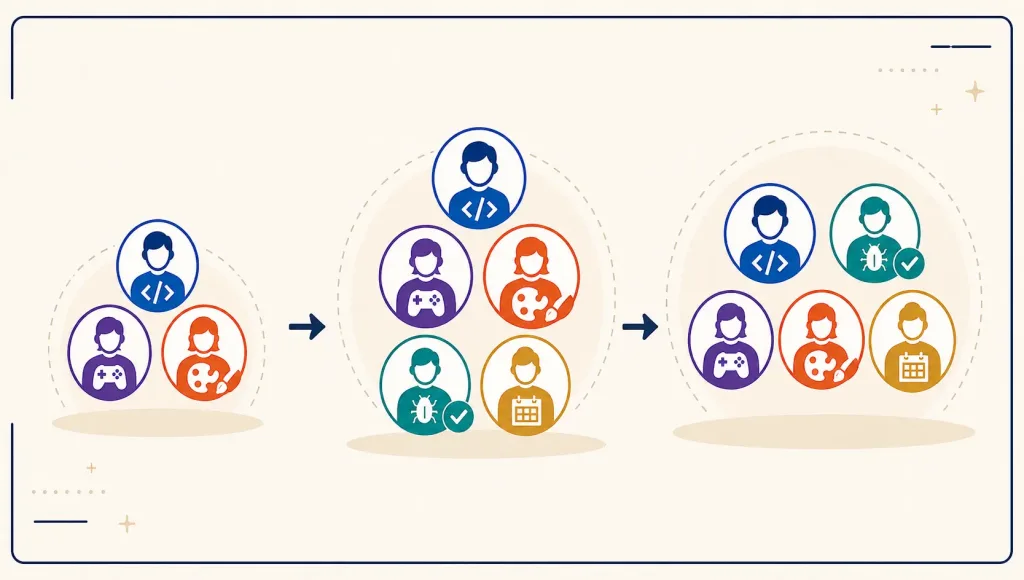
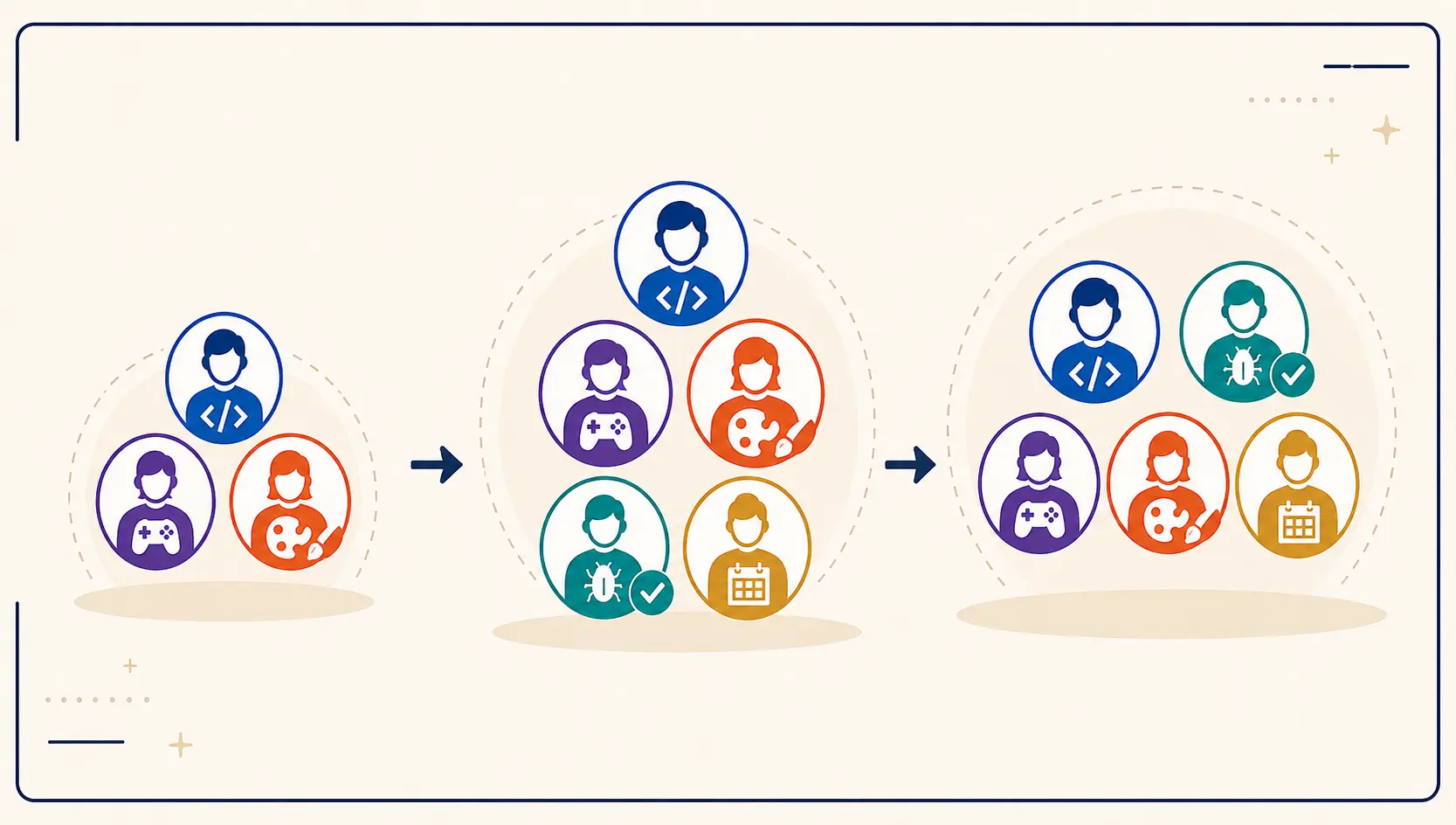
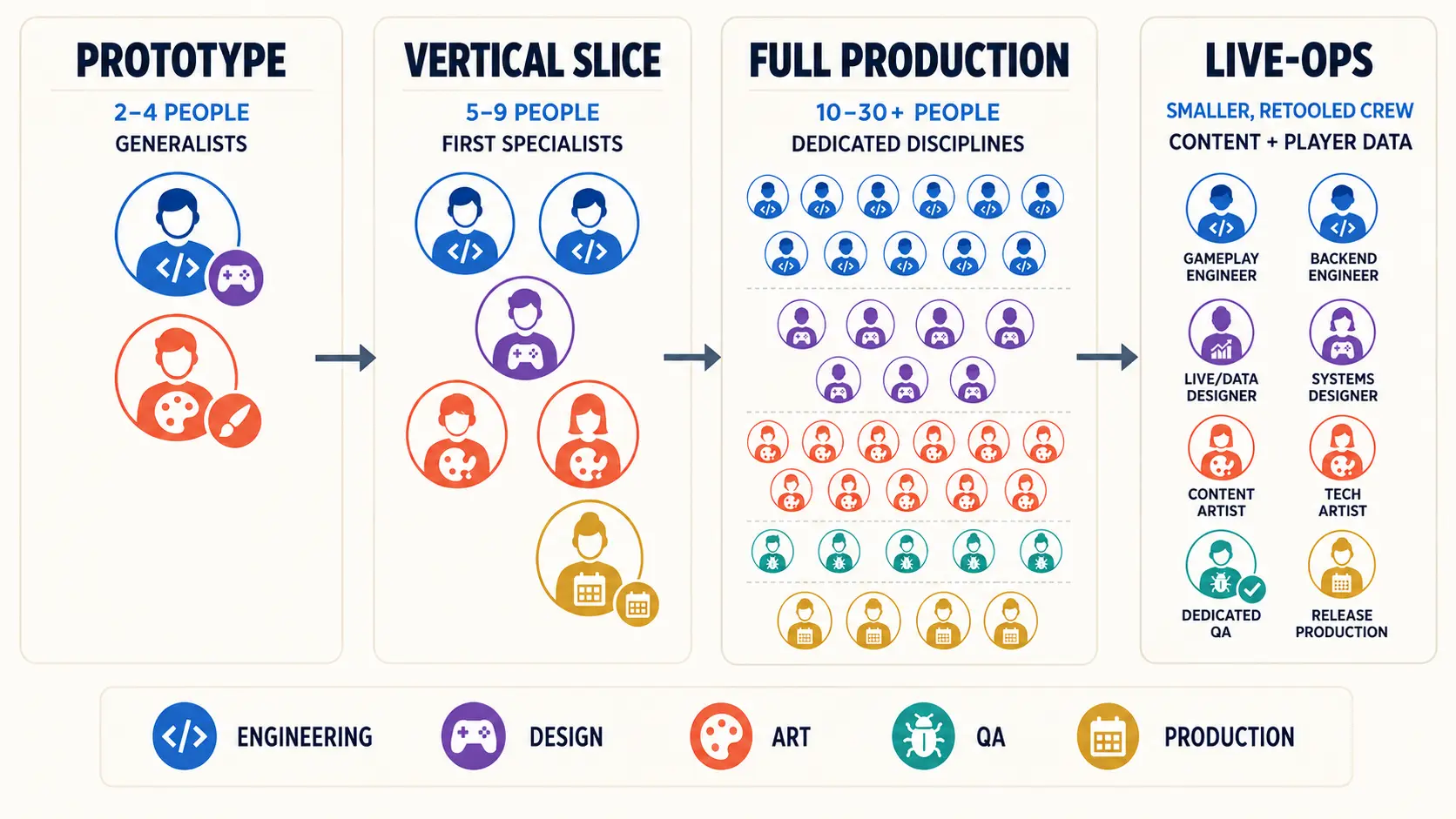
- Team shape isn’t fixed. It grows in steps: prototype (2-4 people, generalists), vertical slice (5-9, first specialists), full production (10-30+, dedicated disciplines), live-ops (a smaller, retooled crew focused on content cadence and player data).
- Your engine decision changes your programmer mix. Per GDC’s 2026 State of the Game Industry report, Unreal Engine is now the primary engine for 42% of developers, ahead of Unity at 30%, and Unreal usage climbs to 59% at AA studios and 47% at AAA, both of which typically require a dedicated engine or tools programmer that a Unity-based indie team can usually skip.
- Not every role needs to be a full-time hire. QA, tools programming, and specialist art are the roles studios most commonly bring in externally rather than staff permanently.
- Getting the shape wrong shows up as a specific failure mode: no producer means missed milestones, no dedicated QA means bugs reach players, and stacking three disciplines onto one generalist for too long caps your quality ceiling.
- The right question isn’t “what roles exist in game development.” It’s “which of these do I need on payroll right now, and which can I bring in for this phase only.”
What roles does every game development team need, no matter the size?
Every game, from a two-person prototype to a 200-person live-service title, needs five functions covered: engineering, design, art, quality assurance, and production. How those functions map to people changes with scale, but skipping one of them outright is how projects stall.
Engineering (programming) turns the design and art into a playable, stable build. At small scale this is one generalist programmer; at larger scale it splits into gameplay programmers (mechanics, systems), engine or tools programmers (pipeline, build stability, editor tooling), and often network or backend programmers for anything multiplayer or live-service.
Design decides what the game actually is: mechanics, progression, level and encounter pacing, economy, and monetization if relevant. A solo project usually has the founder doing this; past vertical slice, most teams split it into game design and level design and add a narrative designer if the game is story-heavy. If the line between design and engineering feels blurry on paper, how those two disciplines actually differ day to day is worth reading before you write either job description.
Art covers everything the player sees: concept art, 3D or 2D asset production, animation, VFX, and UI/UX. This is usually the first discipline to split into specialists, because character art, environment art, and UI design require genuinely different skill sets even though a single game art production pipeline typically owns all of them.
QA (quality assurance) finds what’s broken before players do and covers more ground than most founders expect once you look at the different types of game testing a build actually needs. Teams under about ten people almost always skip a dedicated QA hire and rely on the whole team testing builds; that works until the game gets complex enough that untested edge cases start shipping.
Production keeps the schedule, budget, and communication honest. A producer or project manager isn’t optional past a certain team size. Without one, someone on the team ends up doing it informally, usually while also trying to do their actual job.
How does team structure change from prototype to full production?
Team shape isn’t a fixed org chart. It grows in stages, and each stage has a different failure mode if you overstaff or understaff it.
Prototype (2-4 people)
The goal is proving the core loop is fun, not building a finished game. A generalist programmer and a generalist designer (often the same person) plus one artist covers most prototypes. Adding a producer or dedicated QA here is usually premature; the team is small enough to coordinate informally, and there isn’t enough content yet to warrant systematic testing.
Vertical slice (5-9 people)
This is where you build one polished, representative chunk of the game to pitch to a publisher, investor, or your own leadership. Roles start splitting: you typically add a second programmer, a dedicated artist or two (often the first specialist hire, usually character or environment art depending on the game), and this is the point where a part-time or fractional producer starts paying for itself, because milestone pressure is now real.
Full production (10-30+ people, or a matched external team)
Every discipline gets dedicated ownership. Engineering splits into gameplay, tools, and possibly network programmers. Art splits into concept, character, environment, animation, and UI/UX. Design splits into game design, level design, and narrative if needed. QA becomes a dedicated function, not a favor the team does on Fridays. Production usually needs a full-time producer, and on larger builds, a second producer or project manager focused on a specific workstream, such as live-ops, a console or platform porting push, or a certification cycle.
Live-ops (smaller than production, differently shaped)
Once the game ships, the team usually shrinks but doesn’t disappear. It retools around content cadence, player data, and community response instead of feature completion, which is really its own discipline once you look at what dedicated live-ops support for a shipped game actually involves. A live-ops crew leans harder on data-informed design, backend/network engineering, and a producer who’s now managing a release calendar instead of a development milestone chart, with QA staying dedicated because live patches carry real risk of breaking a production build. We’ve run that kind of crew ourselves on a live-service mobile title, supporting its growth past 30 million registered players and a long run inside the top ranks of free mobile games.
What team size and shape fits your project's scale?
There’s no single ‘right’ team size. The right size is the smallest team that can hit your current milestone without any of the five core functions going unstaffed, and it’s worth cross-checking headcount against a realistic development timeline before you lock either number in. The table below maps typical shape to stage and gives a directional headcount range; treat it as a planning anchor, not a hard rule.
| Stage | Typical headcount | Engineering | Design | Art | QA | Production |
|---|---|---|---|---|---|---|
| Prototype | 2-4 | 1 generalist programmer | Often shared with programmer/founder | 1 generalist artist | Shared across team | None dedicated |
| Vertical slice | 5-9 | 2 programmers | 1 dedicated designer | 1-2 artists (first specialist split) | Shared, more structured | Fractional or part-time |
| Full production | 10-30+ | Gameplay + tools (+ network if multiplayer) | Game design + level design (+ narrative) | Concept, character, environment, animation, UI/UX | Dedicated QA lead + testers | Full-time producer (+ workstream PM at scale) |
| Live-ops | Smaller than production | Gameplay + backend/network | Live/data-informed design | Reduced, content-cadence focus | Dedicated (patch risk is real) | Producer managing release calendar |
This scaling pattern holds directly against spend too. Juego Studios’ own breakdown of indie game development costs shows solo projects typically running $10,000–$80,000, a 2-5 person indie team (the range most projects settle into for the best balance of speed and quality) running $50,000–$400,000, and high-end indie builds needing 5-20 people scaling toward $300,000–$2M+. Team size and budget move together, which is exactly why “how many roles do I need” is really a budget-scoping question, not just an org chart question.
Which roles do you actually need in-house, and which can wait or be outsourced?
Not every role earns a full-time seat on your payroll, and treating all five functions as equally “hire now” is one of the fastest ways to burn budget before you have a shippable build.
Keep in-house early: the person setting creative direction (usually a founder or lead designer) and your lead or most senior programmer, because both require constant, low-latency decision-making that’s hard to hand off externally, especially pre-vertical-slice.
Bring in for a phase, not permanently: dedicated QA (most teams don’t need it full-time until full production), specialist art (character, environment, or UI/UX work is commonly outsourced project-by-project even at larger studios), and tools or engine programming (a role that’s genuinely needed in bursts, such as pipeline setup, a porting push, or a performance pass, rather than continuously). That kind of burst capacity is exactly what a specialist art partner is built for: on one licensed sports title, we stood up a dedicated pipeline and delivered 200 high-fidelity player head models in six months, without that headcount staying on payroll once the roster was done.
Almost always a build-vs-partner decision, not a hire decision: anything requiring a skill set your core team doesn’t have and won’t need past this project. That’s usually art production at volume, QA coverage across multiple platforms, or a full engineering team to hit a deadline your current headcount can’t reach alone. If you only need extra capacity for one phase rather than the whole build, it’s worth understanding how a co-development partnership works before you default to a full hire. . We’ve worked this way ourselves, co-developing a social-world mobile title that has passed 500 million downloads. This is the point where most studios evaluate a dedicated external game development team rather than running a slower internal hiring cycle for roles they may not need permanently.
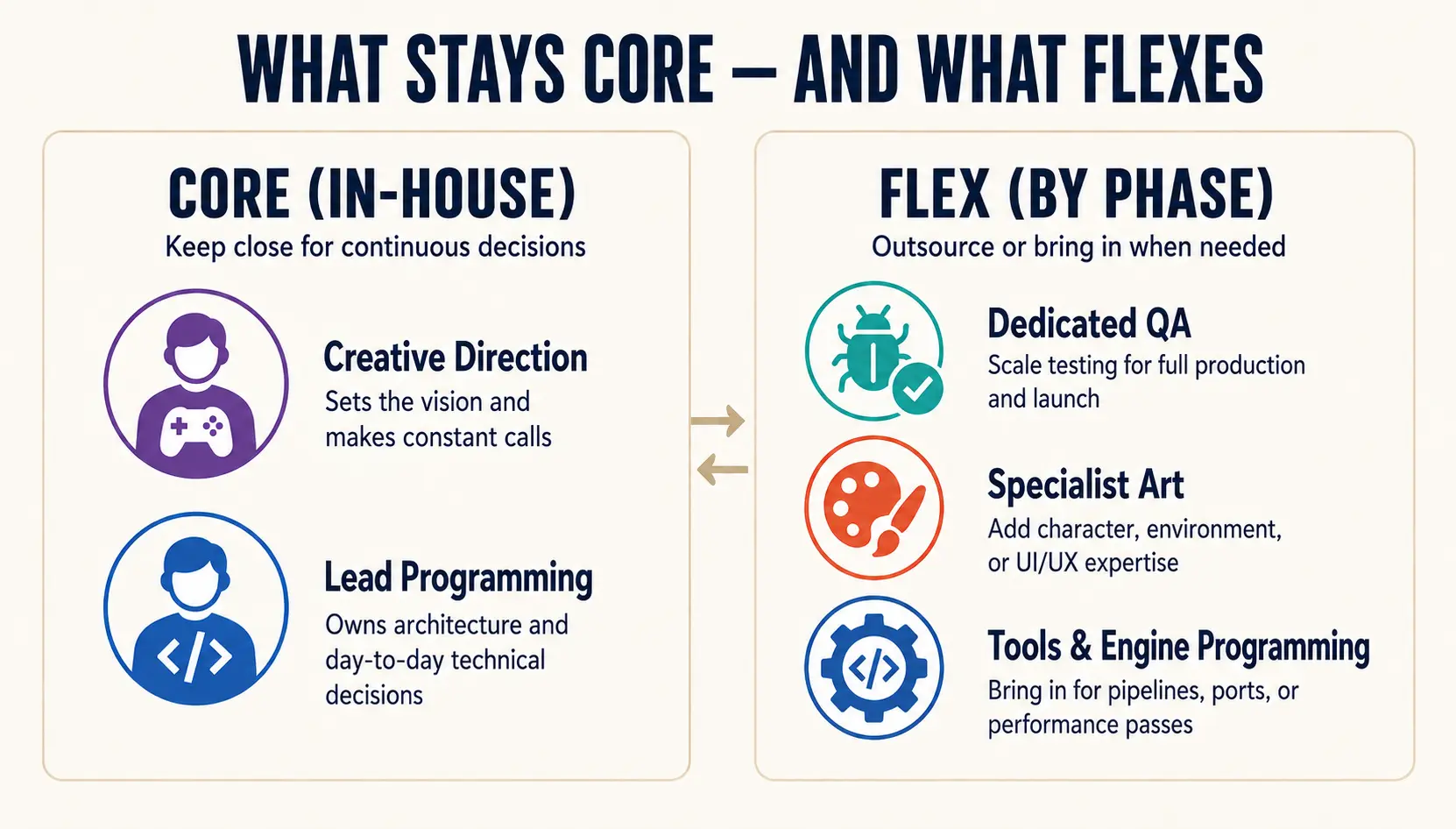
Illustrative example: picture a funded indie founder who ships a vertical slice with a three-person core team (one programmer, one designer/founder, and one artist), then, at full production, keeps that trio in-house for creative direction and lead engineering while bringing in an external team for environment art, a second gameplay programmer, and dedicated QA. The core team stays small and decision-making stays fast; the production-heavy, specialist-heavy work scales through the partner instead of through six months of hiring. (This is a composite scenario for illustration, not a specific client engagement.)
How does your game engine change the roles you need?
Every decision above—who you keep in-house, who you bring in, and when—gets filtered through one more variable: which engine you’re building in. Engine choice is not only a technical decision. It changes what your engineering team actually looks like. Per GDC’s 2026 State of the Game Industry report, Unreal Engine is now the most-used primary engine industry-wide at 42%, ahead of Unity at 30%, and that split isn’t even across studio size: Unreal usage climbs to 59% at AA studios and 47% at AAA, while a majority (54%) of established indie studios are still building in Unity.
That matters for staffing because Unreal projects, especially at AA/AAA scale, more often justify a dedicated engine or tools programmer to manage Blueprints-vs-C++ architecture decisions, build pipeline, and performance profiling, a role a small Unity team can frequently fold into a generalist programmer’s responsibilities. If you’re scaling from a Unity prototype into an Unreal-based full production (a common path for teams stepping up in visual ambition), budget for that tools-programming gap explicitly rather than assuming your existing programmer will absorb it.
What happens if you get your team structure wrong?
Understaffing and overstaffing both have specific, predictable symptoms, and both are cheaper to avoid than to fix mid-production.
No dedicated producer past full production: milestones slip without anyone catching it early, because tracking the schedule was always someone’s second job. Teams usually notice this when a “two-week” task quietly becomes six weeks and nobody flags it at week three.
No dedicated QA once the game is complex: bugs reach players instead of getting caught internally, and post-launch patch costs end up higher than a QA hire would have cost during production. This is also where a widely cited software-testing benchmark of roughly one QA tester per three to four developers is a reasonable starting ratio to plan against once you’re staffing QA as a dedicated function, though the right ratio for your project depends on platform count and how content-heavy the game is.
Stacking too many disciplines on one generalist for too long: this is the same founder-as-everything pattern flagged earlier, and it’s the most common failure mode in funded indie teams specifically. It’s fine at the prototype stage. Left unaddressed through full production, it caps quality (nobody is deep enough in any one discipline to push it further) and burns out the person absorbing the overlap.
Hiring specialists before there’s a role for them: the inverse mistake. Bringing on a dedicated narrative designer or a second producer before the project has enough content or schedule complexity to justify it. This looks responsible on an org chart and quietly drains the runway.
What this means for your hiring and budget plan
Once you know your current stage, the roles-in-house-vs-outsourced split above tells you what to solve for next: either a targeted hire for a role you’ll need continuously or a partner for the specialist or volume work that doesn’t need to sit on your permanent payroll. If you haven’t settled on which engagement model fits, the costs and hiring models available are worth comparing before you post a job listing. Most studios don’t get this wrong by picking the wrong roles. They get it wrong by trying to solve a phase-specific gap with a permanent hire or a permanent gap with a short-term contractor.
Conclusion
Team structure isn’t a fixed template. It’s a function of your project’s stage and your budget, and it should change on a predictable schedule as both grow. Start with the five core functions covered by generalists at prototype stage, split roles into specialists as you move through vertical slice and into full production, and treat QA, specialist art, and tools programming as the roles most commonly staffed per-phase rather than permanently. Get the sequencing right and your team scales with your project instead of ahead of or behind it. If you’re currently sizing a team for a production push and want a second opinion on which roles to hire versus bring in externally, that’s exactly the kind of gap a specialist partner can usually scope faster than an internal hiring cycle, particularly for short-term or specialist needs.
Frequently Asked Questions
Two to four people: one generalist programmer, one person handling design (often the same person as programming, especially solo), and one artist. QA and production get absorbed informally by the team at this size; they don’t need dedicated hires until the project moves past a prototype.
At prototype stage, one. At vertical slice, most teams add a second. In full production, headcount depends on scope, but a common split is gameplay programmers for mechanics and systems plus at least one engine or tools programmer, with a network programmer added for anything multiplayer or live-service.
Usually not before full production. Teams under roughly ten people typically rely on the whole team testing builds, which works until the game’s complexity outpaces informal testing. Bringing in dedicated or outsourced QA coverage once you’re building toward a real launch is a common and effective middle ground before a full-time QA hire is justified.
Neither, usually. Your first hire should fill whichever core function the founding team doesn’t already cover. If the founder already codes, the first hire is often an artist or a second programmer, not a designer, since design responsibility can stay with the founder through prototype and vertical slice.
There’s no fixed number, but AA and especially AAA productions typically staff every discipline as a dedicated function well before full production: separate gameplay, tools, and often network programming; concept, character, environment, animation, and UI/UX art; game, level, and narrative design; a dedicated QA team; and at least one full-time producer, often with a second producer or PM owning a specific workstream like porting or live-ops.
Specialist art (character, environment, or UI/UX work), QA coverage, and tools or engine programming are the roles most commonly brought in externally rather than hired full-time, because they’re either needed in bursts or require a skill set that doesn’t need to sit on permanent payroll for a single project.
Related Posts
Have a Game Idea but No Development Team? How to Get It Built
This guide walks you through every realistic way to get your game made, what each one really costs you in time and control, and how to pick the right one before you spend a dollar finding out the hard way.
Top 10 Game Development Companies in USA (2026 Update)
In this blog, we’ll discuss the top 10 game development companies in USA, along with how to evaluate them beyond surface-level claims, so you can identify partners who actually align with your vision, technical needs, and long-term growth goals.
Top Game Development Companies in 2026: 10 Global Leaders Compared
Most game projects don’t fail because the idea was weak. They fail because the development partner couldn’t scale, adapt, or deliver when pressure peaked.