


 Unity
Unity Unreal
 Godot
Godot
 Mobile
 PC
PC Console
 Full-Cycle
 Co-Development
 Outstaffing



-
 Game Development
 Sep 28th, 2026
- Share:
Table of Contents
- TL;DR (Quick Summary)
- What are your options if you have a game idea but no development team?
- What should you have ready before you talk to anyone?
- So, should you hire freelancers to build your game?
- Should you build your own in-house team?
- What about hiring a dedicated team from a studio?
- When does it make sense to hand the whole game to a studio?
- Why isn't co-development on this list?
- How much will you have to manage under each option?
- Which option fits your situation?
- How much does it cost to get a game built without a team?
- How do you stay in control and keep your IP?
- How do you avoid choosing the wrong development partner?
- What actually happens after you contact a studio?
- Conclusion
You have the idea. Maybe a design doc. Maybe even the money. What you don’t have is anyone to build it.
This guide walks you through every realistic way to get your game made, what each one really costs you in time and control, and how to pick the right one before you spend a dollar finding out the hard way.
Get a free assessment of your game concept
Or jump straight to: Which option fits your situation?
Jordan had more than most first-time game creators ever get. She had a 40-page design document. She had a folder of concept art from an illustrator she’d found online. And after selling her last business, she had enough money to fund a small game properly.
What she didn’t have was a single person who could open a game engine and make any of it move.
So she did what a lot of people do. She posted in a few forums, hired two freelance developers who seemed great on video calls, and got started. Six months later, she had a prototype that crashed on level two. One developer had gone quiet. The other said the code needed “a partial rewrite.” And Jordan realized she’d spent half a year acting as a producer, a job she’d never done and never wanted.
Jordan’s story is a composite, but if you’ve spent any time in game dev forums, you’ve read some version of it a dozen times. The idea wasn’t the problem. The money wasn’t the problem. The problem was that nobody told her the real question wasn’t who can build my game. It was how much of the building she could realistically manage herself.
That’s what the rest of this breaks down.
TL;DR (Quick Summary)
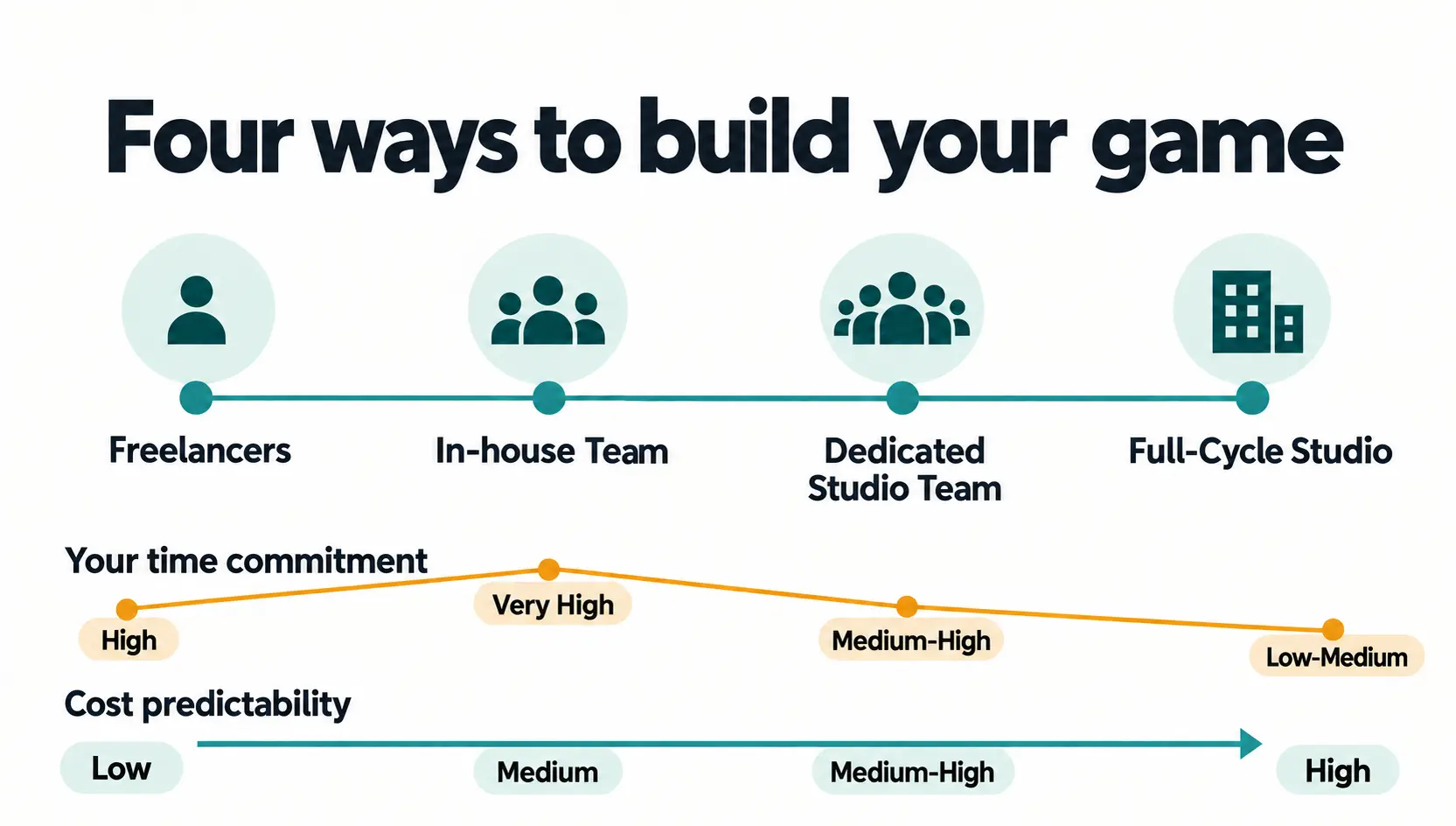
You have four realistic ways to get your game built:
- You can hire freelancers and manage them yourself
- Build your own in-house team
- Bring in a dedicated team from a development studio
- Hand the whole project to a full-cycle studio.
The right choice depends less on your budget than on how much day-to-day production management you can take on. If you can’t act as the producer, a full-cycle studio is usually the safer route.
Key Takeaways
- Having no team doesn’t mean you can’t build your game. It means you need to decide who does the building and who manages it.
- Freelancers cost the least upfront but need the most management from you.
- An in-house team gives you full control but is slow and expensive to build.
- A dedicated studio team works well if you can direct the work weekly.
- A full-cycle studio is usually the best fit for non-technical founders and funded concepts with real deadlines.
- Whatever you choose, keep the creative vision, the IP, and the final decisions with you.
What are your options if you have a game idea but no development team?
Here’s the quick version of each:
- Freelancers. You hire individual developers, artists, and designers, and you coordinate them. It has the lowest upfront cost and needs the most management from you.
- An in-house team. You recruit and employ your own people. You get maximum control, but it’s slow and expensive, and you become a studio owner overnight.
- A dedicated team from a studio. A studio supplies a team that works on your game full time, but you (or someone you hire) still direct the work.
- A full-cycle studio. One partner handles design refinement, art, engineering, QA and launch. You stay the creative owner and decision-maker; the studio handles production.
The rest of this guide walks through each one honestly, including where each tends to go wrong.
What should you have ready before you talk to anyone?
You don’t need a perfect package to start conversations. But the more of this you have, the more accurate every quote and piece of advice will be, whichever option you pick.
- A one-page pitch. What’s the game, who is it for, and why would they play it over everything else? If you can’t explain it on one page, a developer can’t estimate it.
- A game design document, even a rough one. Core loop, main mechanics, progression, and how a session plays out. It doesn’t need to be 40 pages. Ten clear pages beat 40 vague ones. If you’re not sure where to start, this is exactly what a solid game design document is built to nail down.
- Three to five reference games. “It plays like X, looks like Y, and monetizes like Z” saves hours of back-and-forth.
- A target platform. Mobile, PC, console, or several? This one decision changes cost, engine choice, and timeline more than almost anything else. It also shapes whether a Unity or Unreal Engine team makes more sense.
- A budget range. Not a fixed number, just a range. “$50K–$80K” or “under $300K” tells you what’s realistic instead of guessing.
- Your non-negotiables. The art style you won’t compromise on, the mechanic that is the game, or a launch window tied to funding. Knowing these upfront protects them later.
One thing you should keep, no matter which route you choose, is the creative vision. Even established developers keep this close. Game design, narrative writing, and information design were mostly handled in-house in 2023, with more than half of developers and publishers using internal resources for them, according to 80 Level’s research.
Your job isn’t to write code. It’s to own what the game is.
So, should you hire freelancers to build your game?
Freelancers are where most people start, and for good reason. You pay for exactly the work you need, you can start this week, and there’s no shortage of talent looking for contract work right now.
Finding talent isn’t the hard part. Here’s where freelance projects actually go wrong:
When freelancers work well
- You’re building a small prototype or a tightly scoped game.
- You have some production experience, or you’re willing to learn it fast.
- You need one specific skill, like a character artist or a composer, rather than a whole team.
Where it tends to break
- You become the producer. Someone has to write tasks, review builds, resolve conflicts between the artist and the programmer, and decide what gets cut. With freelancers, that someone is you.
- Nobody owns the whole game. Each freelancer owns their piece. When the pieces don’t fit together, there’s no one accountable for fixing it.
- Continuity risk. If your lead programmer takes a full-time job halfway through, the knowledge of how your game works often leaves with them.
- QA falls through the cracks. Testing is usually nobody’s job, so it becomes everybody’s problem right before launch.
Bottom line: Freelancers are cheapest per hour and often most expensive per finished game, unless you can manage production yourself.
Should you build your own in-house team?
If you’re planning a long-term studio, not just one game, hiring your own team can make sense. You get full control, deep ownership of the codebase, and people who are invested in the project.
But go in with clear eyes about what it takes.
It’s expensive. The median annual wage for software developers in the US was $135,980 in May 2025, according to the Bureau of Labor Statistics. That’s general software, not games specifically, and it’s before benefits, equipment, software licenses, office space, and payroll overhead. A small team of five quickly becomes a seven-figure annual commitment.
It’s slow. Gem’s 2025 Recruiting Benchmarks Report found average time-to-hire rose 24% over three years, to 41 days from 33, and that’s across all roles. Senior game engineers, who have plenty of options, often take longer. Multiply that by every role you need, and you can easily spend months hiring before real production starts.
You have to know what good looks like. If you can’t evaluate a programmer’s architecture decisions, it’s hard to know whether you’re hiring the right one. Many non-technical founders hire a strong technical lead first, then let that person build the rest of the team.
If you do go this route, our full breakdown of game developer hiring models and costs covers role definitions, interview questions, and salary ranges in depth.
What about hiring a dedicated team from a studio?
A dedicated team sits in the middle. A studio provides developers and artists who work on your game full time, usually on a monthly contract. The studio handles recruiting, HR, equipment, and replacements if someone leaves.
This model works well when:
- You (or a producer you’ve hired) can direct the work day to day.
- You want the team’s full attention without the cost and delay of hiring.
- You expect to scale the team up or down as production changes.
The catch: a dedicated team usually expects direction from you. Some studios include a producer or project manager; many don’t by default. Ask exactly who writes the tasks, who reviews the builds, and who decides priorities. If the answer is “you,” make sure that’s realistic for you.
If this sounds like your situation, you can hire a dedicated team of game developers who plug into your process or look at broader resource augmentation options when you only need to fill specific roles.
When does it make sense to hand the whole game to a studio?
This is the option most people with a concept and no team should look at first and the one most people overlook because they assume it’s out of reach.
With a full-cycle outsourcing studio, one partner takes your concept from pre-production through design, art, engineering, QA, and launch and often supports the game afterward. You don’t manage developers. You make decisions: approving milestones, playing builds, giving feedback, and protecting the vision.
It makes the most sense when:
- You don’t have production experience and don’t want to become a producer.
- You need one party accountable for the whole game working, not just their slice of it.
- You need art, engineering, and QA together. Coordinating three separate vendors is its own full-time job.
- Your deadline is real. A launch window, a publisher milestone, or funding that runs out on a specific date.
As an example of what this looks like in practice, our team built Super Club Soccer, a turn-based soccer game for PC, in Unity. It was a full-cycle project covering development, 3D art, and LiveOps support.
The trade-off is that you’re trusting one partner with a lot. That makes choosing the right one critical, which we’ll get to below.
Why isn't co-development on this list?
You’ll see “co-development” everywhere when you research game studios, so it’s worth clearing up.
Co-development means an external studio works alongside your internal team, sharing the codebase, pipelines, and production goals. It’s a great model, but it assumes you already have a team to co-develop with. If you have no one in-house, there’s nothing to plug into yet.
Once you’ve built a small core team, even two or three people, co-development becomes a strong way to scale without hiring for every role.
How much will you have to manage under each option?
This is the part most comparisons skip, and it’s the part that matters most when you don’t have a team.
| Option | Who manages day to day | Your time commitment | Cost predictability | Biggest risk | Best for |
|---|---|---|---|---|---|
| Freelancers | You | High: often 20+ hours a week | Low: scope creep and rework add up | Pieces that don’t fit together; people disappearing | Small prototypes; creators with production experience |
| In-house team | You or your hired lead | Very high: you’re running a company | Medium: salaries are fixed, but timelines slip | Slow hiring; wrong early hires | Founders building a long-term studio |
| Dedicated studio team | You, with studio support | Medium to high | Medium to high: monthly cost is fixed | Team waiting on your direction | Creators who can direct work, or who hire a producer |
| Full-cycle studio | The studio’s producer | Low to medium: reviews and decisions | High: milestone-based budgets | Picking the wrong partner | Non-technical founders; funded concepts with deadlines |
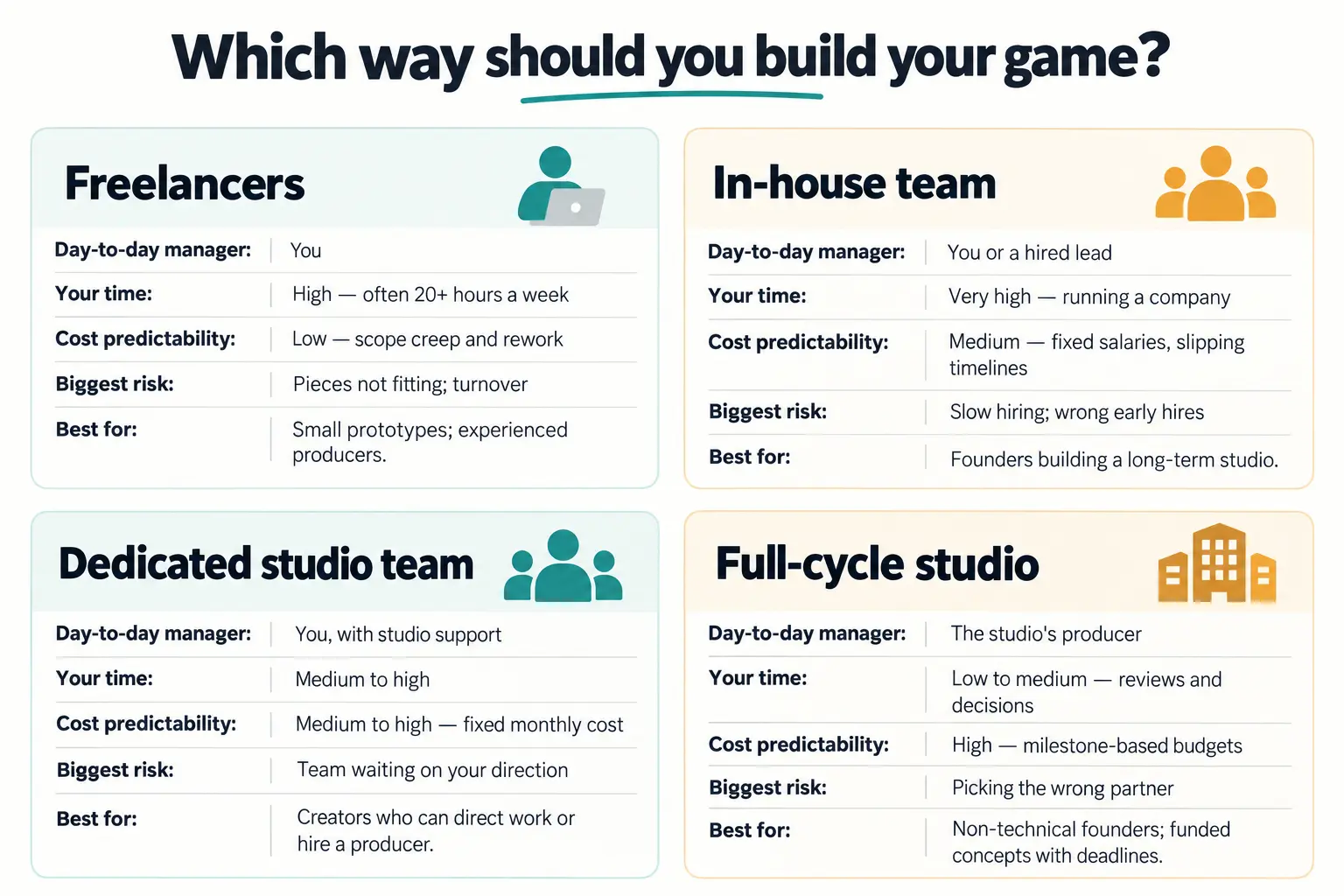
If you read that table and thought, “I don’t have 20 hours a week to manage developers,” that’s your answer.
Want a faster answer than working through the options yourself?
Send us your pitch or design doc, even if it's rough. A real person will look at your specific concept and budget and tell you honestly which option fits, even if the answer isn't us.
Which option fits your situation?
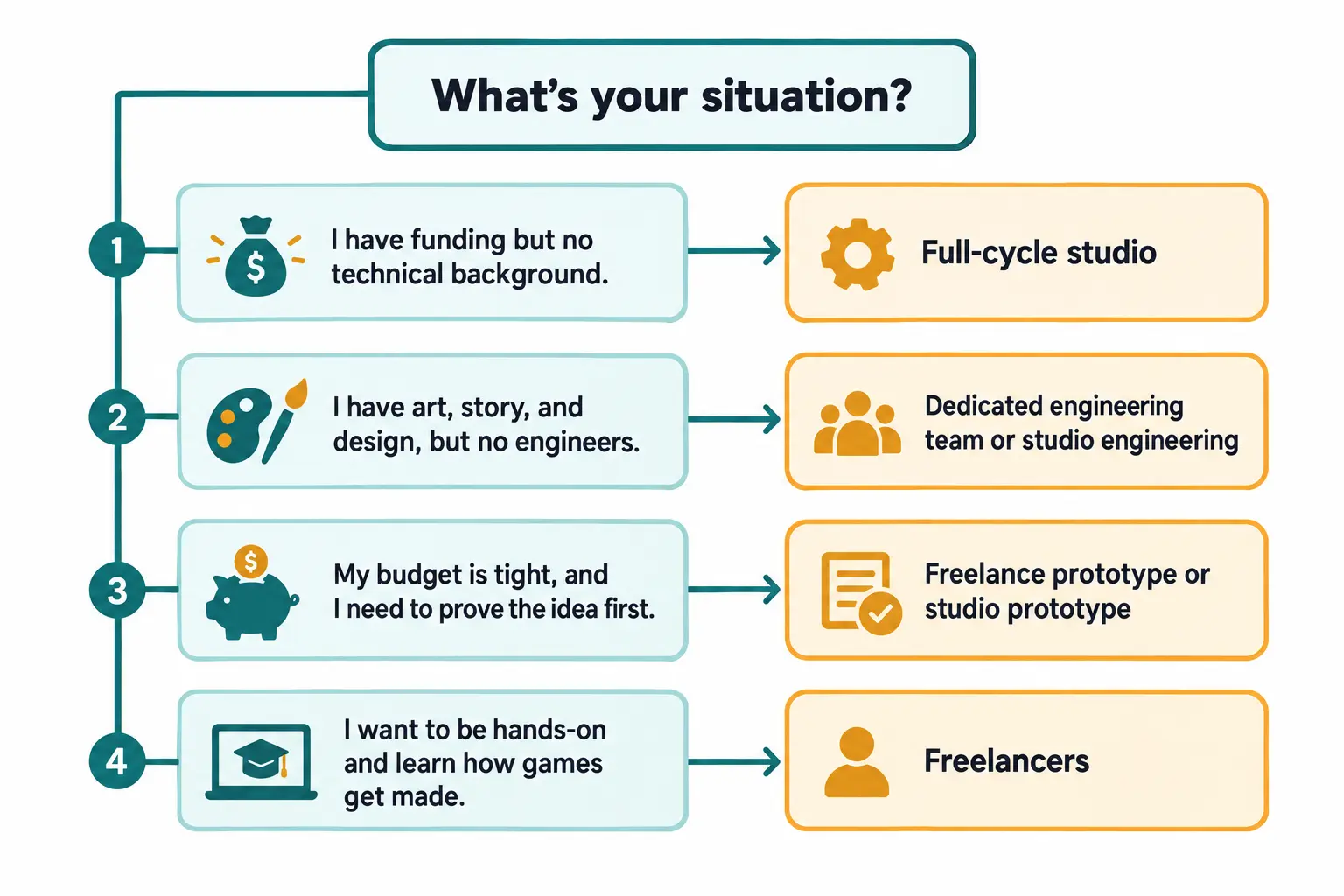
“I have funding but no technical background.”
Start with a full-cycle studio. Your biggest risk isn’t money; it’s making technical decisions you can’t evaluate. Ask for a paid discovery or pre-production phase first so you get a proper scope, timeline, and technical plan before committing to full production.
“I have art, story, and design, but no engineers.”
You’ve already done the part most people struggle with. Look for a studio that can take on engineering and QA while you keep creative direction, or a dedicated engineering team if you can review builds and prioritize work every week.
“My budget is tight, and I need to prove the idea first.”
Don’t try to build the whole game. Build the smallest playable version that proves the core loop is fun, whether that’s a prototype for yourself or a vertical slice for publishers and investors. A small freelance team can work here if the scope is tightly defined; a studio can work if you want the prototype built on foundations you can keep using. Indie game development cost breaks down four real budgets from $14.5K to $2M+, if you want a sense of what ‘tight’ actually looks like in practice.
“I want to be hands-on and learn how games get made.”
Freelancers, plus a willingness to learn production, can work. Start small, use a task tracker from day one, insist on weekly playable builds, and budget for rework. Expect your first project to be as much education as product.
How much does it cost to get a game built without a team?
The honest answer is ‘it depends on scope,’ but there are useful benchmarks. What actually affects game development costs, from hiring model to art complexity to engine choice, is worth understanding before you price anything.
- Hourly rates. 80 Level’s research put the average outsourcing rate in Europe and the US at $50–100 per person per hour in 2024. 80 Level’s cost analysis also breaks rates down by region.
- Hidden costs on both sides. 80 Level’s Outsourcing vs. In-house report estimates the true cost of outsourcing runs about 18% above the quoted rate, while an in-house hire’s real cost, once benefits, equipment, and overhead are counted, runs close to double their base rate. Either way, your budget should include management, communication, and rework, not just the rate.
The number that matters most isn’t the hourly rate. It’s the cost to a finished, shippable game. A cheaper rate that needs two rewrites costs more than a higher rate that ships once.
Timelines matter too, because time is money. If you want to plan around realistic milestones, here’s how long each phase of game development usually takes.
How do you stay in control and keep your IP?
Handing your idea to someone else can feel risky. It doesn’t have to be if the basics are in writing before any work starts.
- Sign an NDA before sharing your design doc. Any serious studio will sign one without hesitation.
- Make IP ownership explicit. The contract should state that you own the code, art, design, and all related IP, and when ownership transfers (typically on payment of each milestone), protecting your IP when someone else builds your game covers the legal and security details in more depth.
- Keep access to the source code. Ideally, the project lives in a repository you own or can access at any time, not just a build you receive at the end.
- Get third-party licenses listed. Engines, plugins, fonts, music, and stock assets all come with licenses. You need to know what you’re allowed to ship.
- Ask for handover documentation. If you ever switch teams, the next one needs to understand how the game works.
- Stay in the decisions. Regular playable builds, milestone reviews, and the final say on anything that changes the core experience.
How do you avoid choosing the wrong development partner?
This is where a lot of projects are won or lost, and the deciding factor is almost always which partner you pick, not whether outsourcing itself works. In 80 Level’s survey of studios that had worked with outsourcing companies, almost half (47%) weren’t fully happy with the result, while the 23% who rated the partnership as extremely positive tended to have vetted the studio hard upfront. 80 Level breaks down why.
The red flags below are how you land in the second group:
- A quote in 24 hours with no questions. If they didn’t ask about your platform, scope, or monetization, the number is a guess.
- No playable builds until late in production. You should be playing something regularly, not waiting months for a big reveal.
- They can’t show similar shipped work. Pretty portfolios are easy. Shipped games in your genre and platform are proof.
- Vague answers about who’s on your team. You should know who your producer and leads are before you sign.
- No clear process for changes. Your design will evolve. Ask how change requests are scoped, priced, and approved.
- Fuzzy IP terms. Covered above. This one is non-negotiable.
And a few green flags: they push back on parts of your scope, they suggest a smaller first milestone, and they explain trade-offs in plain English. A partner who tells you what you don’t want to hear early is saving you money later. The most common mistakes people make when choosing a development partner go deeper into all of this; if you want the full list.
What actually happens after you contact a studio?
If you’ve never worked with a studio, the process can feel like a black box. Here’s roughly how it goes with most established studios:
- Intro call. You talk through the concept, goals, budget range, and timeline. No commitment.
- Material review. Sign an NDA before you send anything, then the studio reviews your pitch, design doc, art, and references and comes back with questions.
- Scoping and estimate. You get a proposed scope, team structure, timeline, and budget, often with options (for example, prototype first vs. full production).
- Proposal and statement of work. Deliverables, milestones, payment schedule, IP terms, and the change process, all in writing.
- Pre-production or prototype. The riskiest ideas get tested first, before the big spend.
- Production in milestones. Regular playable builds, reviews, and feedback loops with you.
- QA and launch. Testing, platform submission, and release.
- Post-launch support. Bug fixes, updates, and LiveOps if your game needs them.
Contracts, sprint governance, and engagement models all follow roughly this shape: how a studio engagement works from start to finish walks through the full sequence in more detail.
Conclusion
Jordan’s mistake wasn’t hiring freelancers. It was choosing a model that required skills she didn’t have, without knowing there was another way.
You now know there is.
If you have a concept, a design doc, or even just a strong idea and a budget, Juego Studios’ game development team can review it and give you an honest read: what it’ll take, what it might cost, and whether a studio is even the right fit. No pressure, no 50-slide pitch deck.
Frequently Asked Questions
Yes. Plenty of games are created by people who never write a line of code. Your role is to own the vision, make decisions, and fund the project; developers handle the technical work. If you have no production experience, working with a full-cycle studio or hiring an experienced producer makes this much easier.
No, but it helps a lot. A rough document covering your core loop, main mechanics, and target platform will get you far more accurate estimates. If you don’t have one, many studios offer a pre-production phase to create it with you.
You should, as long as the contract says so. Make sure the agreement states that all code, art, design, and IP belong to you, specifies when ownership transfers, and gives you access to the source code. Never start work without this in writing.
Per hour, usually yes. Per finished game, not always. Freelancers require you to manage coordination, quality, and testing yourself, and rework or turnover can quickly erase the savings. If you can’t manage production, a studio often costs less overall.
A focused prototype can take a few months, while a full commercial game often takes one to three years or more, depending on scope and platform. Starting with a prototype or vertical slice is the best way to get a reliable timeline for the full game.
Yes, and for most first-time creators it’s the smartest move. A prototype proves your core idea is fun, gives you something to show investors or publishers, and lets you test a development partner before committing to full production.
Outsourcing usually means an external team delivers a defined piece of work, or the whole game, for you. Co-development means an external studio works alongside your internal team, sharing production. If you don’t have a team yet, outsourcing to a full-cycle studio is the relevant option; co-development becomes useful once you have a core team.
Related Posts
Have a Game Idea but No Development Team? How to Get It Built
This guide walks you through every realistic way to get your game made, what each one really costs you in time and control, and how to pick the right one before you spend a dollar finding out the hard way.
Top 10 Game Development Companies in USA (2026 Update)
In this blog, we’ll discuss the top 10 game development companies in USA, along with how to evaluate them beyond surface-level claims, so you can identify partners who actually align with your vision, technical needs, and long-term growth goals.
Top Game Development Companies in 2026: 10 Global Leaders Compared
Most game projects don’t fail because the idea was weak. They fail because the development partner couldn’t scale, adapt, or deliver when pressure peaked.