


 Unity
Unity Unreal
 Godot
Godot
 Mobile
 PC
PC Console
 Full-Cycle
 Co-Development
 Outstaffing






-
 Game Development
 Nov 10th, 2025
- Share:
Table of Contents
- What Affects Game Development Costs in 2026? Insights into Hiring, Art, and Technology
- Why Game Development Costs Matter
- Key Factors Influencing Game Development Cost
- Game Development Cost by Game Type and Complexity
- Game Development Cost by Platform and Technology
- Specific Cost Components in Game Development
- Hiring and Team Structure Costs
- Cost Optimization Strategies
- Conclusion
What Affects Game Development Costs in 2026? Insights into Hiring, Art, and Technology
Game development in 2026 is at the meeting point of creativity, technology, and automation. As AI simplifies production and worldwide hiring transforms budgets, studios must find the right mix of innovation and efficiency. Discover how current tools, art workflows, and developer skills determine the real cost of building next-generation games.
Why Game Development Costs Matter
Every game represents a strategic mix of design vision, technical execution, and resource planning. With growing expectations for realism, performance, and cross-platform functionality, development costs have become a central factor in market success. Smart cost management not only guarantees timely delivery but also helps studios preserve quality and profitability in a crowded marketplace.
Key Factors Influencing Game Development Cost
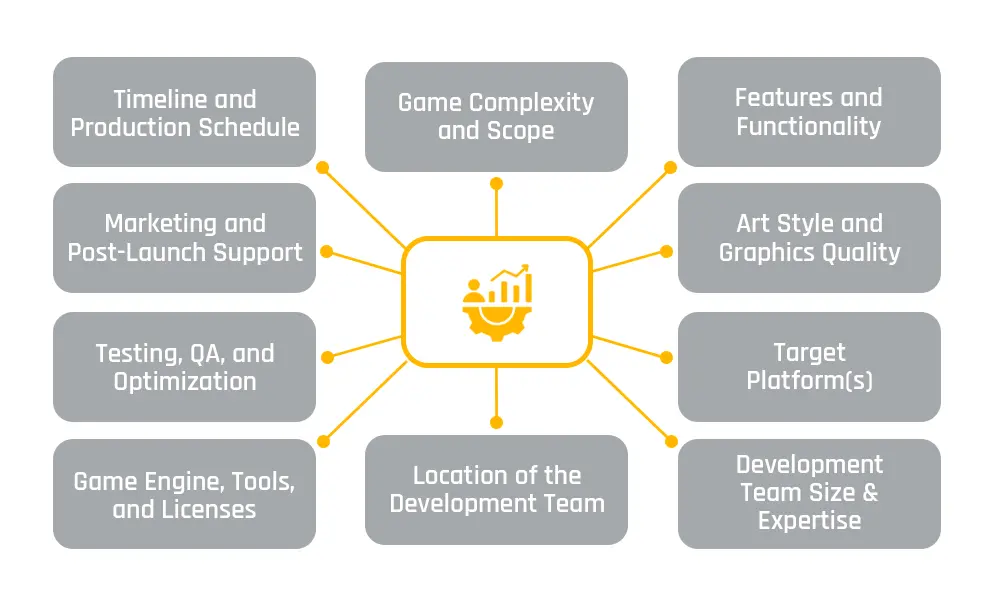
Game development costs in 2026 depend on a combination of creative vision, technical execution, and strategic choices made throughout production. From world design to post-launch updates, each factor plays a role in shaping the overall budget. Below are the major elements that determine the cost of developing a game today.
Game Complexity and Scope
The larger and more complex a game’s world, story, and mechanics, the higher its development cost. Open-world and multiplayer titles require vast content creation, advanced AI behavior, and server infrastructure, while smaller, linear games can often be developed with leaner teams and shorter timelines.
Features and Functionality
Gameplay systems such as multiplayer modes, live-service elements, voice chat, or cross-platform progression significantly affect both cost and development time. Adding online components, AI-driven NPCs, or physics-based interactions increases the need for specialized coding, networking, and balancing efforts.
Art Style and Graphics Quality
Visual quality remains one of the biggest drivers of cost. Stylized 2D games are generally faster and cheaper to produce than photorealistic 3D environments that rely on high-poly modeling, motion capture, and cinematic rendering. Studios using advanced workflows with real-time lighting and PBR textures also face higher hardware and production expenses.
Target Platform(s)
Each platform (mobile, PC, console, or VR) has its own technical requirements, optimization standards, and certification processes. Developing for multiple platforms increases both testing and development workloads, especially when maintaining consistent performance and gameplay experience across devices.
Development Team Size & Expertise
A larger team with experienced programmers, artists, and designers tends to deliver higher-quality results but also raises salary and management costs. In contrast, smaller teams may save on expenses but could require longer production cycles or external specialists for complex tasks.
Location of the Development Team
Geography plays a major role in cost variation. Hiring developers from North America or Western Europe generally costs more than partnering with studios in regions like India, Eastern Europe, or Southeast Asia, where global outsourcing hubs provide competitive pricing with skilled talent.
Game Engine, Tools, and Licenses
The choice of game engine (Unity, Unreal Engine, or custom in-house frameworks) impacts both technical flexibility and licensing fees. Paid tools for modeling, animation, VFX, and middleware (physics, audio, analytics) add to recurring costs, especially when scaling for large development workflows.
Testing, QA, and Optimization
Quality assurance ensures stability, performance, and user satisfaction but demands extensive time and staffing. Automated testing powered by AI tools now reduces repetitive workloads, yet manual testing remains essential for debugging, play balance, and cross-platform verification.
Marketing and Post-Launch Support
Even after release, marketing, community management, and post-launch updates carry ongoing costs. Maintaining live content, fixing bugs, and adding DLCs or seasonal events requires continued support, especially for games built around long-term player engagement.
Timeline and Production Schedule
Longer development cycles increase overall expenditure through salaries, revisions, and delays. Effective project management, milestone tracking, and agile workflows help studios control budgets while maintaining creative quality and team productivity.
Game Development Cost by Game Type and Complexity
Game development costs vary widely depending on the type, scale, and complexity of the project. Whether you’re building a minimalist mobile puzzle or a large-scale open-world AAA title, the scope of features, art style, gameplay depth, and technology used collectively determine the overall budget. Understanding how these elements scale helps studios plan smarter and avoid overspending.
-
2D vs. 3D Game Development Costs

The choice between 2D and 3D design is one of the first and most significant cost drivers.
2D Games:
2D games are simpler and more affordable to create, with budgets often starting around $10,000 to $50,000 for small indie or mobile titles. These games use flat graphics and simpler physics systems, reducing development time. Genres like platformers, casual puzzles, and mobile arcade titles typically fall into this range.
Key cost elements:
- Simple art assets and animation
- Shorter development timelines
- Smaller teams (often 2 to 5 members)
- Less hardware optimization required
3D Games:
In contrast, 3D game development demands larger budgets, often ranging from $50,000 to $500,000+ for mid-tier projects and millions for AAA titles. The cost increase comes from modeling, texturing, lighting, and rendering 3D assets, as well as implementing complex gameplay systems and physics.
Realistic 3D environments, dynamic lighting, and lifelike character animations drive both production time and labor costs.
Key cost elements:
- Advanced art workflows (3D modeling, rigging, animation)
- Use of high-end engines like Unreal Engine 5 or Unity HDRP
- Greater demand for optimization and QA
- Higher hardware and software requirements
Cost takeaway:
While 2D games can be built quickly and economically, 3D games offer richer experiences but require larger teams and longer timelines, raising both direct and indirect costs.
-
Indie, Mid-Core, and AAA Game Cost Breakdown
The scale of production significantly impacts cost structure. Studios generally categorize games into three main tiers:
Indie Games:
- Average cost: $5,000 to $100,000
- Team size: 1 to 10 people
- Typical duration: 3 to 12 months
Indie games rely on smaller teams, open-source tools, and modular assets to stay within budget. Developers often handle multiple roles, from programming to art and sound. Popular engines like Unity or Godot help reduce licensing and technical costs.
Examples: Celeste, Undertale, Hollow Knight
Mid-Core Games:
- Average cost: $100,000 to $500,000+
- Team size: 10 to 40 people
- Duration: 12 to 24 months
These games strike a balance between scope and affordability, featuring more advanced graphics and gameplay systems than indie titles. They might target mobile, PC, or console platforms with richer experiences and limited multiplayer modes.
Examples: Dead Cells, Hades, Cuphead
AAA Games
- Average cost: $5 million to $200+ million
- Team size: 100 to 500+ professionals
- Duration: 2 to 5 years
AAA games represent the pinnacle of production, with cinematic storytelling, realistic visuals, and massive open worlds. Costs skyrocket due to the need for specialized departments: AI engineers, animators, technical artists, voice actors, and marketing teams. Marketing alone can equal or exceed production costs.
Examples: The Last of Us Part II, Cyberpunk 2077, Elden Ring
-
Single-Player vs. Multiplayer Games

Adding multiplayer functionality introduces new technical and cost complexities that go beyond core game logic.
Single-Player Games
- Easier to develop and test, since gameplay doesn’t rely on real-time network connections.
- Require fewer backend systems (no matchmaking or servers).
- Average costs range from $20,000 to $300,000 for smaller projects and up to tens of millions for large story-driven games.
Multiplayer Games
- Require backend servers, networking architecture, and security systems.
- Must support features like matchmaking, leaderboards, and anti-cheat measures.
- Ongoing server maintenance and updates create recurring expenses even after launch.
- Costs typically increase by 30 to 50% compared to a single-player equivalent.
Examples: Fortnite, Apex Legends, Among Us, Valorant
Genre-Specific Cost Variations
Each game genre carries its own development requirements that affect both budget and time:
| Genre | Average Budget Range (2026) | Key Cost Drivers |
| Puzzle / Casual | $5,000 to $50,000 | Simple mechanics, small team |
| Platformer / Action | $50,000 to $200,000 | Art-heavy, requires polished gameplay |
| RPG / Adventure | $100,000 to $1M+ | Story, world-building, voice acting |
| Shooter / FPS | $300,000 to $10M+ | Multiplayer systems, high-fidelity graphics |
| Open-World / MMO | $1M to $200M+ | Massive environments, AI, and servers |
| VR / AR Games | $80,000 to $250,000+ | Specialized hardware, immersive design |
AI tools in 2026 are helping studios reduce time-intensive processes in procedural world generation, NPC behavior scripting, and 3D asset creation, bringing down costs for genres that previously demanded large labor budgets.
-
Complexity Multiplier: How Scale Impacts Cost
Beyond genre and platform, several “complexity multipliers” can dramatically affect cost:
- Procedural generation & AI behavior systems
- Cross-platform support (mobile + PC + console)
- Voice-over and localization for global releases
- Cinematic cutscenes and motion capture
- Online multiplayer scaling (servers, cloud infrastructure)
Every new layer of depth (whether it’s dynamic weather, destructible environments, or adaptive AI) adds both development time and technical overhead.
Game Development Cost by Platform and Technology
The platform you build for plays a pivotal role in shaping your game’s budget. Each platform (whether mobile, PC, console, VR, or cross-platform) brings its own set of technical requirements, audience expectations, and production demands. Similarly, the technology stack and game engine chosen can influence costs as much as design and art direction.
AI-driven tools in 2026 have further reshaped these dynamics, helping developers cut production time while introducing new integration and licensing considerations.
1. Mobile Game Development Cost
Mobile game development remains the most accessible entry point for both indie and mid-sized studios.
Costs range widely depending on the game’s complexity, from $10,000 for simple 2D casual games to $300,000+ for large-scale 3D or multiplayer titles.
Key Cost Drivers:
- Platform support (iOS, Android, or cross-platform)
- UI/UX design for small screens
- Mobile optimization (battery, frame rate, resolution)
- Integration with in-app purchases, ads, and push notifications
- App Store and Play Store compliance
Mobile developers increasingly use AI for A/B testing, ad optimization, and user behavior analytics, allowing studios to refine monetization models and improve retention without ballooning the budget.
Typical genres: Casual, hyper-casual, puzzle, match-3, arcade, idle clickers, mid-core RPGs
2. PC Game Development Cost
PC game development offers flexibility in design and monetization but typically involves higher technical depth and asset quality.
Budgets often range between $50,000 to $500,000 for independent and mid-level games, while advanced 3D or multiplayer titles can reach several million dollars.
Key Cost Drivers:
- High-resolution graphics and complex physics systems
- Cross-hardware optimization (GPU, CPU, OS variations)
- Online distribution (Steam, Epic Games Store) and updates
- AI-driven testing to automate performance and bug checks
PC games often serve as a testing ground for innovation, from AI-powered NPC behavior systems to adaptive difficulty mechanics that personalize player experiences.
Though production can be expensive, PC titles enjoy fewer certification barriers and flexible monetization options compared to consoles.
Typical genres: Strategy, RPG, shooter, simulation, sandbox, indie adventure
3. Console Game Development Cost
Console development is known for high production values and strict certification processes. Budgets often begin at $200,000+ for smaller titles and extend into the multi-million range for full-scale releases.
Key Cost Drivers:
- Platform licensing and certification (PlayStation, Xbox, Switch)
- Exclusive optimization and testing requirements
- High-end 3D art, cinematic design, and controller integration
- Quality Assurance (QA) and compliance checks
- Long development timelines
AI has begun transforming console workflows through procedural asset generation and automated bug tracking, helping teams meet certification faster and with fewer manual iterations.
Typical genres: AAA action, adventure, racing, sports, narrative-driven games
4. VR and AR Game Development Cost
Immersive technologies like Virtual Reality (VR) and Augmented Reality (AR) continue to redefine interactive experiences, but at a premium.
The average development cost for VR/AR games ranges between $80,000 to $250,000+, depending on interactivity, visual fidelity, and device compatibility.
Key Cost Drivers:
- Hardware-specific optimization (headsets, controllers, sensors)
- 3D spatial design and real-time rendering
- Motion tracking, physics simulation, and immersive audio
- Testing across devices (Meta Quest, Vive, Pico, Vision Pro, etc.)
- Advanced art and animation requirements
- AI has become indispensable here, powering:
- Procedural world generation
- Dynamic environment lighting
- Motion capture enhancement and animation cleanup
As VR and AR tools evolve, AI-driven automation continues to lower entry barriers for smaller studios while maintaining immersive quality.
Typical genres: Simulation, exploration, rhythm, education, sports, interactive storytelling
5. Cross-Platform Game Development Cost
Cross-platform development is an attractive option for studios aiming for wider reach across mobile, PC, and console. However, it also increases complexity and cost, typically adding 20 to 40% more to the base budget.
Key Cost Drivers:
- Code adaptation and optimization for multiple operating systems
- UI scaling and input adjustments
- Compatibility testing and certification for each platform
- Network synchronization and save data consistency
- Use of cross-platform frameworks (Unity, Unreal, Godot, etc.)
AI integration has made this process smoother. Automated testing systems now handle device-specific QA, and AI-assisted porting tools reduce redundant code rewriting. Despite higher upfront investment, cross-platform releases often yield better long-term returns through a unified audience base.
Typical genres: RPGs, battle royale, co-op shooters, strategy, sandbox
6. Blockchain, NFT, and Web3 Game Development
Blockchain-based games blend traditional gameplay with tokenized economies. These projects generally start around $60,000 and can exceed $1 million depending on scope and blockchain complexity.
Key Cost Drivers:
- Smart contract integration and security audits
- Marketplace development (for NFTs or digital assets)
- Wallet integration and on-chain transactions
- Compliance and maintenance costs
AI tools now assist in fraud detection, bot prevention, and token economy modeling, ensuring safer and more efficient gameplay ecosystems. Though these games require niche expertise, automation is reducing the technical overhead once associated with blockchain projects.
Typical genres: Strategy, collectible RPGs, trading, simulation
7. Game Engine and Technology Choice
Choosing the right game engine shapes both workflow efficiency and budget allocation.
Here’s how major engines compare in cost and capability:
| Engine | Cost Model | Ideal For | AI/Tech Advantages |
| Unity | Free for small studios; subscription or royalty for high revenue | 2D/3D mobile and mid-core games | AI-assisted code tools, wide plugin support |
| Unreal Engine 5 | Free until revenue threshold; royalty after | AAA and high-end 3D games | Realistic rendering, AI-based animation tools (Metahuman, procedural generation) |
| Godot | Free, open source | Indie and 2D games | Lightweight, customizable scripting |
| CryEngine | Royalty-based | Visual fidelity and simulation games | Advanced physics and rendering features |
| Custom Engine | Fully in-house; high cost | Specialized or experimental projects | Tailored AI logic and custom tools |
AI-enhanced workflows like procedural environment creation, real-time shader optimization, and smart testing bots are redefining how studios use engines to cut production time and maintain visual quality.
Specific Cost Components in Game Development
Every successful game relies on a combination of art, design, technology, and sound, each contributing to the overall budget. Understanding the cost components behind each production stage helps studios and developers allocate resources efficiently.
While the total budget can vary depending on scope and scale, certain categories consistently account for the largest portions of a game’s cost. In 2026, AI integration has become a major influence, automating repetitive tasks, improving asset quality, and optimizing workflows to save both time and money.
1. 3D Animation and Cinematics
Animation breathes life into a game’s world, whether through simple character movements or high-end cinematic sequences. The cost depends on style (realistic, stylized, or motion-captured), complexity, and duration. AI-based animation tools such as Move.AI, DeepMotion, and Unreal’s Control Rig now generate lifelike movement from 2D video input or text prompts, drastically cutting manual keyframing time. This reduces labor hours by 30 to 40% while maintaining professional-grade quality.
Typical Costs (2026 Estimates):
- Basic 3D animations: $500 to $2,000 per minute
- Complex or motion-captured animation: $5,000 to $20,000+ per minute
- Full cinematic sequences: $20,000 to $100,000+, depending on production value
Cost Drivers:
- Rigging and skeletal setup for characters
- Realistic motion and facial animation
- Cutscenes and camera choreography
- Physics-based interactions and crowd animation
2. 3D Character Modeling
Characters are among the most resource-intensive elements in any game production. Their design involves multiple stages, from concept sketches to sculpting, texturing, rigging, and optimization for gameplay. AI tools like Meshy, Luma AI, and Scenario can generate or enhance 3D models directly from text or sketches, reducing turnaround time and allowing studios to produce prototypes or background NPCs at a fraction of traditional costs. However, final hero characters still demand human artistic oversight to ensure originality and polish.
Typical Costs (Per Character):
- Low-poly stylized models: $300 to $800
- Mid-quality 3D models: $1,000 to $2,500
- High-poly or photorealistic characters: $3,000 to $10,000+
Cost Drivers:
- Character complexity and accessories (armor, clothing, hair, props)
- Art style (cartoonish vs. realistic)
- Texturing and material detail
- Rigging for animation and gameplay integration
3. 2D / Concept Art Design
Concept art defines a game’s visual identity, setting the tone for characters, worlds, and UI. The cost depends on the level of detail and number of iterations required. Generative AI tools such as Midjourney, DALL·E 3, and Adobe Firefly now support concept artists by providing quick ideation, color schemes, and lighting references. These tools accelerate brainstorming but still require human refinement to avoid generic or inconsistent visual results.
Typical Costs:
- Basic 2D sketches: $50 to $150 per piece
- Detailed digital concept art: $300 to $1,000+
- Full character/environment concept sets: $2,000 to $5,000+
Cost Drivers:
- Art complexity and revision rounds
- Experience level of the artist
- Style consistency across multiple assets
4. Environment and Level Design
Building immersive game worlds is both art and engineering. Costs scale with the size of environments, interactive elements, and visual fidelity. AI-driven tools like NVIDIA Omniverse, Promethean AI, and Scenario assist in procedural world generation and environment layout. These solutions automatically place props, generate realistic lighting, and simulate physics, saving weeks of manual level design effort.
Typical Costs:
- Simple 2D background design: $100 to $500 per scene
- Small 3D environments (interiors, rooms): $1,000 to $5,000
- Large, open-world environments: $10,000 to $100,000+
Cost Drivers:
- Terrain and prop modeling
- Lighting and shaders
- Dynamic weather, foliage, and destructible objects
- Optimization for frame rate and memory limits
5. User Interface (UI) and User Experience (UX) Design
A seamless UI/UX directly affects gameplay satisfaction. Costs vary depending on interface complexity, platform, and visual design depth. AI-powered UX research tools predict user behavior patterns and highlight friction points early. Design teams use AI wireframing tools to auto-generate responsive layouts and color schemes, allowing faster iteration cycles.
Typical Costs:
- Basic mobile UI: $2,000 to $5,000
- Complex menu systems or HUDs: $10,000 to $25,000
- Full UI/UX pipeline (research + wireframes + visuals): $20,000 to $50,000
Cost Drivers:
- Cross-platform interface consistency
- Accessibility features and responsive layouts
- Custom icons, buttons, and typography
- Iteration and player testing
6. Audio Design and Music Composition
Soundscapes and music enhance emotion, immersion, and identity. Budgets depend on whether the studio uses original compositions, stock tracks, or licensed music. AI-based sound generators like AIVA, Boomy, and Soundful produce adaptive background music that changes with gameplay context. Additionally, AI voice synthesis tools are replacing early-stage placeholder voiceovers, enabling faster prototyping before professional recording.
Typical Costs:
- Sound effects (per set): $500 to $2,000
- Custom background score: $1,000 to $20,000+
- Voice acting and dialogue: $100 to $400 per line (varies by talent level)
Cost Drivers:
- Original vs. royalty-free content
- Number of unique sounds and music tracks
- Mixing, mastering, and integration complexity
7. Game Engine and Middleware Costs
Game engines form the backbone of production, and their licensing models affect long-term cost structures.
| Engine / Tool | Cost Structure (2026) | Primary Use Case |
| Unity | Free up to a revenue limit; then subscription-based | 2D/3D mobile and mid-core games |
| Unreal Engine 5 | Free until revenue threshold, then royalty | AAA and cinematic-quality games |
| Godot | Completely free and open source | Indie or stylized 2D projects |
| CryEngine | Royalty-based model | Realistic simulation and FPS titles |
| Proprietary / Custom Engines | Custom-built; $50,000+ setup | Large studios or unique tech needs |
8. Licensing, Tools, and Middleware Expenses
Beyond direct production, hidden costs emerge from software licenses, storage, and plugins. Adopting AI tools adds subscription fees but reduces human workload. Most studios offset this through faster iteration and smaller art or QA teams.
Common Add-ons:
- Animation suites (Blender, Maya, Cinema 4D): $1,000 to $3,000 per seat
- Project management tools (ShotGrid, Jira, Trello): $20 to $50/user per month
- Version control and collaboration tools (Perforce, Git, Ftrack)
- Cloud storage, hosting, and build servers
Hiring and Team Structure Costs

The composition and size of the team heavily influence the cost of game development. Different production models (in-house, outsourced, or freelance) come with unique financial implications.
-
In-House Development Teams
Hiring a full-time internal team provides control and consistency but requires long-term investment. Typical costs include salaries, benefits, software licenses, and infrastructure. This model suits studios managing multiple ongoing projects or those needing tight collaboration across departments.
Pros: Full control, easier communication
Cons: High fixed costs, slower scaling
-
Outsourced Development
Outsourcing allows studios to collaborate with specialized external partners for art, programming, or entire projects. It’s ideal for reducing overhead and accessing expertise without permanent hires. Costs depend on project scope and studio reputation.
Pros: Flexible pricing, access to specialists
Cons: Requires strong project management and clear documentation
-
Freelance Contributors
Freelancers offer cost-effective short-term support for specific tasks like concept art, modeling, or level design. Rates vary by skill level, from entry-level artists charging a few hundred dollars per asset to senior developers commanding premium rates.
Pros: Budget flexibility, task-specific hiring
Cons: Inconsistent availability, potential coordination challenges
-
Team Size and Budget Correlation
Larger teams naturally increase total project cost but enable faster production. A small indie game may be built by 3 to 5 people, while mid-core projects often need 15 to 40 professionals, and AAA productions can involve 100+ specialists across multiple departments.
Cost Optimization Strategies
Managing expenses effectively is as crucial as the creative process itself. In game development, costs can escalate quickly due to iterative design, evolving features, or unanticipated technical challenges. A solid cost optimization strategy ensures that studios maximize value without compromising quality or innovation. Here are proven approaches to keeping development efficient, scalable, and financially balanced.
1. Define a Clear Scope and Game Vision
Unclear project goals are one of the leading causes of budget overruns. Before development begins, establish a well-defined game design document (GDD) outlining the core mechanics, art style, feature list, and platform targets.
A clear scope prevents “feature creep,” the gradual addition of new ideas that extend timelines and inflate costs. Prioritize must-have features over optional ones and define early what success looks like in gameplay, visuals, and performance.
Key takeaway: Start small, validate early, and scale gradually.
2. Build an MVP (Minimum Viable Product)
An MVP is a simplified version of the game that focuses on core gameplay and mechanics. Developing an MVP first allows teams to:
- Test market interest
- Gather user feedback
- Identify design flaws before investing heavily
This approach reduces rework and helps secure funding or partnerships before full-scale production begins.
Example: Testing a core combat loop or level prototype before producing full story arcs, cinematics, or multiplayer systems.
3. Reuse Assets and Modular Components
Asset reuse can save both time and money without sacrificing creativity.
Developers can:
- Use pre-made 3D models, textures, and sounds from asset stores
- Recycle internal assets from past projects
- Build modular systems (e.g., environment pieces, character rigs) that can be rearranged or adapted for new content
This reduces the need for creating every asset from scratch and speeds up prototyping.
Pro Tip: Keep an organized internal asset library to streamline future projects.
4. Optimize Team Structure
A balanced team structure prevents underutilization and overstaffing. Instead of hiring full-time specialists for every role, studios can:
- Outsource specialized tasks (like cinematic animation or VFX)
- Hire freelancers for short-term assignments
- Keep a core in-house team for creative direction and project management
This hybrid model maintains creative control while scaling resources flexibly as the project evolves.
5. Streamline Production with Efficient Tools
Choosing the right game engine and project management tools is one of the smartest cost-saving decisions. Popular engines like Unity and Unreal Engine 5 provide robust frameworks and asset marketplaces that accelerate production. Cloud-based collaboration platforms (e.g., ShotGrid, Trello, Jira) enhance communication, especially for distributed teams, preventing miscommunication that leads to costly revisions.
Efficiency tip: Standardize tools across departments to ensure asset compatibility and avoid redundant software licenses.
6. Prioritize Automation and Procedural Workflows
Procedural generation, even when not AI-based, can dramatically cut production costs by automating repetitive tasks. For example:
- Procedural terrain or building generation reduces manual level design work
- Automated testing tools detect bugs early, lowering QA costs
- Batch rendering and build automation free up developer time
These techniques minimize manual intervention, allowing teams to focus on creativity and polish.
7. Adopt Milestone-Based Budgeting
Breaking the project into phased milestones provides better control over spending and accountability. Budgets are released in stages (concept, prototype, vertical slice, alpha, beta, and launch) ensuring that funds are tied to measurable progress.
This approach allows for:
- Early identification of cost overruns
- Timely course correction
- Transparent financial reporting for stakeholders or investors
Result: Projects stay agile while minimizing financial risk.
8. Leverage Open-Source and Free Tools
Not every production stage requires premium software. Free or open-source solutions (like Blender for modeling, Godot for lightweight 2D projects, or GIMP for texture editing) can replace paid licenses during early development or indie production.
Using open tools doesn’t just save costs; it encourages experimentation and community-driven support.
9. Optimize Marketing and Launch Costs
Marketing often consumes a large portion of the budget, sometimes equaling production costs for large titles. To optimize:
- Build a community early through social media, dev blogs, or Discord
- Use organic marketing and influencers before large ad campaigns
- Release early access or demo versions to generate traction
A smart marketing plan focuses spending on proven channels instead of expensive, broad campaigns.
10. Post-Launch Optimization
Cost efficiency doesn’t stop at release. Post-launch strategies can extend profitability and minimize wasted effort:
- Reuse the game’s core systems for expansions or DLCs
- Introduce live-service updates gradually instead of all at once
- Monitor analytics to prioritize high-impact improvements
Iterative updates keep costs predictable while sustaining player engagement over time.
Conclusion
Game development costs in 2026 are shaped by countless moving parts, from team structure and technology to art quality and platform choice. Successful studios balance creativity with smart budgeting, building sustainable workflows that blend efficiency and innovation. With clear planning, modular processes, and disciplined cost control, even small teams can deliver world-class experiences that rival big-budget productions.
Frequently Asked Questions
Game development costs range from $10,000 for small indie titles to over $10 million for AAA games, depending on complexity, art quality, and platform.
The biggest cost drivers are team size, art and animation quality, platform choice, and feature complexity, including multiplayer, 3D assets, and ongoing updates.
Development timelines vary from 3 to 6 months for small games to 2 to 5 years for large-scale, high-fidelity productions with multiple teams.
Yes. Outsourcing specific tasks like 3D art, programming, or QA to specialized studios helps reduce overhead and accelerates delivery without compromising quality.
By defining a clear scope, setting milestones, budgeting 10 to 20% for contingencies, and monitoring progress regularly to catch issues before they escalate.
Related Posts
Have a Game Idea but No Development Team? How to Get It Built
This guide walks you through every realistic way to get your game made, what each one really costs you in time and control, and how to pick the right one before you spend a dollar finding out the hard way.
Top 10 Game Development Companies in USA (2026 Update)
In this blog, we’ll discuss the top 10 game development companies in USA, along with how to evaluate them beyond surface-level claims, so you can identify partners who actually align with your vision, technical needs, and long-term growth goals.

Top Game Development Companies in 2026: 10 Global Leaders Compared
Most game projects don’t fail because the idea was weak. They fail because the development partner couldn’t scale, adapt, or deliver when pressure peaked.