


 Unity
Unity Unreal
 Godot
Godot
 Mobile
 PC
PC Console
 Full-Cycle
 Co-Development
 Outstaffing






-
 Unreal Game Development
 Jul 7th, 2026
- Share:
Table of Contents
- TL;DR - Key Takeaways
- What Is Unreal Engine Game Development?
- Unreal Engine 5 Explained (UE5 vs UE4)
- Using Unreal Engine for Game Development in 2026: Key Features, Pros, and Cons
- Unreal Engine vs Other Game Engines
- Common Challenges in Using Unreal Engine for Game Development
- When Outsourcing Unreal Development Makes Sense
- Choosing a Studio for Unreal Engine Game Development
- How to Choose the Right Unreal Engine Game Development Company
- Core Unreal Engine Game Development Services to Look For
- Trends Shaping Unreal Engine for Game Development in 2026
- Why Choose Juego Studios for Unreal Engine Game Development
- Conclusion
Unreal rarely fails at the idea stage. Projects built using Unreal Engine for game development tend to break later, when teams underestimate performance demands, production complexity, or the engineering discipline required at scale. With Unreal now powering 28% of Steam games and accounting for over 53.9% of mid-to-high revenue titles, the engine has become the standard for visually ambitious, high-performance games.
As UE5 adoption accelerates in 2026, Unreal is projected to account for 40% of Steam sales by 2030, driven by Nanite, Lumen, and real-time world-building workflows. These capabilities raise creative potential but demand deep technical execution.
In this guide, we explain what Unreal Engine game development truly involves, where it delivers the most value, the challenges teams face at scale, and how experienced studios turn Unreal’s power into stable, production-ready games.
TL;DR - Key Takeaways
In 2026, projects that rely on Unreal Engine for game development succeed or fail based on production discipline, not creative ambition. UE5’s Nanite, Lumen, and large-world systems dramatically expand what teams can build, but they also increase the cost of weak optimization, unstable multiplayer architecture, and late pipeline corrections. Stable Unreal game development occurs when performance budgets, asset management, networking architecture, and LiveOps readiness are defined early, not after visual targets are met.
Key Takeaways
- Unreal projects often fail due to weak production pipelines, late optimization, and underestimated multiplayer or open-world complexity.
- UE5 reduces manual friction but demands stronger asset structuring, lighting strategy, and streaming discipline from day one.
- Blueprints speed must be balanced with C++ system control to prevent performance instability at scale.
- Released Unreal titles reveal more about engineering maturity than prototypes or visual demos ever can.
- Outsourcing Unreal Engine game development works best when it mitigates technical and optimization risk, not when it is used purely for cost reduction.
- Studios with multiplayer, backend, and platform certification experience prevent expensive rewrites late in development.
- Juego Studios is particularly well-suited for Unreal Engine game development projects that require UE4/UE5-native pipelines, multiplayer architecture, performance optimization, and full-cycle co-development under real production scale rather than demo-driven experimentation.
What Is Unreal Engine Game Development?
Unreal Engine is a high-performance real-time game engine developed by Epic Games, designed to build visually rich, technically complex, and scalable interactive experiences. Unreal Game Development refers to creating games using this engine’s advanced rendering, physics, animation, networking, and tooling stack to deliver high-fidelity gameplay across PC, console, and immersive platforms.
Unlike lightweight engines optimized for speed or simplicity, Unreal is built for production-grade execution, where visual realism, performance optimization, and system-level control matter as much as creativity.
What Is Unreal Engine for Game Development Used for in Real Production?
In practice, Unreal is chosen when a game requires depth, scale, or visual ambition beyond basic builds. Studios rely on it for:
- PC and console games requiring high frame-rate stability, advanced lighting, and large environments
- AAA and AA productions with cinematic storytelling, complex AI systems, and performance-critical pipelines
- Indie games with high visual ambition that aim for a premium look and feel without building custom engines
- Multiplayer and live-service games where networking, replication, and scalability are core requirements
- VR, AR, and XR gaming experiences that need real-time rendering, spatial interaction, and low-latency performance
This combination of visual power and technical control is what positions Unreal as a production engine rather than just a creative tool.
Unreal Engine 5 Explained (UE5 vs UE4)
Unreal Engine 5 is not a surface-level upgrade to UE4. It changes how games are built, scaled, and shipped. For teams working in Unreal Engine game development, UE5 reduces a lot of the technical friction that earlier pipelines had to work around, especially when pushing visual quality or building large worlds.
UE4 often forced teams to balance visuals, performance, and production speed. UE5 shifts that balance by making high-fidelity output more practical during real production, not just demos.
What actually changed with UE5 for Unreal Engine game development
- Geometry no longer relies on heavy manual LOD work, allowing artists to use highly detailed assets more directly.
- Lighting shifted from long bake cycles to fully dynamic systems, accelerating iteration during level design.
- World-building supports large, continuous environments that multiple teams can work on in parallel.
Why does this matter in real projects?
- Teams spend less time optimizing early and more time refining gameplay and visuals.
- Open-world and multiplayer projects scale more cleanly as content grows.
- Visual targets can be tested earlier without locking teams into risky performance decisions.
How does it impact Unreal game development?
- Shorter iteration loops between art, design, and engineering.
- Fewer late-stage surprises are tied to lighting, asset limits, or world size.
- Better alignment between creative ambition and what can realistically ship.
UE5 doesn’t remove the need for experience, but it rewards teams that understand how to use the engine properly. The real difference from UE4 shows up in production stability, not just visuals.
Using Unreal Engine for Game Development in 2026: Key Features, Pros, and Cons
By 2026, Unreal has evolved from a powerful engine into a production-grade platform used across AAA, indie, and immersive projects. Teams adopting Unreal Engine for game development today are choosing it not just for visual output, but also for how well it supports scale, performance, and the realities of long-term production.
At its core, Unreal’s strength lies in how its systems work together across art, engineering, and production.
Key features shaping modern Unreal game development projects
- Real-time visual fidelity: Advanced lighting and geometry systems enable cinematic-quality visuals without long bake cycles.
- Blueprints + C++ workflows: Designers iterate quickly in Blueprints while engineers maintain performance-critical systems in C++.
- Scalable world building: Large environments can be developed and streamed efficiently, even by distributed teams.
- Cinematics and storytelling tools: In-engine sequencing supports film-grade cutscenes and narrative pacing.
- Cross-platform readiness: Single pipelines support PC, console, VR, and emerging platforms with fewer rewrites.
- Ecosystem depth: Asset marketplaces, plugins, and integrations reduce the overhead of custom tooling.
These strengths make Unreal a clear choice for ambitious projects, but they also introduce trade-offs teams must account for early.
Pros vs Cons
| Pros | Cons |
| Enables high-end visuals without custom engine development | Steeper learning curve for teams new to Unreal workflows |
| Production-ready tools for large and complex projects | Requires stronger hardware for development and testing |
| Strong support for open worlds, multiplayer, and XR | Overengineering risk for small or tightly scoped games |
| Flexible pipelines for art, design, and engineering teams | Royalty considerations once commercial thresholds are crossed |
| Backed by a mature ecosystem and long-term engine roadmap | Poor optimization choices can compound late in production |
Unreal Engine vs Other Game Engines
Choosing a game engine isn’t about which tool is “better” in isolation. It’s about how well the engine aligns with your game’s scope, visual ambition, team skill set, and long-term roadmap. Unreal Engine often sits at one end of the spectrum, optimized for high-fidelity and complex productions, while other engines prioritize speed, simplicity, or flexibility. Here’s how Unreal compares at a practical level.
Engine Comparison at a Glance
| Aspect | Unreal Engine | Unity | Godot | Custom Engine |
| Visual fidelity | Industry-leading, cinematic-quality rendering | Strong but requires more tuning for high-end visuals | Limited out of the box, improving steadily | Fully customizable, but resource-intensive |
| Best suited for | AAA, AA, high-end indie, VR/XR, simulations | Mobile, indie, live-service, rapid prototyping | Indie, 2D, lightweight 3D projects | Very specific, long-term flagship projects |
| Programming model | Blueprints + C++ hybrid | C# scripting | GDScript / C# | Fully custom |
| Open-world support | Built-in large-world systems | Possible with plugins and tooling | Limited for large-scale worlds | Depends entirely on internal investment |
| Multiplayer readiness | Native networking and replication | Requires additional frameworks | Basic, needs custom work | Fully custom |
| Learning curve | Steep but powerful | Moderate and accessible | Low | Very high |
| Tooling maturity | Enterprise-grade, production-tested | Mature, widely adopted | Lightweight, community-driven | Depends on internal tools |
| Cost model | Free to start, royalty after revenue threshold | Subscription-based tiers | Free and open source | High upfront and maintenance costs |
The Verdict:
- Unreal excels when visual quality, scale, and performance are non-negotiable.
- Unity favors speed, accessibility, and a broad talent pool, especially for mobile and LiveOps games.
- Godot works well for smaller teams seeking control without licensing costs.
- Custom engines only make sense when long-term differentiation justifies the engineering overhead.
The right choice depends less on trends and more on how realistically an engine supports your production goals without adding unnecessary friction.
Common Challenges in Using Unreal Engine for Game Development
Unreal is incredibly powerful, but that power comes with real production challenges. Teams that underestimate Unreal game development often run into delays, performance issues, or budget overruns, not because the engine falls short, but because it demands stronger technical discipline than lighter tools.
Here are the most common challenges teams face, especially as projects scale.
- Steep learning curve across UE5 systems: Features like Nanite, Lumen, World Partition, and Chaos Physics require specialized workflows. Teams new to Unreal often lose early momentum as they adapt to engine-specific production patterns.
- Performance optimization becomes complex at scale: High-quality assets and lighting can quickly strain memory and frame rates. Without early profiling and technical art involvement, performance issues surface late when fixes are costly.
- Asset and pipeline management is growing rapidly: large Unreal projects demand strict version control, asset-naming rules, and build pipelines. Weak structure slows collaboration and increases integration errors.
- Multiplayer architecture is unforgiving: Replication, server authority, and synchronization require careful design from the start. Retrofitting multiplayer systems after core gameplay is risky and expensive.
- Talent availability for advanced Unreal roles is limited: Senior Unreal engineers, technical artists, and optimization specialists are harder to source, making scaling the team during peak production phases difficult.
These challenges explain why many Unreal projects stall after promising prototypes. Avoiding them requires experience not just with the engine, but with production-grade pipelines, which leads many teams toward specialized partners.
When Outsourcing Unreal Development Makes Sense
Unreal projects demand precision. High visual fidelity, performance tuning, and multi-platform builds leave little room for on-the-job learning. That’s why many teams now choose to outsource Unreal Engine game development rather than stretch internal teams too thin.
Here’s why it works.
- Immediate access to UE5 production workflows: Studios experienced with Nanite, Lumen, and large-world systems already know how to structure environments and lighting without late-stage performance breakdowns.
- Optimization built into early development: Specialized Unreal teams profile memory, rendering, and networking from early builds, preventing last-minute visual cuts or system rewrites.
- Scalable team capacity without long-term hiring pressure: Outsourcing allows studios to expand art, engineering, and QA during heavy production phases and scale down after release without permanent staffing risk.
- Multiplayer and backend systems integrated earlier: Matchmaking, analytics, and LiveOps hooks were designed alongside gameplay, not added after launch plans were finalized.
- Smoother certification and platform readiness: Teams that regularly ship Unreal projects already follow console and XR compliance workflows, reducing submission delays.
Outsourcing strengthens internal teams by keeping execution stable while creative and product ownership stays in-house. The key variable, then, is choosing a partner whose production style fits your project’s real demands.
Choosing a Studio for Unreal Engine Game Development
As Unreal-powered projects grow more complex, teams increasingly look for partners with proven production experience, not just familiarity with the engine. Studios that stand out typically show UE5-native workflows, cross-platform delivery, and production discipline under real deadlines rather than portfolio polish alone.
For a full side-by-side breakdown of five vetted Unreal Engine studios, including
production depth, notable clients, and best-fit project type, see our comparison of the best Unreal Engine studios in 2026.
How to Choose the Right Unreal Engine Game Development Company
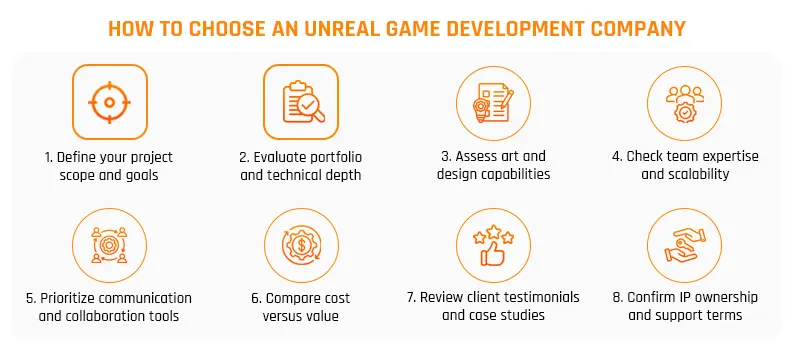
Unreal projects succeed when creative ambition is matched with production discipline. Use this checklist to evaluate studios the same way experienced publishers and product teams do.
- Define your project scope and goals: Be clear about genre, platforms, scale, and performance expectations. Unreal projects vary massively between cinematic single-player, live-service multiplayer, XR, and simulation builds.
- Match studio experience to your game type: Cinematic single-player, live multiplayer, VR, and simulation projects all require different pipeline strengths. Prioritize studios with shipped work similar to your scope.
- Review released projects, not only demos: Playable releases reveal far more about optimization quality, stability, and patch readiness than trailers or concept builds.
- Assess depth in both Blueprints and C++ systems: Strong Unreal teams balance fast iteration with performance-critical engineering, including networking, AI systems, and engine-level customization.
- Evaluate art pipelines and world-building workflows: Large scenes require disciplined asset management, lighting standards, and streaming strategies to prevent bottlenecks.
- Validate production cadence and reporting: Regular playable builds, sprint-based delivery, and transparent milestone tracking reduce risk far more than long development phases without feedback.
- Confirm post-launch support readiness: Live games require monitoring, balancing, and updating pipelines long after launch, not just delivery teams.
- Compare cost versus value: Lower rates don’t guarantee lower total cost. Efficient Unreal teams reduce rework, stabilize builds earlier, and shorten time to launch.
Choosing the right Unreal partner ensures the engine’s complexity becomes an advantage instead of a bottleneck, keeping production stable as scope and player load increase.
Core Unreal Engine Game Development Services to Look For
A strong Unreal partner isn’t defined by engine access, but by how well they execute across production, art, and engineering. Here are the core Unreal Engine game development services to look out for:
- Full-cycle game development: Concept, prototyping, production, QA, launch support, and LiveOps delivered through a structured Unreal pipeline.
- Custom Unreal Engine development: C++ systems, Blueprints–C++ hybrid workflows, engine extensions, plugins, and performance-critical customization.
- Art, animation, and world building: Environment design using Nanite and Lumen, character pipelines with MetaHuman or custom rigs, and cinematic storytelling through Sequencer.
- XR, simulation, and immersive builds: AR/VR, digital twins, training simulations, and real-time visualization built on Unreal’s XR and rendering stack.
- Technical art and optimization: LOD pipelines, shader optimization, memory profiling, and platform-specific tuning for console, PC, and XR.
- Multiplayer and backend systems: Replication, matchmaking, server architecture, analytics integration, and LiveOps readiness.
- QA, testing, and certification support: Automated builds, cross-platform testing, console compliance, and performance validation.
- Unreal Engine 5 features proficiency: Hands-on experience with Nanite, Lumen, World Partition, Chaos Physics, Niagara, and MetaHuman across real production builds.
Trends Shaping Unreal Engine for Game Development in 2026
Unreal’s role is expanding beyond traditional games into real-time worlds, simulations, and persistent experiences. In 2026, studios that remain competitive are those that align their production pipelines with these shifts.
- UE5 is becoming the default production standard: features such as Nanite, Lumen, and World Partition are no longer experimental. Studios now design pipelines around them from day one.
- Real-time cinematics and virtual production growth: Unreal is increasingly used for in-engine cutscenes, trailers, and virtual production, reducing reliance on offline rendering workflows.
- AI-assisted workflows entering production: Procedural content generation, animation blending, and AI-supported Blueprints logic are speeding up iteration in Unreal Engine game development pipelines.
- Cloud-based collaboration and CI/CD pipelines: Distributed teams rely on Perforce, cloud builds, and Pixel Streaming to review and test Unreal projects without local builds.
- MetaHuman-driven character pipelines: Lifelike characters are becoming faster and more consistent to produce, especially for narrative-heavy and cinematic games.
- XR and immersive gaming acceleration: Unreal continues to dominate high-fidelity VR, AR, and mixed-reality experiences as devices gain mainstream adoption.
Why Choose Juego Studios for Unreal Engine Game Development
Juego Studios pairs hands-on UE4/UE5 production experience (Nanite, Lumen, World Partition, MetaHuman, Chaos Physics, Niagara) with full-cycle and co-development flexibility, so teams get stable, optimized builds without stretching internal resources thin. The team has shipped multiplayer and performance-heavy titles for global publishers, with production pipelines built for predictable milestones rather than one-off engagements.
Conclusion
As Unreal Engine continues to shape the future of real-time experiences, the next generation of games will be defined by studios that blend creative vision with technical mastery. Partnering with the top Unreal Engine game development companies is about more than just production support. It’s about future-proofing your ideas for the evolving world of interactive entertainment.
The studios leading today are those investing in innovation, AI-assisted workflows, and scalable pipelines that adapt to change. Therefore, choose partners who not only understand Unreal’s power but know how to turn it into lasting player impact.
Frequently Asked Questions
Unreal Engine is free to download and use for development. Epic Games applies a 5% royalty only after a product earns more than USD 1 million in lifetime gross revenue. This makes Unreal accessible for indie teams and studios during development, while aligning costs with commercial success. Enterprise use cases, such as simulations or non-game applications, may follow different licensing terms depending on the deployment.
Most developers start with Epic Games’ official documentation and tutorials, which cover Unreal Engine basics and advanced systems such as Blueprints, C++, lighting, and physics. Many teams combine this with hands-on prototyping, sample projects, and community learning via YouTube, Unreal forums, and structured courses. For production work, learning both Blueprint workflows and C++ integration is essential.
Several engines offer alternatives depending on project goals:
- Unity: Easier onboarding and strong mobile support, but less suited for high-fidelity visuals at scale
- Godot: Open-source and lightweight, popular with indie developers
- CRYENGINE: Known for realism and outdoor environments
- Custom engines: Used by large studios but costly to maintain
The right choice depends on performance needs, visual ambition, platforms, and team expertise.
Unreal is chosen for its real-time rendering quality, scalability, and production maturity. Features like Nanite and Lumen enable high-end visuals without heavy offline workflows, while Blueprint and C++ hybrid systems support both rapid iteration and deep optimization. This makes Unreal suitable for AAA, AA, and visually ambitious indie games, as well as VR and live-service titles.
Unreal Engine is powerful but unforgiving at scale. Experienced Unreal teams understand performance optimization, asset pipelines, multiplayer architecture, and UE5 systems. Partnering with specialists reduces technical risk, avoids costly rework, and helps ensure your project remains stable as scope and fidelity increase.
Yes. While Unreal powers AAA titles, it’s increasingly used by indie teams aiming for high visual quality or immersive gameplay. Blueprints enable small teams to prototype quickly, and Unreal Engine’s asset ecosystem reduces production overhead. Many indie studios use Unreal Engine selectively, prioritizing visual impact over large-scale systems.
Timelines vary widely by scope and platform.
- Prototype or vertical slice: 2–4 months
- Indie or mid-scale game: 8–18 months
- AAA or multiplayer projects: 2+ years
Unreal’s real-time workflows can speed up iteration, but optimization and content scale still define overall timelines.
Several studios specialize in Unreal Engine–based VR projects that demand high visual quality and stable performance. Juego Studios stands out for building optimized VR and XR experiences with strong physics, interaction design, and support across major headsets. Other global studios also offer Unreal-powered VR development, especially for simulations, training, and immersive entertainment.
When choosing a VR-focused partner, prioritize hands-on device experience, performance tuning skills, and proven deployment on real hardware, not just demo-quality visuals.
Related Posts

External Unreal Team vs In-House: Which Model Fits Your Project?
Your Unreal project needs more hands than you have, and the question is whether to build that capacity yourself or bring in an external Unreal team. The Unreal Engine outsourcing vs in-house team decision comes down to three things: how long you need the capacity, how fast you need it, and how much control you need to retain.

How to Compare Unreal Engine Studios: A 2026 Evaluation Guide
Unreal Engine is easy to name in a pitch deck and much harder to manage in production. The engine can carry high-fidelity visuals, multiplayer systems, large environments, cinematic lighting, and console-first releases. But those same strengths create pressure on performance, memory, build pipelines, QA, and platform readiness.

Unreal Engine Cost in 2026: A Studio’s Full Budget Breakdown
In 2026, Unreal Engine 5 remains the gold standard for modern game production, uniting design, engineering, and deployment into one seamless ecosystem.