


 Unity
 Unreal
 Godot

 Mobile
 PC
 Console

 Full-Cycle
 Co-Development
 Outstaffing






-
 Unreal Game Development
 Oct 23rd, 2026
- Share:
Table of Contents
- TL;DR
- Should you use an external Unreal team, scale in-house, or go hybrid?
- Pros and cons of using an external Unreal team: what do you gain and what do you give up?
- What does each model cost as your Unreal team grows?
- How long until you have a playable build with each model?
- What breaks when you grow an in-house Unreal team?
- Perforce source control with an external Unreal team: how do you keep your IP safe?
- What should you look for in an external Unreal Engine partner?
- Which model fits your studio's size and stage?
- Conclusion: Choose the Model That Fits Your Production Needs
Your Unreal project needs more hands than you have, and the question is whether to build that capacity yourself or bring in an external Unreal team. The Unreal Engine outsourcing vs in-house team decision comes down to three things: how long you need the capacity, how fast you need it, and how much control you need to retain. A hybrid approach can also work, with a small in-house team owning long-term development while external specialists cover capacity spikes or defined production requirements. This guide covers the model decision that comes before any vendor shortlist.
TL;DR
- Use an external Unreal team when you need specialist capacity quickly or for a defined period. Build in-house when long-term engine knowledge and continuity are essential. Consider a hybrid model when you need both permanent ownership and flexible external capacity.
- Cost depends on how long you need additional capacity. In the illustrative model used here, a partner charging 25% above the estimated loaded in-house cost reaches break-even at 9.6 months. Actual results depend on staffing commitments, productivity, and vendor pricing.
- For a US-based cost comparison, the BLS-reported median software developer wage of $135,980 provides a useful starting point. Applying the average private-industry compensation split gives an estimated annual employer cost of $194,257 per developer, excluding additional project-specific overhead.
- A partner with people available starts sooner than a new hire can. SHRM’s median time-to-fill is 39 calendar days for non-executive roles, and onboarding comes after that.
- Settle IP ownership and Perforce access before kickoff. Both are much harder to fix mid-project.
- Judge a partner on shipped Unreal titles, C++ depth beyond Blueprints, and UE5 experience and how they work inside your depot, not on the rate card.
Should you use an external Unreal team, scale in-house, or go hybrid?
The right model comes down to how long you need the capacity, how fast you need it, and what must stay in-house. The table compares the three on cost, control, specialist depth and knowledge retention.
“External team” covers three arrangements, and they differ most on control.
Staff augmentation (outstaffing): engineers join your team, work in your tracker and standups, and you direct their day-to-day work.
Co-development: a partner team takes on a defined workstream inside your production, using your tools and review process while you keep the roadmap.
Full outsourcing: the partner owns delivery of an agreed scope under a contract.
In the table below, the External team column describes a partner that owns its work. Staff augmentation sits closer to the in-house column on control.
The commercial arrangement also matters, as different outsourcing engagement models affect pricing flexibility, resource allocation, and delivery responsibilities.
| Criterion | In-house | External team | Hybrid |
|---|---|---|---|
| Speed to start | Slow. Recruiting and onboarding come first. | Fast. A formed team starts once access and scope are set. | Medium. The external team starts while the in-house team expands. |
| Cost structure | Fixed payroll, paid whether or not work is queued. | Variable. You pay for the months you use. | Fixed in-house team plus flexible external capacity. |
| Control | Highest. Your people, your process. | Lower. Set by the contract: review rights, reporting, and milestone sign-off. | High on direction, shared on execution. |
| Specialist depth (rendering, networking, console) | Whatever you can hire and keep. | Brought in for the months you need it. | In-house team for ongoing work, external specialists for additional expertise. |
| Knowledge retention | Stays with your team. | Leaves with the partner unless handover is planned. | Stays with the in-house team if handover is built in. |
| Scaling up and down | Hard. Hiring and layoffs both take time. | Easy. Add or release people at milestones. | Flexible external capacity with a stable in-house team. |
| Main risk | Hiring bottleneck and key-person dependency. | Quality, communication, and IP exposure. | Unclear ownership between the two teams. |
A hybrid can also run as co-development, with the partner inside your workflows and milestones. Who owns what is set in the scope.
Pros and cons of using an external Unreal team: what do you gain and what do you give up?
Most Unreal Engine outsourcing pros and cons come down to one trade: you gain speed, specialist depth and flexible capacity, and you give up some control, some project knowledge and a layer of communication. Every one of those costs has a mitigation, and most are decided in how you set up the engagement, not in the vendor you pick.
What you gain
- Speed. You skip the hiring queue.
- Specialist depth on demand. Rendering, networking, and console optimization are skills you may need for a quarter and not for a year. Renting them beats carrying them.
- Flexible capacity. Scale the team up or down at agreed milestones, within the contract’s notice periods and minimum commitments.
- Less recruiting load. Your leads keep building the game instead of running interviews.
What you give up
- Day-to-day control. Mitigate it by putting the partner in your tracker and standups, and by writing acceptance criteria for every milestone.
- Project knowledge. It walks out the door when the contract ends. Require code review into your own team, written decisions, and a planned handover sprint.
- Communication overhead. Time zones turn a ten-minute question into a day. Agree on overlap hours and keep decisions in writing.
- Vendor dependency. Keep source code and assets in a client-controlled repository, retain ownership of build infrastructure and credentials, and document critical technical decisions. This makes it easier to transition work if the engagement ends.
What does each model cost as your Unreal team grows?
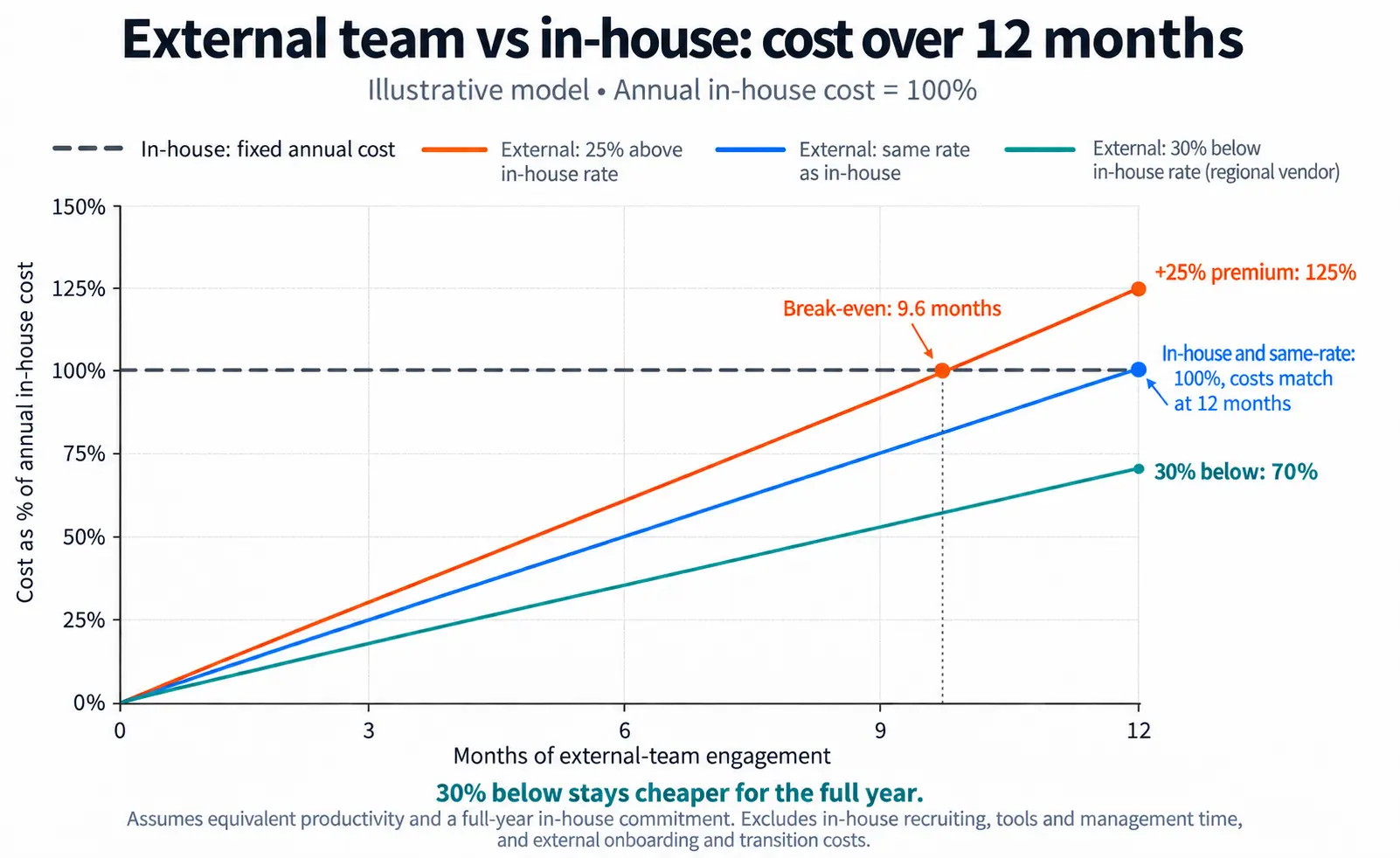
Cost grows in a straight line with team size under both models, so headcount changes the size of the gap, not where the lines cross. What moves the crossover is how many months you need the capacity and how the vendor’s rate compares with your loaded in-house cost.
For an illustrative US-based comparison, the Bureau of Labor Statistics reports a median annual software developer wage of $135,980 as of May 2025. This is a general software development benchmark, not an Unreal Engine-specific salary.
In June 2026, wages and salaries made up 68.5% of employer compensation costs for full-time private-industry workers, with benefits making up the other 31.5%. Dividing the median developer wage by 0.685 gives an estimated annual employer cost of about $198,511. That ratio is a cross-industry average, not one measured for game studios.
This is a modeling assumption rather than a published Unreal developer compensation figure. Actual costs will vary by seniority, location, benefits, recruitment expenses, and the roles required for the project.
The table prices the same ten developers at three vendor rates: a premium vendor at 25% above your loaded in-house cost, a vendor at parity, and a regional vendor 30% below. The 25% case is our assumption, not a published average or a Juego Studios quotation. The 30% case draws on the regional rate gaps in the breakdown of Unreal Engine budget tiers and regional rates [link: cost post], which compare developer pay, not vendor billing rates, so real quotes will land higher. Replace any of these with your own proposals.
| Vendor model | 6 months | 12 months | Cost-parity point |
| Premium vendor (+25%) | $1.24M | $2.48M | Costs match at 9.6 months |
| Vendor at parity (0%) | $0.99M | $1.99M | Costs match at 12 months |
| Regional vendor (30% below) | $0.69M | $1.39M | Cheaper even at 12 months; parity would be 17.1 months |
At a 25% premium, six months of partner time costs 62.5% of a full in-house year and twelve months costs 125%, so the costs match at 9.6 months (12 divided by 1.25). Need the capacity for less than that and the partner is cheaper. Need it year-round and in-house wins. At a 10% premium the crossover moves to 10.9 months, and at 50% it drops to eight. At parity the costs match at 12 months. Below parity the partner is cheaper even for a full year, so cost stops deciding and control, knowledge retention and IP take over.
These thresholds assume equivalent productivity, a full-year in-house employment commitment, and no additional transition or coordination costs. Studios should calculate their own break-even point using actual vendor proposals and staffing requirements.
The in-house estimates exclude additional project-specific expenses such as recruitment, software licenses, tools, and management overhead. External engagements can also involve onboarding, coordination, and handover costs. Regional compensation differences and the mix of seniority levels will affect both models, so these figures should be treated as a starting point rather than a project quotation.
How long until you have a playable build with each model?
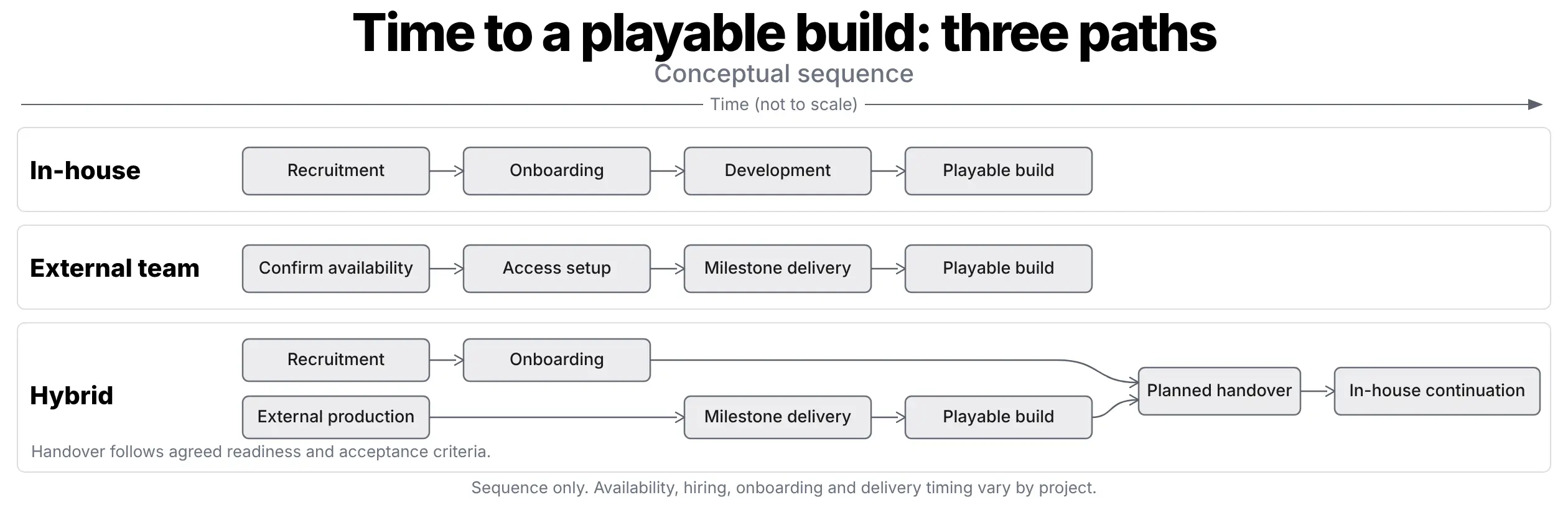
A partner reaches a first playable sooner because it skips hiring. The in-house clock only starts when your last key hire lands.
The hiring timeline
SHRM’s 2026 recruiting benchmarking data reports a median time-to-fill of 39 calendar days for nonexecutive positions, based on data from more than 4,600 organizations.
This figure covers roles across industries, not Unreal engineers specifically. SHRM’s public summary doesn’t say where the clock stops. If it ends at offer acceptance, the new hire’s notice period and onboarding come on top. Senior engine programmers will take longer than the median, so treat 39 days as a floor.
Hire the lead first, and the rest of the team waits on them, so two hiring rounds stack. Hiring in parallel shortens that, but onboarding, repository access, and pipeline familiarization still come after.
The partner timeline
The first weeks go on access, depot permissions, build setup and agreeing what “playable” means. Confirm the ramp-up in a paid pilot before you commit to the full engagement.
The hybrid path
A hybrid approach allows external production and permanent recruitment to run in parallel. For example, an external team could support vertical slice development while the in-house team recruits additional engineers. With shared code reviews, documentation, and a planned handover, permanent employees can gradually take ownership of the externally developed systems.
What breaks when you grow an in-house Unreal team?
If you’re working out how to scale an Unreal Engine team in-house, hire the roles that carry engine risk first. Expect it to break at the senior hiring bottleneck, at retention and at single points of failure.
What a production Unreal team looks like
Team structure varies by genre and platform, and roles change from prototype to live-ops. The table covers the Unreal-specific roles that decide whether a project stays on schedule. The balance between C++ and Blueprint also decides who you hire: engineers build core systems and performance-critical code, while designers and technical artists use Blueprint for gameplay and content.
| Role | What it owns | When dedicated support may be needed |
|---|---|---|
| Gameplay and C++ engineers | Core systems, tools, and the C++ layer that designers build on | From day one |
| Technical artist | The bridge between art and engine: materials, Niagara effects, and Nanite and Lumen setup | Once the content pipeline ramps |
| Rendering and performance specialist | Profiling, frame budgets, and optimization on target hardware | Before the vertical slice and again before console certification |
| Networking engineer | Replication, multiplayer architecture, and server behavior | Before any online feature is built |
| Build and Perforce engineer | Depot structure, CI, packaging, and access control | As soon as more than one team shares a depot |
| QA | Test plans, regression, and platform requirements | Throughout development, with dedicated coverage increasing as features and platform requirements expand. |
Where in-house scaling stalls
Experienced Unreal engineers are hard to hire because projects need C++, engine architecture, performance optimization, and production experience in the same person. Treat the 39-day median above as a floor for these roles.
Knowledge retention is another concern. When critical systems are understood by only one engineer, their departure can disrupt development. Shared documentation, code reviews, and cross-training help reduce this dependency.
What to keep in-house even when you outsource
Retain internal ownership of product direction and critical technical decisions, and build infrastructure. External teams can contribute to core gameplay and other important systems, provided responsibilities, documentation, access permissions, and handover requirements are clearly defined.
Perforce source control with an external Unreal team: how do you keep your IP safe?
Unreal Engine outsourcing Perforce source control setups come down to two questions: who owns the work, and who can access project files. IP ownership depends on the terms agreed upon in the contract, including which rights are assigned to the client and when that transfer takes effect. Day-to-day access is managed separately through source control permissions. Both should be agreed upon before development begins.
What the contract has to say
The agreement should specify which project deliverables are assigned to the client, when ownership transfers, and how pre-existing tools, licensed assets, and third-party components are handled. It should also define confidentiality obligations, permitted use of project materials, and the rights retained by each party. These terms should be reviewed and agreed upon before production begins.
How to set up Perforce for an outside team
Epic says it primarily uses Perforce, and many features in its guide to scaling an Unreal Engine team are built around Unreal’s Perforce integration. It also suits the assets: .uasset and .umap files are binary and cannot be merged with text-based tools, so Unreal checks them out to one person at a time.
With the appropriate Perforce typemap and locking configuration, teams can prevent conflicting edits to binary assets. External contributors should follow agreed checkout and lock-release practices so that one person’s unfinished work does not unnecessarily block other team members.
- Give external contributors individual user accounts within a dedicated vendor group. Configure Perforce permissions by user, group, and depot path, granting only the access required for assigned work. Review permissions periodically and revoke access when individual contributors leave the engagement.
- Set the typemap before anyone submits. Epic notes that the typemap controls which files are read-only or writable in Perforce, which keeps binary assets from being edited without a lock.
- Own the build pipeline. Keep CI, packaging credentials, and platform accounts in your hands, and give the partner build access, not ownership. Teams that run Git for code and Perforce for art need the two systems to stay in step, and keeping Perforce and Git pipelines aligned covers how.
Which Unreal tools help an outside team get productive faster?
- Unreal Game Sync (UGS). A client that connects Perforce, Unreal Build Tool and your IDE so people can download or compile working builds. Without an IDE, a new contributor can download a build with pre-built binaries instead of compiling the source.
- Installed builds. If you have forked and customized the engine, you can package it as an installed build (an offline installer), so the partner works on the same engine you ship on.
- C++ modules. Organizing code into modules means only the module being edited recompiles, which keeps iteration fast as the codebase and team grow.
- Automated builds with UAT, BuildGraph and Horde. UAT packages builds from any command line, BuildGraph defines more detailed automated build systems, and Horde is a CI suite built on BuildGraph that monitors build health and provides logs and analytics. Together they let you give the partner build access without handing over the pipeline.
Offboarding
Remove the vendor’s group the day the engagement ends, rotate any shared credentials, confirm the last submitted changelist, and collect the handover documentation. Do this on a checklist, not from memory.
What should you look for in an external Unreal Engine partner?
For this decision, three things matter more than a rate card: whether the partner works inside your depot, whether handover is built in, and whether the team you meet is the team you get. The full vetting checklist is covered in judging Unreal studios on shipped projects, optimization, and post-launch support.
- Works inside your depot. They accept your Perforce permissions, lock etiquette, and build pipeline instead of asking you to move work onto theirs.
- Handover built in. Code review into your team, written decisions, and a handover sprint are in the contract from the start.
- Team stability. The people you meet in the pitch are the people on your build, with named leads and terms for any replacement.
- A paid pilot. Agree a limited, representative scope with measurable acceptance criteria before you expand the engagement.
If you are mid-project on UE4, ask whether they have done the move. The migration timing and effort for UE4 to UE5 is a real cost.
Red flags: a quote without a scope, resistance to working in your depot, and staff swapped out after kickoff. The common partner-selection mistakes go deeper.
Which model fits your studio's size and stage?
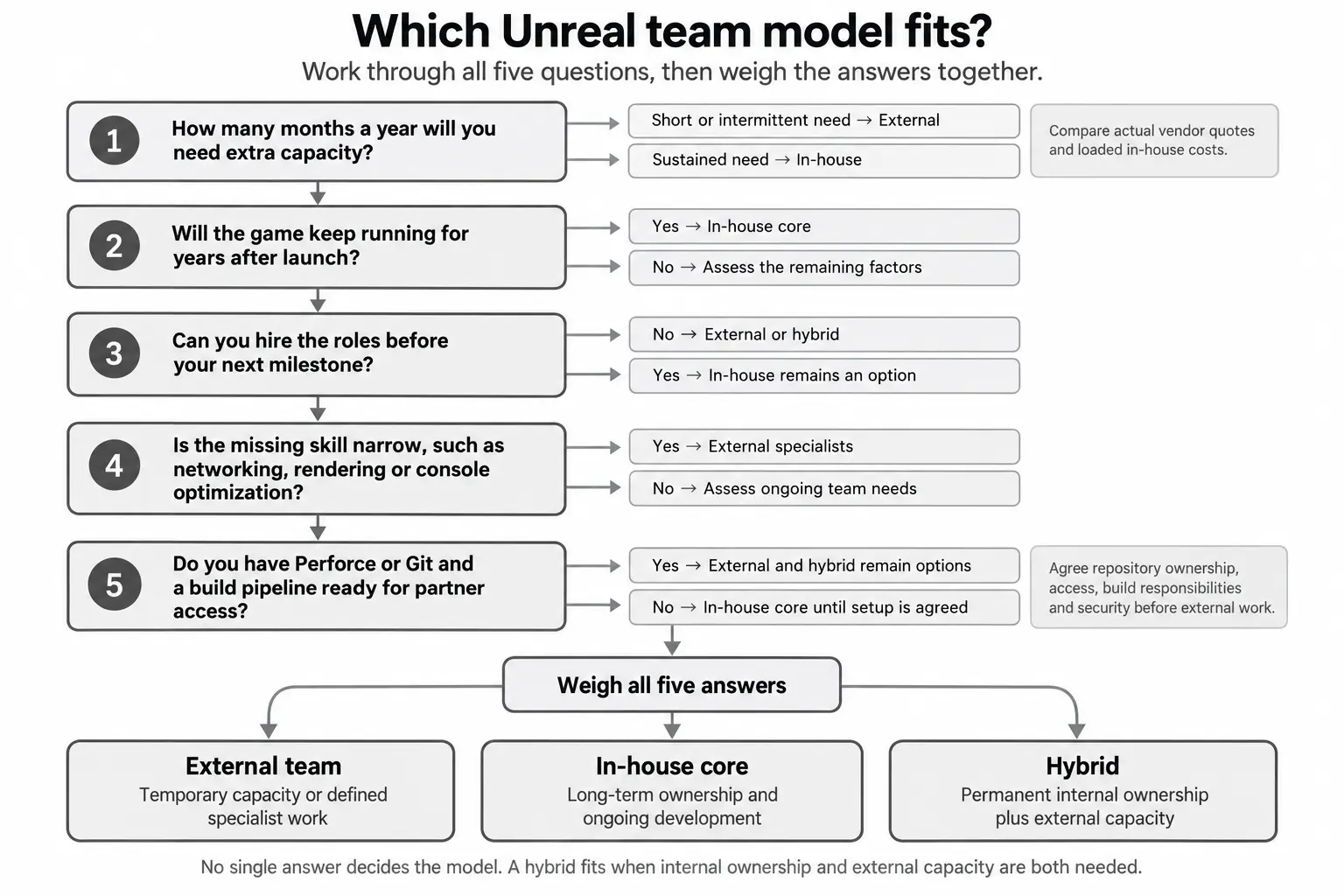
Use the following five questions to assess which model best fits your production requirements. If your answers point toward both long-term internal ownership and temporary external capacity, consider a hybrid approach.
- How many months a year will you need the extra capacity? Under roughly 10 months points to an external team when vendor rates run above your in-house cost. Beyond that, hiring wins. Check the cutoff against real vendor quotes.
- Will the game keep running for years after launch? Yes points to an in-house core, because the knowledge compounds.
- Can you hire the roles you need before your next milestone? No points to an external team or a hybrid.
- Is the missing skill narrow, like networking, rendering, or console optimization? Yes points to external specialists for a defined stretch.
- Do you already run Perforce or Git and a build pipeline you can give a partner access to? Yes keeps external and hybrid on the table. No means agree on repository ownership, access permissions, build responsibilities, and security requirements first. Until then, an in-house core is the lower-risk choice.
AA and AAA studios
At a larger scale, production pressure can emerge through capacity spikes, specialist gaps, and parallel workstreams. A hybrid approach allows studios to retain internal production leadership while assigning defined workstreams or specialist responsibilities to external partners.
Funded indie teams
For a first Unreal project, the risk is a small core stretched across too many roles. A partner for the vertical slice and for one or two specialist problems can keep a small team from hiring ahead of its funding. If you decide to bring in embedded Unreal engineers, the engagement can run inside your own depot and tracker.
A worked example
Here is an illustrative scenario, not a client case. A six-person indie studio is building a co-op survival game in Unreal Engine 5. Its team covers design, gameplay engineering, technical art and production. To reach its next milestone it needs six more developers for about eight months. Assume each added role costs the same $198,511 a year used in the cost model above.
- All in-house: Six hires carried for a full year cost about $1.19M. That buys four months beyond the milestone, and the hires and what they have learned stay for the next one. If there is no follow-on work, those four months (about $0.40M) are idle cost. Releasing the hires at month eight would bring in-house to about $0.79M, below the partner, before recruiting, severance, and ramp-up.
- External team: Engaging six equivalent developers for eight months at the assumed 25% premium would cost approximately $971,286. This is around $194,257 less than the full-year in-house scenario, excluding transition and coordination costs.
- Hybrid: The studio could retain permanent ownership of gameplay architecture and production while using external developers for defined milestones. Selected responsibilities could then transition to permanent employees as the project progresses.
The result turns on one assumption, whether the hires have follow-on work. Actual staffing costs also vary with seniority, location, and commercial terms.
Conclusion: Choose the Model That Fits Your Production Needs
The decision between an external Unreal team and an in-house team depends on more than headcount. Production timelines, specialist requirements, long-term knowledge retention, and the cost of maintaining capacity all influence which approach makes sense.
An external team can help address temporary capacity gaps or specialist requirements. An in-house team offers continuity when engine knowledge and ongoing development are central to the project. A hybrid approach can combine both, provided responsibilities and handover expectations are clear.
Before committing, compare actual costs, confirm delivery responsibilities, and establish contractual IP ownership and source control access.
Juego Studios’ Unreal production team can help assess your project requirements and identify an engagement model that fits your development roadmap.
Frequently Asked Questions
It depends on the duration of the engagement, the roles required, and the commercial terms. In the illustrative model used in this article, an external team charging a 25% premium over estimated loaded in-house costs reaches break-even at 9.6 months. Actual costs should account for recruitment, onboarding, productivity, coordination, and transition expenses.
Team size is not the trigger. Months of need is. If you need the role for steady work beyond the break-even point (roughly 8 to 11 months a year in our model, 9.6 at a 25% vendor premium), hiring usually wins. For shorter or uneven needs, an external team usually wins. If a vendor’s rate matches or beats your in-house cost, cost will not decide it and control and knowledge retention will.
Yes, and it’s the safer setup. Give the vendor its own user group, grant write access only on the paths they work in, set the typemap before anyone submits, and agree on lock etiquette for binary assets. You keep sources, history, and credentials in your own depot.
IP ownership depends on the terms agreed upon in the outsourcing contract. The agreement should clearly define ownership of newly developed code and assets, the timing of any rights transfer, and how pre-existing or third-party components are handled. Keeping source code in a client-controlled repository provides operational control but does not independently establish legal ownership.
Yes, if you plan for it from week one. Require code review into your own team, keep decisions in writing, work in your own depot and schedule a handover sprint before the contract ends. The hybrid model builds that handover into the engagement.
Scope and milestones with acceptance criteria, IP assignment, NDA and access terms, key-person and team continuity, engineering standards (code review, the C++ and Blueprint boundary, build practice), QA and certification responsibilities, and exit and handover terms. Add a rate-change clause so a long engagement doesn’t drift.
A dedicated Unreal team is a group of engineers and artists assigned to your project for a set term, working to your milestones and inside your tools. It makes sense when you need the capacity for several months or more, the work is ongoing rather than one deliverable, and you want one stable team to build up knowledge of your codebase. For a short, well-scoped task, a fixed-scope engagement usually costs less. Juego Studios offers this as a dedicated Unreal team.
Related Posts

External Unreal Team vs In-House: Which Model Fits Your Project?
Your Unreal project needs more hands than you have, and the question is whether to build that capacity yourself or bring in an external Unreal team. The Unreal Engine outsourcing vs in-house team decision comes down to three things: how long you need the capacity, how fast you need it, and how much control you need to retain.

How to Compare Unreal Engine Studios: A 2026 Evaluation Guide
Unreal Engine is easy to name in a pitch deck and much harder to manage in production. The engine can carry high-fidelity visuals, multiplayer systems, large environments, cinematic lighting, and console-first releases. But those same strengths create pressure on performance, memory, build pipelines, QA, and platform readiness.

Unreal Engine Cost in 2026: A Studio’s Full Budget Breakdown
In 2026, Unreal Engine 5 remains the gold standard for modern game production, uniting design, engineering, and deployment into one seamless ecosystem.