


 Unity
Unity Unreal
 Godot
Godot
 Mobile
 PC
PC Console
 Full-Cycle
 Co-Development
 Outstaffing






-
 Unreal Game Development
 Sep 10th, 2026
- Share:
Table of Contents
- TL;DR
- How Much Does It Really Cost to Use Unreal Engine 5?
- What Does an Unreal Engine License Cost Beyond the Royalty?
- How Much Does It Cost to Build a Game in Unreal Engine 5?
- What Actually Moves Unreal Engine Development Cost Up or Down?
- What Do Unreal Engine Developers Cost, Region by Region?
- What's Hidden in a Typical Unreal Project Quote?
- How Do You Choose an Unreal Partner Without Overpaying?
- How Do You Keep Unreal Engine Costs Down Without Cutting Corners?
- Does Unreal Engine 6 Change Your Budget Right Now?
- Conclusion: The Royalty Is the Smallest Line Item
If you’re scoping a build in Unreal Engine 5, or vetting a studio that’s already committed to it, the real Unreal Engine cost question isn’t the licensing fine print; that part’s simple. Epic’s royalty structure is easy to state and easy to misjudge in a real budget: free until $1 million in revenue, 5% after that, with a couple of exceptions worth knowing before you sign a contract or set a milestone budget. The harder question is what it actually costs to ship in the engine, once team, region, and platform choices enter the picture, and where that number quietly doubles once QA, live ops, and marketing show up. Here’s the full picture, not just the royalty line.
TL;DR
- Unreal Engine itself costs nothing until your project clears $1 million in lifetime gross revenue. After that, Epic takes a 5% royalty, and only on the revenue above that line, not the whole amount.
- Non-game commercial work (archviz, training sims, film) needs a $1,850-per-seat annual subscription, but only once your company itself clears $1 million in annual revenue. Below that, it’s free too.
- Total Unreal game development cost still runs from roughly $15,000 for a small indie build to $100 million or more for a true AAA production. The royalty is almost never the biggest line item.
- Launch day-and-date on the Epic Games Store and your royalty drops to 3.5% instead of 5%. Sell exclusively through EGS and it’s royalty-free.
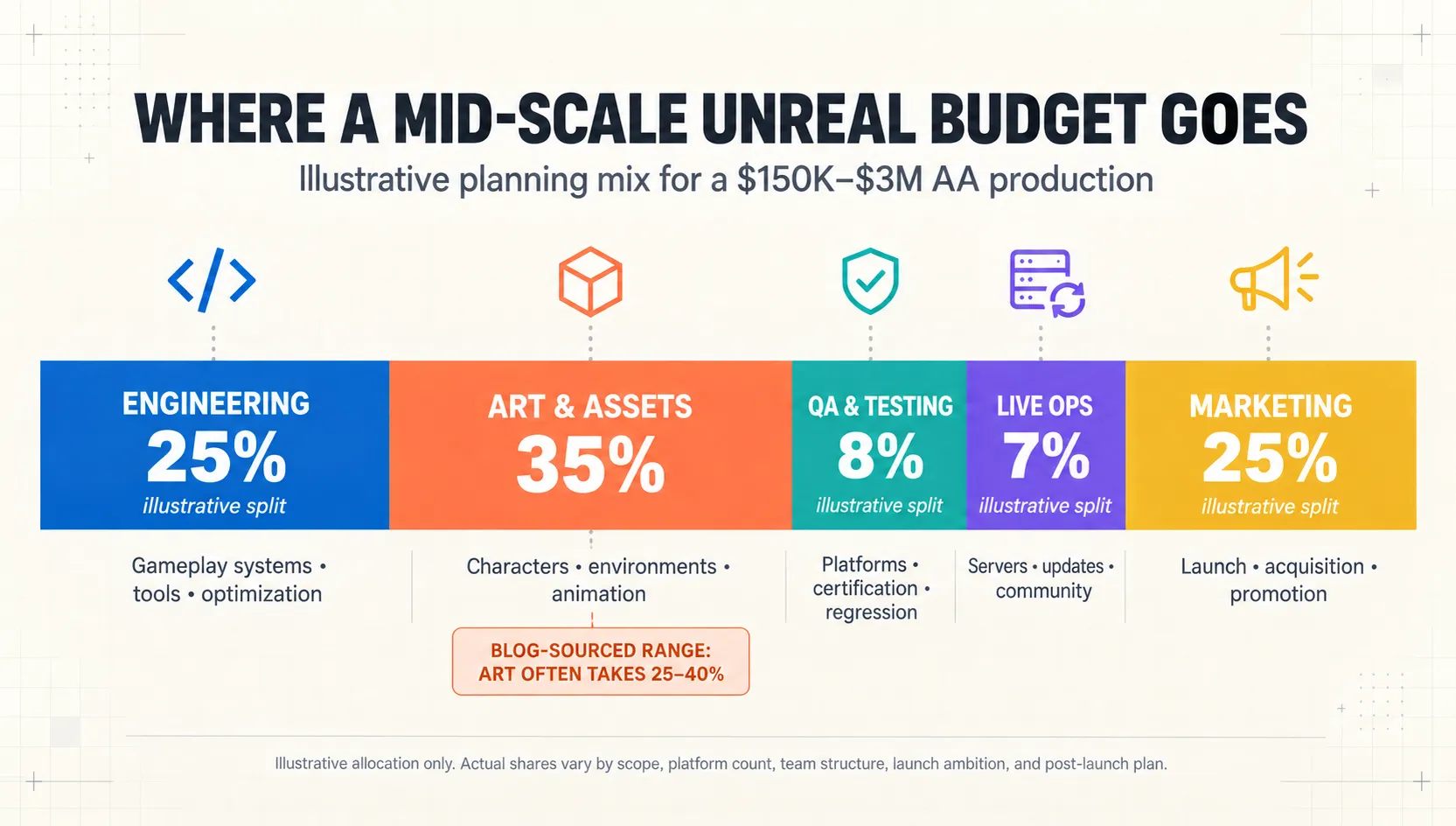
- Developer time drives most budgets, not licensing. Expect roughly $40 to $70 an hour for a mid-to-senior Unreal developer in the US, with art and asset production alone often eating 25 to 40% of total spend.
- Unreal Engine 6 is still in development, Epic’s own target is early access by late 2027, so it shouldn’t change your 2026 budget. Worth knowing before you commit to a multi-year plan, though.
How Much Does It Really Cost to Use Unreal Engine 5?
Unreal Engine 5 costs nothing to download, build with, and ship until your project has earned $1 million in lifetime gross revenue. Past that threshold, Epic takes a 5% royalty on revenue above the $1 million line only, confirmed directly in Epic’s own licensing terms. There’s no upfront fee, no seat cost for the game engine itself, and full source code access from day one.
The 5% Royalty, and When It Doesn’t Apply
The royalty only applies to revenue directly attributable to the Unreal-built product, and Epic has carved out two exceptions that change the real Unreal Engine costs for a lot of studios:
- Sell exclusively through the Epic Games Store, and that revenue is royalty-free, per Epic’s licensing page.
- Launch day-and-date (or earlier) on EGS alongside other storefronts under Epic’s “Launch Everywhere with Epic” program, and the royalty drops to 3.5% instead of 5%, effective since January 1, 2025, per CG Channel’s reporting on the change. iOS titles are temporarily excused from the day-and-date requirement because of Apple’s distribution rules, but that exemption cuts the other way on cost: without a day-and-date EGS launch, iOS titles still pay the standard 5% royalty, not the reduced 3.5%.
For a project doing real revenue above $1 million, that’s a genuine budget lever, worth a line in your release-planning deck, not just a footnote in the licensing agreement.
The Engine Royalty Isn’t the Only Cut You’ll Pay
Epic’s royalty and your storefront’s revenue share are two separate deductions, and budgeting for one while forgetting the other is a common way Unreal Engine costs get underestimated. Steam takes 30% of revenue as a base rate, dropping to 25% once a title clears $10 million in lifetime sales and 20% past $50 million, a tiered structure Valve introduced in 2018 and which remains unchanged going into 2026. Console platforms take a comparable cut, though the exact terms are typically negotiated per publishing agreement and not published the way Steam’s are.
Stack that against Epic’s 5% (or 3.5%, or zero, depending on your storefront choices from the section above), and the two percentages add up fast on a title doing real revenue. Neither one is optional, and neither replaces the other.
What Does an Unreal Engine License Cost Beyond the Royalty?
For most game studios, there’s no separate license fee. The royalty above is the whole story. The Unreal Engine license cost that actually trips people up applies to non-game commercial work, architectural visualization, training simulations, film and broadcast, and that kind of thing.
If that’s your use case, the Unreal subscription runs $1,850 per seat, per year, but only once your company clears $1 million in annual gross revenue and doesn’t create games or license Unreal-based applications to third parties. Below that revenue threshold, non-game use stays free, the same as game development, confirmed in Epic’s own pricing update. A lot of the cost guides floating around state the $1,850 figure without that threshold, which makes it read as universal when it isn’t.
One more thing that changed recently: as of May 27, 2026, Twinmotion and RealityScan are no longer bundled into that seat subscription. They’re priced separately now, Twinmotion at $445 per year and RealityScan at $1,250 per year (the old pay-per-input model is gone), and both carry the same $1 million annual revenue threshold as the seat license itself, free below that line, same as everything else in this section. If your budget assumed those tools came free with the seat license, rebuild that line item.
Is an Unreal Engine Certification Worth the Cost?
Not as a hiring requirement, no. Epic’s own credential, the Epic Games Game Design Professional Certificate on Coursera, runs $49 a month, and most learners finish it in under six months of part-time study, so the Unreal Engine certification cost typically lands under $300 total. That’s a reasonable ask for someone entering the field. It’s a much weaker signal once you’re evaluating a mid- or senior-hire.
A certificate proves someone worked through Epic’s curriculum. It doesn’t replace shipped credits or a portfolio that survives a technical interview. If a candidate has one, treat it as a tie-breaker between two otherwise-equal resumes, not a qualifying filter, and don’t pay a premium for it on a rate card.
How Much Does It Cost to Build a Game in Unreal Engine 5?
It depends almost entirely on scope, not on the engine. Here are the wide market ranges reported across three tiers of Unreal game development cost, compiled from public industry cost breakdowns rather than any single studio’s internal numbers:
| Tier | Team size | Timeline | Typical budget |
| Indie / prototype | 3–8 people | 6–14 months | $15,000 – $150,000 |
| Mid-scale (AA) | 10–30 people | 1–2 years | $150,000 – $3,000,000 |
| Enterprise AAA | 50–200+ people | 2–5+ years | $5,000,000 – $100,000,000+ |
These ranges are broad by design. They reflect what’s commonly reported across public game-development cost guides and industry surveys, not an audited figure from any one studio, and actual cost on a given project can land outside them depending on scope, region, and team structure. Treat them as a starting point for a conversation, not a quote.
That AAA ceiling isn’t hypothetical. When Immortals of Aveum’s development costs became public, a former developer put the build itself at roughly $85 million, with total spend (marketing included) reportedly closer to $125 million. Neither figure has been officially confirmed by EA or Ascendant Studios, but the gap between the two numbers is the real lesson here: on a true AAA Unreal production, marketing and launch spend can rival the development budget itself, not trail it by a small margin.
Why “Free to Start” Isn’t “Cheap to Finish”
Every tier above assumes a working team and a real production plan. The engine’s free entry point has nothing to do with how much it costs to staff, art, test, and ship a game in it, and that gap is where most first-time Unreal game development budgets go wrong.
Want a number tied to your actual scope instead of a market tier?
Juego Studios can walk your project against real ranges before you commit to a budget.
What Actually Moves Unreal Engine Development Cost Up or Down?
Four variables explain most of the spread inside each tier above:
- Project scope and complexity. Open-world systems, multiplayer netcode, and procedural content all add engineering time that a linear single-player build doesn’t need.
- Team structure and experience. Senior Unreal developers cost more per hour and finish faster; junior-heavy teams cost less per hour and often take longer to hit the same bar, which can net out close to even.
- Platform count. Every additional platform (mobile, PC, and each console) adds its own optimization, certification, and QA pass. Budget per platform, not once for the whole project.
- Visual fidelity. Photoreal work built on Nanite and Lumen is asset- and lighting-heavy; a deliberately stylized art direction can hit a strong bar for a fraction of the cost.
Team structure has a second-order cost, too: whether your gameplay logic leans on Blueprints or hand-rolled C++ changes both iteration speed and long-term maintenance cost, and it’s worth deciding deliberately rather than defaulting to whatever the first hire happens to prefer.
What Do Console Certification and Dev Kits Actually Cost?
More than most first-time console teams budget for, and it’s rarely a one-time expense. Physical dev kits alone vary widely by platform: Xbox raised its dev kit price from $1,500 to $2,000 in October 2025, citing “macroeconomic developments,” as reported by Pure Xbox. PlayStation and Nintendo run their own kit and approval programs with their own terms, and none of the three publish a simple price sheet.
On top of the hardware, every console submission goes through a first-party certification pass (Microsoft’s and Sony’s technical requirements checklists, Nintendo’s Lotcheck), and a failed pass means resubmitting, which costs schedule time even when it doesn’t cost a resubmission fee outright. Budget certification as a recurring cost tied to your platform count and your patch cadence, not a single line item you clear once at launch.
What Do Unreal Engine Developers Cost, Region by Region?
In the United States, the market data is fairly tight. Here’s how Unreal Engine developer costs typically break down by region:
| Region | Typical salary-equivalent rate | Basis |
| United States | Roughly $40–$70/hr, averaging about $53/hr | ZipRecruiter, Glassdoor |
| Eastern Europe & Latin America | Roughly 30–50% below US rates | Commonly reported across public salary aggregators |
| India & Southeast Asia | Typically the lowest of the major outsourcing regions, often less than half the US rate | Commonly reported across public salary aggregators |
The US figures are tied to specific, current sources. The regional comparisons are directional, reflecting a pattern widely reported across public salary aggregators and industry rate guides rather than one single verified study, and can shift significantly based on seniority, specialization, and engagement model (freelance vs. dedicated vs. outsourced team). Treat them as a planning range, not a quote. One more distinction worth making: these are salary-equivalent figures, not studio billing rates. Billing rates fold in overhead, non-billable time, PM, QA, and margin, which is why they don’t reconcile 1:1 with a salary-derived number, and why an actual US studio quote runs materially above this range.
The rate itself is only part of the comparison. Whether that hourly number sits inside a freelance, dedicated, or fully outsourced engagement model changes what you’re actually paying for, project management, QA coverage, and continuity included or billed separately.
Get a quote that already prices in art, QA, and live ops instead of finding the gaps mid-production. Talk to Juego Studios about your scope.
How Do You Choose an Unreal Partner Without Overpaying?
Three checks catch most of the expensive mistakes before a contract is signed:
- Portfolio and technical depth. Ask for Unreal-specific work, not general 3D work relabeled. Nanite, Lumen, and multiplayer replication are different skill sets from generic engine experience.
- What’s actually in the quote. Two quotes at the same headline rate can cover very different scopes, get QA, iteration rounds, and post-launch support written down, not implied.
- Communication cadence. A studio that won’t commit to a specific build and review cadence before signing usually won’t hold to one after.
The studios that keep Unreal budgets honest tend to be the ones running full production in-house rather than subcontracting piecemeal, since every extra hand-off between vendors is another place scope and cost can drift without anyone owning the gap.
How Do You Keep Unreal Engine Costs Down Without Cutting Corners?
- Use Marketplace assets and Blueprints for non-critical systems. Save custom engineering for the mechanics that actually differentiate the game.
- Prototype before you commit to full production. A rough Blueprint prototype answers “is this fun” far cheaper than finding out mid-production.
- Scope to an MVP and resist feature creep. Every added system after scope lock adds QA and integration cost on top of its own build time.
- Outsource specialized modules deliberately. Hand off niche work, like a specific tools pipeline or a co-development partnership for a full production slice, rather than stretching a generalist in-house team across everything.
Does Unreal Engine 6 Change Your Budget Right Now?
No, not yet. Epic confirmed at State of Unreal 2026 that UE6 is still in development, with an early access target of late 2027, built around Verse as the primary gameplay-programming model, cross-project content portability, and built-in AI tooling (including Model Context Protocol integrations). None of that affects a project shipping on Unreal Engine 5 today.
What’s already shipped and relevant now: Unreal Engine 5.8 is the current release, with Lumen running at 60fps on Nintendo Switch 2 among its headline improvements, and Epic released Lore, a free, open-source version control system built for large binary game assets, in 2026. Epic has also called 5.8 the last planned major UE5 release, holding 5.9 open only as an option, so if you’re planning a multi-year build, the next real engine decision on your roadmap is UE6, not another UE5 feature cycle. For any team wrestling with Perforce licensing costs on a growing asset library, Lore is worth a look on its own merits, separate from anything UE6-related.
If your studio migrated off Unreal Engine 4 in the last couple of years, you’ve already been through one engine-version cost recalculation, and the UE4-to-UE5 migration decision is a reasonable preview of what a future UE6 move will eventually require: re-benchmark, don’t assume drop-in compatibility, and budget the transition as its own line item when it’s actually time.
If your studio migrated off Unreal Engine 4 in the last couple of years, you’ve already been through one engine-version cost recalculation, and the UE4-to-UE5 migration decision is a reasonable preview of what a future UE6 move will eventually require: re-benchmark, don’t assume drop-in compatibility, and budget the transition as its own line item when it’s actually time.
Conclusion: The Royalty Is the Smallest Line Item
Unreal Engine’s licensing terms are genuinely simple once you’ve seen them laid out: free until $1 million in revenue, 5% after that (3.5% or zero with the right storefront choice), and a separate $1,850 seat fee only for non-game commercial work above the same revenue line. None of that is where an Unreal budget actually gets built or blown. Team, art production, platform count, and everything that happens after ship, QA, live ops, and marketing decide the real number.
If you’re scoping a build and want a second read on where your numbers land, Juego Studios runs full-cycle Unreal Engine production and can walk through a realistic budget against your actual scope, not a generic tier.
Frequently Asked Questions
Nothing, until your project earns $1 million in lifetime gross revenue. After that, Epic takes a 5% royalty on revenue above that threshold, dropping to 3.5% for games launched day-and-date on the Epic Games Store, or 0% for EGS-exclusive titles.
Yes, for development, full source access, and shipping, up to $1 million in lifetime revenue. It stays free indefinitely for students, educators, and hobbyists regardless of revenue.
$1,850 per seat per year, but only for companies doing non-game commercial work (archviz, film, training sims) that clears $1 million in annual revenue. Below that threshold, it’s free. Twinmotion and RealityScan are priced separately since May 2026, at $445 and $1,250 per year, respectively.
Licensing aside, total unreal game development cost runs from about $15,000 for a small indie title to $100 million or more for a full AAA production, driven by team size, platform count, and visual fidelity, not the engine’s royalty terms.
Epic’s own credential is the Epic Games Game Design Professional Certificate on Coursera, priced at $49 a month, typically under $300 total to complete. It’s a reasonable signal for an entry-level candidate, not a requirement for hiring an experienced Unreal developer.
Related Posts

External Unreal Team vs In-House: Which Model Fits Your Project?
Your Unreal project needs more hands than you have, and the question is whether to build that capacity yourself or bring in an external Unreal team. The Unreal Engine outsourcing vs in-house team decision comes down to three things: how long you need the capacity, how fast you need it, and how much control you need to retain.

How to Compare Unreal Engine Studios: A 2026 Evaluation Guide
Unreal Engine is easy to name in a pitch deck and much harder to manage in production. The engine can carry high-fidelity visuals, multiplayer systems, large environments, cinematic lighting, and console-first releases. But those same strengths create pressure on performance, memory, build pipelines, QA, and platform readiness.

Unreal Engine Cost in 2026: A Studio’s Full Budget Breakdown
In 2026, Unreal Engine 5 remains the gold standard for modern game production, uniting design, engineering, and deployment into one seamless ecosystem.