


 Unity
Unity Unreal
 Godot
Godot
 Mobile
 PC
PC Console
 Full-Cycle
 Co-Development
 Outstaffing





-
 Gaming Industry
 Apr 1st, 2026
- Share:
Table of Contents
- Introduction
- TL;DR — Key Takeaways
- How Big Is the Gaming Industry in Ireland?
- Why Irish Studios Are Trusted for Global Game Development
- Major Studios & Key Players in the Irish Game Industry
- Ireland's Digital Games Tax Credit: The Policy Engine Behind the Growth
- Challenges Facing the Irish Gaming Industry
- The Future Outlook
- Strategic Recommendations for the Sector
- Conclusion
Ireland has quietly become one of Europe’s most exciting gaming destinations — and most people outside the industry still don’t know it.
Modern Irish gaming reality is that 66% of the gaming population is over the age of 35, and nearly half are female. Ireland now holds the third-highest video game penetration rate in Europe and the seventh-highest globally. As of early 2026, the gaming industry in Ireland is generating over €700 million annually, employing thousands of developers, artists, and engineers, and a deliberate decade-long alignment between government policy, fiscal incentives, and a burgeoning creative class is what made it happen. This is not a coincidence. It is a strategy. And it is working.
Introduction
The Republic of Ireland stands at the vanguard of a digital entertainment revolution. What began as a cluster of multinational tech companies setting up European headquarters has evolved into something far more ambitious: a world-class Irish gaming industry defined by original intellectual property, high-end AAA co-development, and a sophisticated service layer spanning art production, cybersecurity, and localisation.
The introduction of the Digital Games Tax Credit (DGTC) in 2022 marked a pivotal moment in this evolution, placing Ireland in direct competition with established gaming jurisdictions like Canada and the United Kingdom. Yet as the sector matures, it faces a complex set of macroeconomic pressures — from a housing crisis threatening talent retention to a competitive global labour market demanding greater international visibility.
At Juego Studios, we work at the intersection of global game development and the kind of creative, technical depth that ecosystems like Ireland’s are increasingly producing. Understanding this market matters to us — and it should matter to anyone building, investing in, or partnering with studios across Europe. This blog breaks down where the Irish game industry stands in 2026, who the key players are, what is driving growth, and what the road ahead looks like through 2027.
TL;DR — Key Takeaways
- Ireland’s gaming market is generating over €700 million in 2025 and is projected to reach €813 million by 2027.
- Juego Studios brings global-standard game development expertise to the kind of ecosystem Ireland is actively building — bridging creative ambition with production-ready capability.
- A dedicated Digital Games Tax Credit (DGTC) offers up to 32% relief on qualifying development costs, making Ireland one of Europe’s most incentivised development destinations.
- Mobile gaming dominates current revenue, while cloud gaming, AR/VR, and the metaverse represent the next frontier.
- 53% of the Irish population currently plays video games, with the average gamer spending 19 hours per week playing, more than the time spent watching traditional TV.
- Structural challenges — including housing costs, below-market developer salaries, and limited global trade show presence — remain the sector’s most pressing headwinds.
- Ireland’s indie studio pipeline is growing fast, with regional funds like IndieDev 2025 backing original IP development outside of Dublin.
How Big Is the Gaming Industry in Ireland?
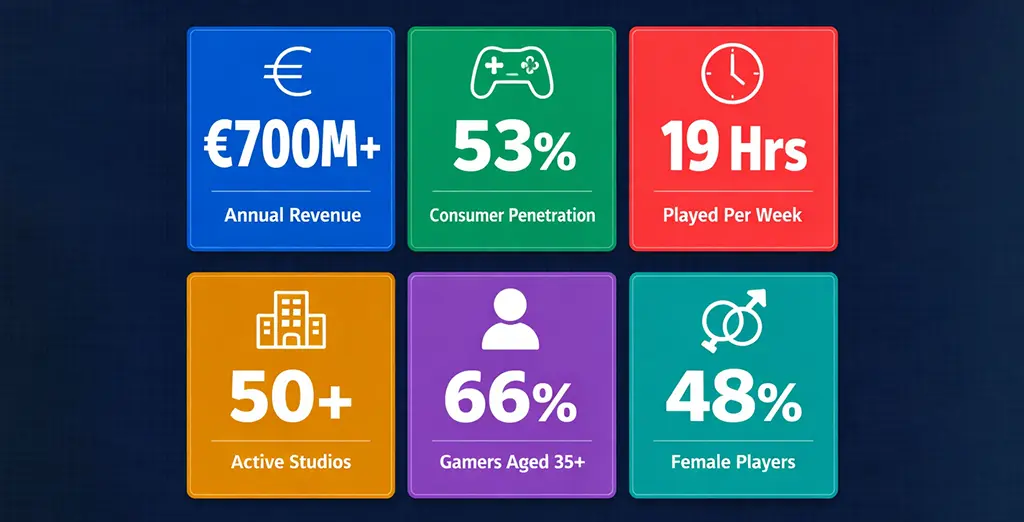
Industry projections of the gaming industry in Ireland place the total market valuation at approximately €813.19 million by 2027, reflecting a trajectory driven by cloud gaming adoption, mobile expansion, and a consumer base with high disposable income and deep engagement habits.
To put this in perspective: Ireland, with a population of just over 5 million, holds a 53% consumer penetration rate in gaming — among the highest in the world. The average Irish gamer plays 19 hours per week, exceeding the time spent watching traditional television. These are not casual numbers. They signal a market with embedded, habitual engagement that studios and publishers can build sustainable businesses around.
| Economic Indicator | 2025 Estimate | 2027 Projection | Key Growth Catalyst |
| Video Game Market Revenue | > €700 Million | €813.19 Million | Cloud Gaming / 5G Adoption |
| Consumer Penetration Rate | 53% | > 55% | Mobile & Casual Gaming |
| Avg. Weekly Engagement | 19 Hours | 20+ Hours | Social & Mental Health Gaming |
| Total Gambling Revenue | €2.5 Billion | Continued growth | GRAI Regulation |
The Irish Gamer: Who They Actually Are
One of the most commercially significant insights about the video game industry in Ireland is the demographic profile of the Irish gamer — and it dismantles almost every cliché. Only 34% of gamers are under 35. The 35–44 age group represents the highest concentration at 27%, and 48% of players are female. These are consumers with mortgages, cars, and discretionary income — approximately 73% of Irish gamers own cars, and 26% are homeowners with mortgages.
| Demographic Segment | Statistic | Industry Implication |
| Over 35 Years Old | 66% of adult gamers | Demand for complex, narrative-driven titles |
| Female Players | 48% of the gaming population | Growing market for diverse genres and themes |
| 35–44 Age Group | 27% (highest concentration) | High disposable income and parenting influence |
| Weekly Time Spent | 19 Hours | Exceeds time spent watching traditional TV |
| Mental Health Gaming | 35% play to relax/manage stress | Rising demand for “cozy” and co-op titles |
The demand is shifting toward complex, narrative-driven experiences, cooperative multiplayer titles, and “cozy” games. 35% of Irish adults play games specifically to support their mental health — a trend that creates real opportunity for studios building calm, community-oriented, and simulation titles. Gaming in Ireland is also deeply social: players connect via in-person chat (23%), messaging apps (22%), and voice apps (13%) — making word-of-mouth and community-led marketing exceptionally powerful in this market.
Mobile, Console & Cloud: Segment Breakdown
Mobile gaming remains the dominant segment within the Irish gaming industry, driven by smartphone penetration and the accessibility of free-to-play models. Console gaming maintains strong engagement among the 18–35 bracket, with Xbox Game Pass and PlayStation Plus subscriptions performing particularly well.
Cloud gaming, while still in its early phase in Ireland, is poised for rapid expansion. The 5G rollout now underway across Ireland is removing the hardware barriers that previously locked high-fidelity gaming behind expensive consoles. With AWS, Google, and Microsoft all operating major data centres on Irish soil, the latency and bandwidth infrastructure cloud gaming requires is — uniquely — already in place. This positions Ireland as one of the most cloud-gaming-ready markets in Europe as we move through 2026.
iGaming: A Parallel High-Value Sector
The distinction between traditional video games and iGaming (gambling) is important for a complete market picture. Ireland’s iGaming sector is exceptionally robust, fuelled by a deeply embedded gambling culture and major regulatory shifts with the establishment of the Gambling Regulatory Authority of Ireland (GRAI) in 2025. Total gambling revenue is projected to reach €2.5 billion, with online casinos and sports betting accounting for approximately €1.17 billion of that figure.
Crossovers between iGaming and traditional gaming — through esports betting and loot-box monetisation models — are growing, though EU-wide regulatory scrutiny is increasing. Irish studios will need to navigate this carefully as Brussels moves toward more standardised rules on monetisation transparency.
Why Irish Studios Are Trusted for Global Game Development
One of the most telling indicators of a healthy game development ecosystem is not simply how many studios exist, but how much the global industry trusts those studios with demanding, high-value projects. By that measure, the gaming industry in Ireland is building serious credibility — and the reasons are structural, not incidental.
English-Language Proficiency & Cultural Fluency
Ireland’s native English-language environment is an operational advantage that is easy to underestimate. For international publishers and development partners, engaging an Irish studio means frictionless communication, no translation overhead in documentation or design briefs, and cultural familiarity with the Western markets that generate the bulk of global gaming revenue.
When publishers need to hire a video game developer who can collaborate seamlessly with North American or UK teams — navigating creative briefs, milestone reviews, and publisher feedback without friction — Ireland is a natural and low-risk choice.
Deep Roots in the Global Tech Ecosystem
Ireland is not a gaming island. It is embedded within one of the world’s densest concentrations of technology companies. The presence of Google, Meta, Apple, Amazon, and Microsoft has cultivated a talent environment where software engineering, UX, data infrastructure, and digital product development are deeply embedded in workforce culture. Game studios benefit directly — through talent pipelines, technology partnerships, and shared infrastructure — from decades of multinational tech investment.
QA, Localisation & Production Depth
Irish operations have long been trusted with the precision-critical work of quality assurance and localisation for major global titles. That trust has expanded into broader development roles — Irish teams are now involved in concept development, technical direction, and full production management on projects that reach global audiences. For any mobile game app development company or publisher evaluating where to anchor European production, Ireland’s track record translates directly into reduced delivery risk and proven on-spec output.
Strong IP Protections & Regulatory Stability
Ireland operates under EU law, providing robust intellectual property protections aligned with the standards expected by international publishers and institutional investors. For studios entering co-development or licensing arrangements, this legal environment reduces risk and provides confidence that IP will be properly protected throughout the development lifecycle — a material consideration for any international studio evaluating European development partners in 2026.
Major Studios & Key Players in the Irish Game Industry
Ireland hosts over 50 gaming-related organisations as of 2026 — a diverse mix of multinational AAA publishers, specialist co-development houses, outsourcing studios, and emerging indie creators. This breadth is precisely what makes the ecosystem resilient: it is not dependent on any single segment or company to sustain momentum.
The landscape spans three distinct tiers. At the top sit major multinational operations — names like Juego Studios, Activision Blizzard, Riot Games, and Larian Studios — which have established Dublin as a credible European hub for publishing, online services, and high-end game production. The concentration of gaming companies in Dublin alone rivals any comparable city in Europe for the density of active game development talent. In the middle tier, specialist studios handle co-development, art production, QA, and platform services for global clients. And at the base, a growing indie layer — supported by initiatives like IndieDev 2025 — is producing original IP from Galway to County Down, decentralising the ecosystem beyond its historically Dublin-centric roots.
For a detailed breakdown of who operates in this market and what they do, the full list of game development companies in Ireland covers the landscape comprehensively — from AAA giants to boutique specialists. Among them, Juego Studios stands out as a globally active, full-service video game development studio and co-development partner — bringing scalable production capability across art, mobile, and co-development to clients operating in and around the Irish market.
The IndieDev Movement & Regional Growth
The most forward-looking development in the Irish game industry heading into 2026 is the deliberate decentralisation of development activity beyond Dublin. The IndieDev 2025 initiative — co-managed by Ardán and Imirt on behalf of Screen Ireland and Northern Ireland Screen — has funded eight studios with €15,000 each plus intensive mentorship to move from concept to playable prototype.
The 2025 cohort illustrates how broadly creative ambition is now distributed across the island — from a survival strategy game in Galway to a folklore-rooted stealth-puzzle title in Antrim, an educational exploration game in Mayo, and a post-apocalyptic visual novel in County Down. Studios in Galway, Waterford, and across Northern Ireland are gaining international attention, signalling that the Irish game industry’s creative foundation is genuinely broadening beyond what any single city could sustain alone.
Ireland's Digital Games Tax Credit: The Policy Engine Behind the Growth
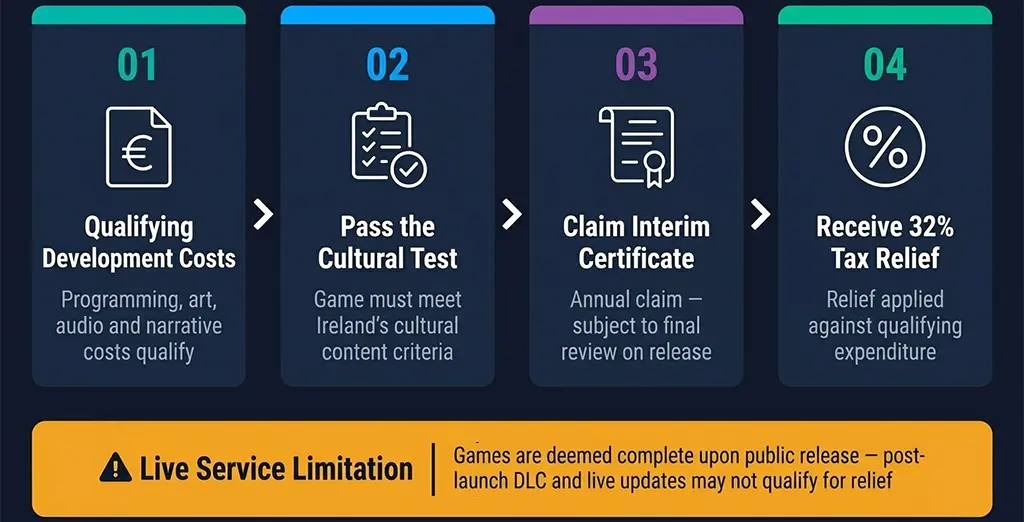
The single most significant policy intervention in the Irish gaming industry in recent years has been the introduction of the Digital Games Tax Credit (DGTC) in 2022. Designed to position Ireland as a competitive destination for game development investment, it places Irish policy on par with comparable schemes in the UK, France, and Canada — and it has been cited directly by studios as a factor in their decision to establish or expand Irish operations.
What the DGTC Offers
Qualifying companies can claim up to 32% relief on eligible development costs — covering programming, art production, audio design, and narrative development — for games that pass a cultural test and meet specific expenditure criteria. Companies can claim on an interim certificate basis annually, which supports cash flow management, though interim claims are subject to clawback if the game is abandoned or fails to meet qualifying criteria at final completion.
The Live Service Problem
One of the DGTC’s most discussed limitations involves post-launch content. Under current rules, games are considered “complete” upon their initial public release. This fails to account for the Live Service model that dominates the modern industry, where studios like Larian or Riot continue investing millions in DLC and updates for years after launch. These post-launch costs may not qualify as claimable expenditures, which can deter long-term project anchoring in Ireland.
This was experienced directly by Larian Studios with Baldur’s Gate 3, whose extensive post-launch content fell outside the credit’s scope. Industry advocates, including Imirt, are actively pushing for a framework update to reflect how modern game development actually works.
The Broader Institutional Ecosystem
The DGTC does not operate in isolation. It is supported by:
- Screen Ireland & Imirt — Providing networking, advocacy, and governmental representation for the developer community
- Enterprise Ireland & IDA Ireland — Operating a “Living Lab” model focused on anticipatory policy and Research, Development & Innovation (RD&I)
- Irish Games Talent Incubator & Ardán — Building the next generation of storytellers and technical leaders through structured mentorship and seed funding
For those considering Irish operations, the DGTC combined with Ireland’s 12.5% corporation tax rate and the institutional support system around it provides a level of strategic coherence that many competing jurisdictions lack.
Challenges Facing the Irish Gaming Industry
An honest assessment of the Irish gaming industry requires acknowledging the structural challenges that could constrain its trajectory if left unaddressed.
Developer Pay & the “Crunch” Culture
Industry surveys paint a concerning picture of compensation. Over 65% of game developers in Ireland report concerns about low pay compared to counterparts in other tech sectors like fintech or cybersecurity. Unpaid overtime is commonplace, with developers regularly working 50–60-hour workweeks without additional compensation. Insecure contract work has become the norm rather than the exception, leaving talented developers without the job security their skills should command.
The Housing Crisis
The housing crisis affecting Ireland’s broader tech sector hits game developers particularly hard. Developers are spending 35–50% of their net income on rent, well above the 30% threshold generally considered financially sustainable. For studios attempting to hire game designers or attract international talent, this creates a direct competitive disadvantage relative to gaming hubs like Berlin, Amsterdam, Prague, or Montreal, where housing costs are substantially more manageable.
Some studios are exploring remote-first models — as VOID Interactive has done, operating with flat hierarchies and distributed teams — as a pragmatic response to urban cost pressures.
International Visibility
Ireland’s gaming companies remain significantly under-represented at major international trade events. At Gamescom — the industry’s premier deal-making venue — Ireland lacks the coordinated national pavilion presence that Germany, France, and the Netherlands invest in annually. Without institutional backing for unified international representation, Irish studios struggle to compete for publisher attention, investment, and co-development mandates on the global stage.
The Future Outlook
Despite the structural headwinds, the forward trajectory for the gaming industry in Ireland through 2027 is genuinely optimistic.
Cloud Gaming & 5G: The Infrastructure Advantage
Ireland’s status as a global data centre hub — hosting major facilities for Google, Amazon, and Microsoft — provides a distinctive infrastructure advantage for cloud gaming. With 5G now rolling out across Ireland in 2026, mobile-first users can access high-end AAA content without expensive consoles, expanding the addressable market significantly and positioning Ireland as one of the most cloud-gaming-ready markets in Europe.
XR, the Metaverse & Next-Generation Platforms
Ireland is already home to innovative Extended Reality companies, including ENGAGE XR and BeyondCreative. As the metaverse matures into a practical platform for training, education, and branded entertainment, Irish firms specialising in immersive VR and XR experiences are positioned to capture meaningful share. The EU is simultaneously tightening scrutiny on loot-box monetisation, meaning studios that proactively shift to subscription and battle pass models will be better positioned for regulatory compliance.
AI Integration in Game Development
Artificial intelligence is reshaping the game development pipeline faster than almost any other technology. AI-assisted tools are already changing how art assets are created, how narrative branches are written, and how QA processes are conducted. For video games in Ireland — whether produced by large co-development studios or emerging independents — AI integration is shifting from competitive advantage to operational baseline.
STEM Education & the Talent Pipeline
Irish universities consistently produce graduates skilled in game development, computer science, animation, and digital arts. Specialist recruitment agencies, including Haptic Recruit (art, animation, and design), Connexus Recruit (UX, UI, and product design), and Games Talent (connections between major and indie studios), reflect a maturing labour market where niche skills are in high demand.
Foreign Direct Investment
The combination of DGTC incentives, EU market access, English-language operations, and a 12.5% corporation tax rate creates a compelling FDI proposition for studios considering European expansion. Ireland can and should position itself as the default European game co-development partner for global publishers facing rising costs in the UK and North America.
The growing demand for game development outsourcing services across Europe means Ireland is increasingly being evaluated not just as a tax-efficient base, but as a genuine centre of production excellence — a reputation that decades of multinational tech investment have laid the groundwork for.
Strategic Recommendations for the Sector
Based on current conditions in 2026, the following actions represent the clearest opportunities for Ireland to fulfil its potential as a Global Games Hub:
- Update the DGTC Framework — Extend the Digital Games Tax Credit to cover post-launch Live Service development, reflecting how modern games are actually built and monetised.
- Address Cost of Living — Policy interventions in housing are essential for Ireland’s entire technology ecosystem to remain competitive for international talent.
- Unified Global Branding — A coordinated, state-backed presence at Gamescom and major international trade events would establish “Games from Ireland” as a recognised and sought-after brand globally.
- Support Regional Hubs — Continued investment in funds like IndieDev 2025 will alleviate pressure on Dublin and foster a more geographically diverse creative landscape across the island.
Conclusion
The gaming industry in Ireland has well and truly arrived — €700 million in revenue, 50+ studios, and a clear path to €813 million by 2027. The foundations are strong; the challenges around pay, housing, and global visibility are real but solvable. The Irish game industry belongs in the global conversation, and the window to engage — as an investor, partner, or studio — is now.
For those seeking a trusted development partner, Juego Studios delivers production-ready game development services built for scale and built to last.
Need art production support? Our game art outsourcing services span concept, character, and environment work — supporting studios at every stage of the development lifecycle.
Frequently Asked Questions
The Irish gaming industry is generating over €700 million in annual revenue in 2025, with projections to reach approximately €813 million by 2027, driven by cloud gaming adoption, mobile growth, and the Digital Games Tax Credit.
The DGTC offers up to 32% relief on qualifying development costs for digital games that pass a cultural test. It covers programming, art, audio, and narrative development — making it one of Europe’s strongest fiscal incentives for the Irish game industry.
The key structural challenges are below-market developer salaries, a severe housing crisis that deters international talent, a “crunch” culture of unpaid overtime, and limited coordinated presence at major international events like Gamescom.
Ireland offers native English-language operations, EU market access, a 12.5% corporation tax rate, robust IP protections, world-class data infrastructure, and a growing pipeline of skilled graduates — making the video game industry in Ireland one of Europe’s most attractive co-development and outsourcing destinations.
Related Posts

US-Based Unreal Partners: How the Top 5 Compare in 2026
Picking a US-based Unreal partner matters most for teams building high-fidelity, performance-driven games. Visual standards keep climbing, console and PC pipelines keep getting stricter, and LiveOps readiness is no longer optional. Plenty of teams talk up their Unreal experience. Few deliver at a production-grade level once a title has to ship and stay live.

How Game Porting Works: Process, Stages, and Cost Breakdown (2026 Guide)
How does game porting work? This is one of the most frequent questions game developers ask as they look to expand their reach and take advantage of the different platforms available today. The game porting process is an important part of how developers can leverage the different platforms for their game, allowing them to reach a […]

Cost of Game Development in Australia
This blog talks about what it costs to build a video game in Australia in 2026 — covering developer salaries, project-type budgets, phase-by-phase cost breakdowns, Australian tax incentives like the Digital Games Tax Offset (DGTO), hybrid outsourcing strategies, and common budget mistakes studios make.