


 Unity
Unity Unreal
 Godot
Godot
 Mobile
 PC
PC Console
 Full-Cycle
 Co-Development
 Outstaffing



-
 Game Co-Development, Gaming Industry, Outsourcing
 Apr 9th, 2026
- Share:
Table of Contents
- TL;DR — Key Numbers at a Glance
- The Australian Gaming Market: A 2026 Snapshot
- Understanding Game Development Cost Tiers in Australia
- What Drives Game Development Costs in Australia?
- Australian Developer Salaries and Hiring Costs (2026 Benchmarks)
- What "True Employer Cost" Actually Means in Australia
- Team Composition and Role-Based Cost Planning
- Game Development Cost Breakdown by Project Type
- Choosing the Right Game Engine: Cost Implications
- How to Estimate Your Game Development Budget: The Formula
- Phase-by-Phase Budget Breakdown
- MVP and Phased Development: Budget-Smart Production Strategy
- Art and Animation Costs in Australia
- Operational and Hidden Costs Australian Studios Often Miss
- Marketing Budget Planning for Australian Game Developers
- Australian Funding and Financial Incentives
- When Should You Hire In-House vs. Outsource?
- Cost Comparison: Local Team vs. Hybrid vs. Full Outsourcing
- The Hybrid Development Model: What Australian Studios Are Actually Doing
- Engagement Models and How They Affect Your Budget
- The Best Development Model for Australian Studios in 2026
- Budget Planning for Specific Game Types
- How AI Tools Are Changing Game Development Costs in Australia
- Common Budget Mistakes Australian Studios Make
- How to Select the Right Development Partner for Your Budget
- Conclusion
You’ve got a game idea with real potential. Maybe you’ve already assembled a small team, or you’re a solo developer who’s done the research and decided it’s time to go all in. The one question that keeps coming back, though, is the one nobody seems to give a straight answer to: how much is this actually going to cost?
The problem isn’t a lack of information — it’s that most budget guides throw global averages at an Australian audience and call it a day. That AUD $50,000–$500,000 range you keep seeing? It’s accurate in the same way that “a car costs between $5,000 and $500,000” is accurate. Technically true. Not that useful. And if you’re budgeting without understanding Australian cost structures specifically — the mandatory superannuation, the city salary premiums, the certification overhead — you’re likely underestimating your total project cost by 20–40%. That gap doesn’t surface as a single crisis. It surfaces as a slow bleed that runs you out of runway six months before launch.
Building a game in Australia in 2026 has its own cost structure, its own talent market, its own tax incentives, and its own set of financial landmines that aren’t covered in any US-centric development guide. This blog breaks all of it down — so you can build a budget that’s grounded in what Australia actually looks like as a development environment, not what it looks like on a global spreadsheet.
TL;DR — Key Numbers at a Glance
- A small 2D or hyper-casual mobile game in Australia typically costs between AUD $5,000 and $100,000, with a team of one to four people working over two to four months.
- Mid-level 3D or casual mobile games fall in the AUD $100,000–$500,000 range, generally requiring a team of four to ten across six to twelve months.
- A properly scoped indie title targeting PC or console realistically demands AUD $500,000 to $2,000,000+ for a twelve to twenty-four month production.
- Senior game developers in Australia earn AUD $100,000–$130,000+ gross annually, and mandatory superannuation at 12% (from July 2025) pushes the true employer cost significantly higher.
- Studios working with Juego Studios as a co-development partner get access to dedicated teams that plug into existing Jira, Slack, and Perforce workflows within days — helping control costs without losing sprint momentum.
- The Digital Games Tax Offset (DGTO) offers a 30% refundable tax offset on qualifying development expenditure above AUD $500,000 — one of the most generous incentives in the global games industry.
- Marketing is the line item most budgets underestimate: expect to allocate 25–50% of your production budget to reach a viable audience at launch.
- Every budget needs a 15–20% contingency reserve — Australian productions consistently encounter platform certification delays, scope adjustments, and integration surprises that make this non-negotiable.
The Australian Gaming Market: A 2026 Snapshot
Before you can make smart budget decisions, you need a clear picture of the industry you’re operating in. The numbers coming out of Australia right now tell a story of a market that’s growing faster than most people realise.
Australia’s game development sector is at a clear inflection point. The video game industry in Australia generated AU$608.5 million in FY2025—up sharply from AU$339.1 million—with 2,443 full-time developers and studios planning further hiring through 2026 (IGEA). Employment is holding steady at around 2,443 full-time roles, and with larger studios flagging hiring intentions for 2026, the local talent market is expected to tighten further. Nearly a third of surveyed studios were working on their first title — a sign that new entrants are coming into the market with real conviction, not just curiosity.
What makes the Australian market genuinely unusual is its export orientation. Approximately 95% of revenue generated by Australian studios comes from international markets. That means studios here are competing globally from day one, which changes how you think about scope, quality bar, and marketing spend. A game built in Brisbane needs to hold up against titles from Stockholm, Tokyo, and Austin. That’s both the challenge and the opportunity.
The main development clusters are Melbourne, Sydney, Brisbane, Adelaide, and Perth. Melbourne tends to have the densest concentration of established studios and the strongest ties to Screen Australia funding pathways. Brisbane benefits from Queensland’s state incentive stacking on top of the federal DGTO. Sydney attracts co-development work from international publishers. The smaller cities offer lower operating costs and easier talent retention, which matters more than people often acknowledge when calculating the true game development cost in Australia.
Australian video games have punched well above their weight globally for years — from the atmospheric underground of Hollow Knight to the gentle chaos of Untitled Goose Game. These aren’t outliers. They reflect a development culture that’s learned to make creative constraints work as a competitive advantage. The studios behind those games didn’t have the budgets of their international counterparts. They had better scoping discipline and a genuine understanding of what their resources could actually deliver.
Understanding Game Development Cost Tiers in Australia
The video game development cost in Australia sits across a wide spectrum, and the gap between tiers is significant enough that grouping them under a single average is genuinely misleading. Here’s what each tier actually looks like in practice.
Simple 2D / Hyper-Casual Mobile: AUD $5,000–$100,000
This is the entry point — solo developers or micro-teams of two to three people building straightforward mobile games or basic 2D titles. Timelines are short, typically two to six months. Most work in Godot or Unity’s free tier, lean heavily on purchased asset packs, and treat QA as a personal responsibility rather than a dedicated role. Marketing budgets at this level are often near zero, which means discoverability is almost entirely organic. Revenue expectations should match that reality.
Mid-Level 3D / Casual Mobile: AUD $100,000–$500,000
This tier is where things start to look like a proper production. Teams of four to ten people, timelines of six to twelve months, and a game that needs to compete on quality with the wider market. Art production becomes a meaningful budget line. QA needs to be systematic rather than ad hoc. Marketing requires real spend to generate visibility. This is also the tier where external funding — a Screen Australia grant or early publisher interest — starts to make a material difference to what’s achievable.
Mid-Size Indie (PC / Console): AUD $500,000–$2,000,000
Twelve to twenty-four months, ten to thirty people, original IP, and a game targeting Steam, PlayStation, Xbox, or Nintendo. This is where the Digital Games Tax Offset becomes a structural input to your financial model rather than a bonus you discover after the fact. Art and QA outsourcing at this level delivers the most immediate budget relief without compromising the final product’s quality.
Large Studio / 3D Complex Projects: AUD $1,000,000–$2,000,000+
Established studios working on complex 3D games, live-service titles, or contracted work for international publishers. At this level, the full stack of Australian incentives — DGTO, state grants, and co-development arrangements — needs to be modelled into the budget from the beginning, not retrofitted after approval.
AAA: AUD $100,000,000+
Out of scope for most domestic independent studios but worth acknowledging that several major publishers, including EA, Riot Games, and Sledgehammer Games, maintain Australian studios. Their operations contribute to the talent market and to the benchmarks that determine what experienced developers expect to be paid.
How Australia Compares Globally
From a salary perspective, Australian senior game developers earn around AUD $117,600 annually — below the US figure of approximately USD $156,000 but more than most of Asia and Eastern Europe. It positions Australia as a premium-quality, mid-tier-cost market in global terms. What the DGTO does is compress that cost gap significantly for projects that qualify — making Australia genuinely competitive with incentivised European markets for the right scale of project.
What Drives Game Development Costs in Australia?
The average cost of game development in Australia isn’t just headcount multiplied by salary. There are five distinct variables that independently push budgets off course — and each one deserves explicit attention during pre-production planning.
Personnel: The 70–90% Line Item
Labour is where the money goes in game development, full stop. In Australia, that means not just salaries but superannuation, leave entitlements, and the time cost of recruitment. A mid-level developer at AUD $85,000 gross costs meaningfully more than that number suggests once you factor in the full employer overhead. Every unplanned hire mid-production — the kind made in a panic when a milestone is slipping — costs two to three times what a planned hire would have.
Scope Creep: The Silent Multiplier
Feature additions feel free in the design room. In production, they’re compounding — they add workload to engineering, art, QA, and localisation simultaneously. A feature added after the Game Design Document is locked typically costs two to three times what it would have cost if it had been scoped from the beginning. Studios that let scope drift routinely find themselves 30–50% over their original budget, usually without any single decision being the obvious culprit.
Platform and Engine: Decisions That Echo
Choosing between Unity Pro at USD $2,400 per seat annually, Unreal with its royalty structure above USD $1 million in revenue, and free-tier Godot isn’t just a licensing decision — it’s a hiring market decision, a team training decision, and a long-term support decision. Add console certification (typically AUD $5,000–$25,000 per platform per submission cycle), and the platform stack you choose in week one is still affecting your costs twelve months later.
Operational Overhead: What Nobody Puts in the First Draft
Office space in Sydney CBD commands around AUD $1,000 per square metre annually for prime-grade locations, with Melbourne at approximately AUD $850/m². [6] The annual software stack for a mid-size team — engine licences, art tools, project management platforms, version control — adds AUD $15,000–$40,000 before anyone logs a single hour. Australian Privacy Act compliance for any game collecting user data adds legal and technical setup costs that many studios only discover when they’re already in production. These aren’t surprises if you plan for them. They are surprises if you don’t.
Post-Launch LiveOps: The Budget That Follows the Budget
A shipped game is not a finished financial commitment. Server infrastructure, bug fix cycles, seasonal content, and community management all carry ongoing costs. For a live-service mobile title operated by an Australian-based team, that typically means AUD $15,000–$40,000 per month. Studios that allocate 100% of their capital to development and nothing to the live phase don’t run out of money at launch — they run out of runway 60 days after it, when the retention curve starts to drop and there’s nothing left to respond with.
Australian Developer Salaries and Hiring Costs (2026 Benchmarks)
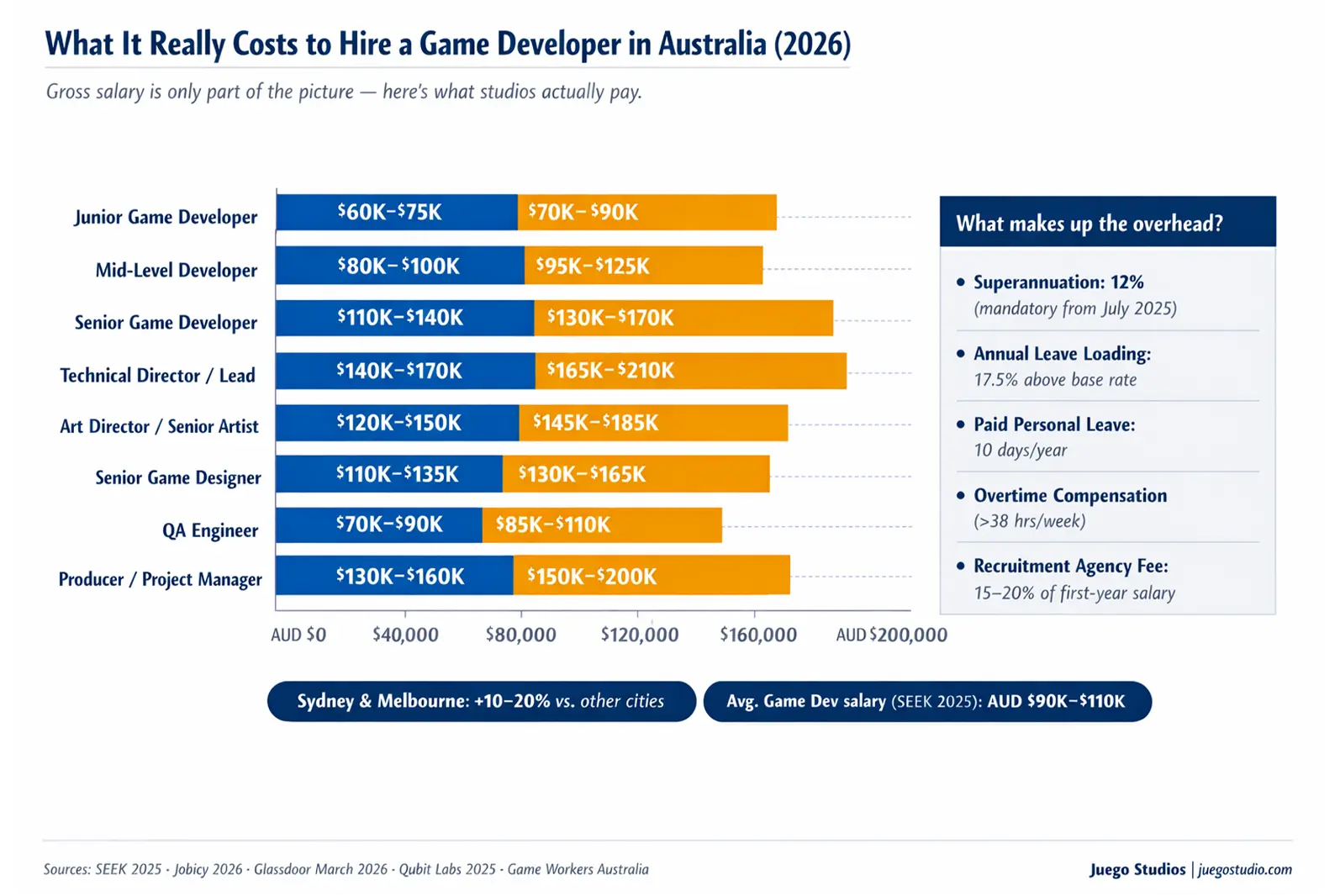 Salary benchmarks are where budgets either hold together or start leaking from day one. The figures below reflect 2026 Australian market rates, including the effect of mandatory employer contributions.
According to SEEK, the average game developer salary in Australia sits between AUD $90,000 and $110,000. Jobicy places the average at AUD $97,600, with senior roles reaching AUD $117,120–$175,680. Glassdoor’s March 2026 data, based on 42 anonymous submissions, shows a typical range of AUD $64,000–$86,500, with top earners at AUD $100,000. The spread across sources reflects both the wide range of studios — from solo-founder startups to established co-development studios — and the significant impact of seniority.
| Role | Gross Annual Salary (AUD) | Est. True Employer Cost |
| Junior Game Developer | $65,000–$80,000 | $73,000–$92,000 |
| Mid-Level Developer | $80,000–$100,000 | $90,000–$115,000 |
| Senior Game Developer | $100,000–$130,000+ | $112,000–$150,000+ |
| Technical Director / Lead | $130,000–$160,000 | $146,000–$184,000 |
| Art Director / Senior Artist | $90,000–$120,000 | $101,000–$138,000 |
| Senior Game Designer | $85,000–$110,000 | $95,000–$127,000 |
| QA Engineer | $55,000–$80,000 | $62,000–$92,000 |
| Producer / Project Manager | $90,000–$115,000 | $101,000–$132,000 |
What "True Employer Cost" Actually Means in Australia
From July 2025, superannuation sits at 12% of gross salary — mandatory, not optional. [3] On top of that, four weeks of paid annual leave (with 17.5% leave loading above base rate), ten days of paid personal leave per year, and mandatory overtime compensation for hours exceeding 38 per week all add to the real cost of an employee. Budgets built on gross salary figures alone will be 15–25% short of reality by the end of their first full payroll cycle.
Contractor and Freelancer Rates
Contractors in Australia typically charge AUD $70–$130 per hour for generalist roles. Specialists in areas like Houdini VFX, multiplayer networking architecture, or console certification compliance run AUD $150–$250 per hour. For work that is genuinely discrete — a specific platform port, a technical art pass, a narrative implementation — contractors often represent better value than full-time hires, since you’re not carrying the overhead between projects.
City Salary Premiums
Sydney and Melbourne consistently command 10–20% more than equivalent roles in Brisbane, Perth, or Adelaide. For a ten-person studio, the choice of city affects annual payroll by AUD $100,000–$200,000 — a number large enough to fund an additional full production phase at smaller scales.
Recruitment Agency Fees
When you use an agency to fill a role, budget 15–20% of the first year’s salary as a one-time fee. On a senior developer earning AUD $120,000, that’s AUD $18,000–$24,000 before that person writes a line of code. Internal referrals and direct sourcing through LinkedIn, GCAP connections, and AIE networks cut this substantially.
Team Composition and Role-Based Cost Planning
Getting the right team structure for your project type is one of the most direct levers a studio has over its monthly burn rate.
Minimum Viable Team: Simple Mobile Game
- 1 Unity Developer — gameplay systems and UI integration
- 1 Game Designer / Artist — level design, 2D art, UX
- 1 QA / PM (part-time) — testing and milestone tracking
Estimated monthly burn rate: AUD $14,000–$20,000 (true employer cost)
Core Team: Mid-Level 3D Game
- 1 Technical Lead / Senior Engineer
- 2–3 Game Developers (Unity / Unreal)
- 1–2 3D Artists / Technical Artists
- 1 Game Designer
- 1 QA Engineer
- 1 Producer / Project Manager
Estimated monthly burn rate: AUD $65,000–$100,000
When to Hire Full-Time vs. Contract vs. Outsource
| Function | Recommended Model | Rationale |
| Core engine engineering | Full-time / dedicated | Institutional knowledge critical; onboarding time is expensive |
| 2D / 3D art at scale | Outsource | Volume work manageable via style guide and sprint alignment |
| QA and regression testing | Contract / outsource | Surge-based need; specialist firms are more efficient |
| Audio and music | Freelance / contract | Discrete deliverables; rarely a long-duration need |
| Platform certification | Specialist contractor | Very specific expertise required infrequently |
| LiveOps management | Dedicated or outsource | Depends on live-service maturity and operational volume |
Game Development Cost Breakdown by Project Type
The Australia game development pricing structure varies widely by scope. The table below uses 2026 Australian market rates as its baseline — not global benchmarks.
| Project Type | Estimated Cost (AUD) | Timeline | Typical Team Size |
| Simple 2D / Hyper-Casual Mobile | $5,000–$100,000 | 2–4 months | 1–4 people |
| Mid-Level 3D / Casual Mobile | $100,000–$500,000 | 6–12 months | 4–10 people |
| Mid-Size Indie (PC / Console) | $500,000–$2,000,000 | 12–24 months | 10–30 people |
| Multiplayer / Live-Service Game | $200,000–$1,500,000+ | 12–24 months | 10–40 people |
| Large Studio / AAA-Lite | $1,000,000+ | 24–48 months | 30–100+ people |
| VR / AR / Serious Game | $80,000–$500,000 | 6–18 months | 5–20 people |
| Enterprise Gamification / XR | $50,000–$300,000 | 3–12 months | 3–15 people |
A few important notes on reading this table: these figures assume a primarily Australian-based core team. Hybrid models that outsource art or QA offshore can reduce costs by 20–40% at the mid-size tier and above. Marketing, platform certification, and post-launch operations are excluded — those are budget layers that sit on top of these development figures, not inside them.
What Causes Timelines to Blow Out
Every additional month on a ten-person Australian production adds roughly AUD $80,000–$130,000 in personnel costs alone. The most common timeline killers aren’t drama — they’re mundane: scope decisions that weren’t fully costed before being approved, a first certification submission that gets rejected and adds eight weeks to the schedule, a key engineer who leaves at month nine of a twelve-month project. Plan for these because they are not rare events. They are industry norms.
Choosing the Right Game Engine: Cost Implications
Engine selection is where financial consequences hide behind what feels like a purely technical decision.
Unity
Unity is the most widely used engine in Australia’s indie sector, largely because the talent pool is deep and the free Personal tier is accessible for studios earning under USD $200,000 annually. The Pro licence at USD $2,400 per seat per year becomes necessary at commercial scale. Unity’s asset store ecosystem also means faster prototyping for teams that know how to use it well — which has a real dollar value in shortened timelines.
Unreal Engine
Unreal carries no licence cost until a game generates USD $1 million in revenue, at which point a 5% royalty applies. The graphical ceiling is higher, which matters for certain project types. The tradeoff is that senior Unreal developers are less abundant in Australia than Unity developers, which affects both hiring timelines and rate expectations. The engine is also more complex to onboard a team onto mid-project.
Godot
Godot is free, carries no royalties, and has been gaining real traction among Australian solo and micro-studio developers building 2D games. For projects where the budget is genuinely tight and the team is comfortable in the engine, it removes one of the recurring cost lines entirely. The limitation is team size scalability — Godot’s talent market in Australia is still developing.
The Hidden Cost of Engine Mismatch
The single most expensive engine decision is picking one your team doesn’t already know. Mid-project engine changes are almost always catastrophically expensive. Engine misalignment with an outsourcing partner adds ramp time before a single production asset is delivered. When evaluating game development outsourcing services, engine expertise — specifically your engine version, not just the engine family — should be a non-negotiable qualification criterion.
How to Estimate Your Game Development Budget: The Formula
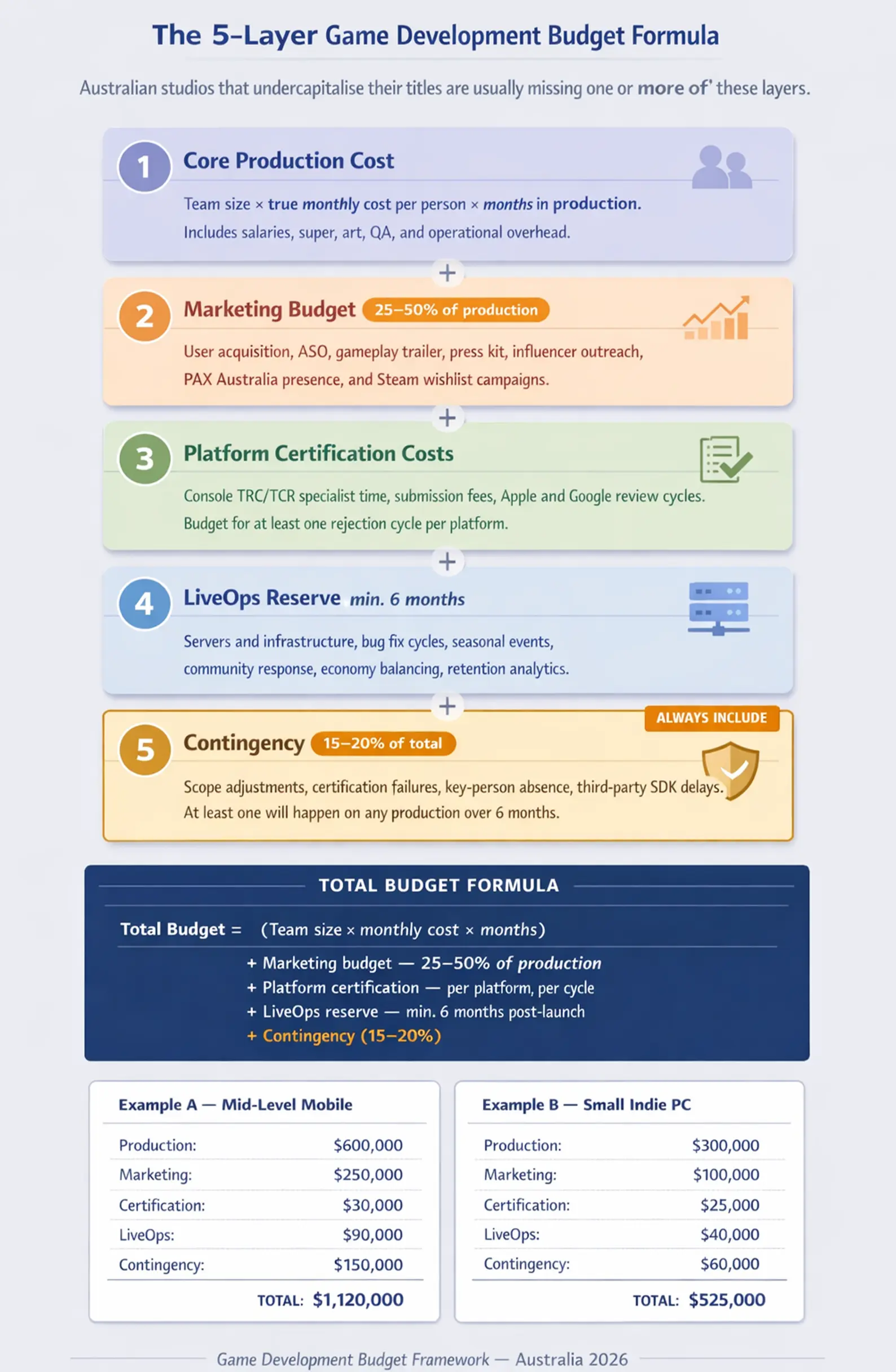
Most budget conversations focus only on development costs. That’s the equivalent of budgeting a road trip by calculating only the fuel. The full cost of bringing a game to market in Australia has five layers, and all five need funding before the project is genuinely ready to ship.
The 5-Layer Budget Stack
Layer 1 — Core Production Cost: Team size × monthly cost per person × development timeline in months. This covers salaries, contractor fees, art production, QA, and operational overhead. It’s the number most people start with — but it’s only the base.
Layer 2 — Marketing Budget: Allocate 25–50% of your production cost to marketing. This isn’t a discretionary line — it determines whether anyone finds the game you spent twelve months building. UA campaigns, trailers, press outreach, influencer kits, and ASO all live here.
Layer 3 — Platform Certification Costs: Console TRC/TCR compliance specialist time, submission fees, and — critically — the cost of at least one rejection cycle. Every console certification has a non-trivial probability of a first submission failure. Budget for it.
Layer 4 — LiveOps Reserve: A minimum of six months of post-launch operational costs: servers, bug fix cycles, seasonal content, analytics, and community response. Games that launch without this reserve go quiet within 60 days.
Layer 5 — Contingency (15–20%): Apply this to the sum of Layers 1–4, not just production. Scope changes, integration delays, and unexpected platform requirements will occur on any project running longer than six months. This is not pessimism — it’s the historical average of how game development projects behave.
Worked Budget Examples
| Cost Line | Mid-Level Mobile | Small Indie PC |
| Core production | AUD $864,000 | AUD $240,000 |
| Marketing (30%) | AUD $259,200 | AUD $72,000 |
| Certification costs | AUD $6,000 | AUD $150 (Steam) |
| LiveOps (6 months) | AUD $120,000 | AUD $30,000 |
| Contingency (15%) | AUD $187,380 | AUD $51,323 |
| Total Estimate | ~AUD $1.44M | ~AUD $393K |
(Mid-level assumes 8 people at AUD $9K/month true cost over 12 months. Indie PC assumes 3 people at AUD $8K/month over 10 months.)
Phase-by-Phase Budget Breakdown
Effective studios don’t manage a single budget — they manage a series of phase budgets, each with its own approval gate. This matters because it catches the most common failure pattern in Australian game development: deploying 80% of capital before discovering the core loop doesn’t hold together.
Phase 1: Pre-Production (10–15% of Total Budget)
Pre-production is underfunded in almost every studio that goes over budget. A proper pre-production phase produces a locked Game Design Document, a technical feasibility assessment, a vertical slice of the core loop, a risk register, and a milestone schedule with buffer built in. The money spent here is the cheapest insurance available against rework costs in full production. Skipping a AUD $30,000 pre-production phase on a AUD $300,000 project is a pattern that reliably generates AUD $100,000+ in avoidable mid-production rework.
Pre-production deliverables include:
- Game Design Documentation
- Technical architecture and engine selection
- Playable vertical slice of the core loop
- Competitive analysis and monetisation modelling
- Risk register and contingency planning
Phase 2: Full Production (60–70% of Total Budget)
The heaviest phase in both spend and coordination. Art, engineering, audio, and QA all run simultaneously, which means communication breakdown and scope drift become expensive faster than in any other phase. Sprint-based delivery with real milestone gates — not milestone dates that are aspirational — protects both quality and budget. Scaling from a core team to a full production team should be planned from day one, not improvised when a milestone slips.
Phase 3: Post-Production and Certification (10–15% of Total Budget)
The last phase before launch tends to cost more per unit of progress than any other. Optimisation work, platform compliance passes, store submission preparation, and full regression QA all require dedicated time and, for console targets, specialist knowledge. Building for at least one certification rejection per platform isn’t pessimism — it’s the industry default.
Phase 4: Launch and Post-Launch LiveOps (Ongoing)
The financial commitment doesn’t end at gold master. Any game with engagement-dependent revenue needs a funded operational phase. For a mobile title with live features, that typically means AUD $15,000–$40,000 per month for an Australian-operated team. For a PC indie game, it’s lighter — but patch cycles, community management, and seasonal updates still carry real costs that should be in the plan from the start.
MVP and Phased Development: Budget-Smart Production Strategy
The Minimum Viable Product approach in game development isn’t about shipping something unfinished. It’s about building the smallest version of your game that meaningfully tests whether the core experience works — and doing it before you’ve committed the majority of your budget.
What Is Game Development MVP?
An MVP in this context is a playable build where the core loop functions, the art direction is established (even if assets are placeholder), and there’s enough of the game present to evaluate whether it’s fun and marketable. It’s distinct from a prototype (too rough to show) and from a vertical slice (production quality but narrow). The MVP is the version that tells you, before you’ve spent 70% of your budget, whether the game you’re building is the game worth building.
The Vertical Slice
Before full production, build a vertical slice: a 5–15 minute fully playable section of the game at final quality bar across art, engineering, and design. It costs AUD $25,000–$100,000 depending on scope. What it buys you is threefold: it validates the core loop before the major spend, it gives the full production team a concrete quality target, and it is far more compelling in a publisher or investor conversation than any GDD or concept art ever will be.
Phased Development Structure
- Phase 1 — Concept and Prototype: Core mechanics defined and tested. Scope locked before moving forward.
- Phase 2 — Vertical Slice: Production-quality section of the game. Internal greenlight gate.
- Phase 3 — Alpha: Full game playable end-to-end, placeholder assets acceptable.
- Phase 4 — Beta: Content complete, QA-focused, all assets final.
- Phase 5 — Gold Master and Certification: Ready for platform submission.
Decisions That Save Money at Every Stage
- Stylised art over photorealism — faster to produce, more distinctive at scale, ages better
- Single-player before multiplayer — defers all backend infrastructure costs to a confirmed success
- PC and mobile before console — lower certification overhead and fewer platform compliance requirements
- Pre-launch community building before paid UA — tests product-market fit before committing major spend
Art and Animation Costs in Australia
Art is the second-largest budget line in most productions and the category most affected by outsourcing decisions.
2D Asset Costs
A professionally produced 2D sprite typically costs AUD $30–$60. Character illustration at production quality runs AUD $150–$400 depending on complexity and detail level. UI asset sets for a mobile game — icons, buttons, menus, and backgrounds — commonly run AUD $3,000–$8,000 for a complete package from a quality freelancer or small studio.
3D Asset Costs
A 3D character model with full rigging starts at AUD $500 and scales to AUD $2,000+ depending on poly count, surface detail, and animation rig complexity. Fully dressed 3D environments range from AUD $3,000 to $10,000 per scene. On a project requiring 40+ unique assets, this tier of production becomes one of the largest individual budget lines outside of salaries.
Animation Pricing
Skeletal animation for a 2D character — a complete set of 10–15 movement states — costs roughly AUD $300–$700. For 3D characters, multiply that by two to three. Games requiring many animation states across multiple characters should cost this out explicitly, as it surprises a lot of first-time producers.
Outsourcing Art: A Rate Comparison
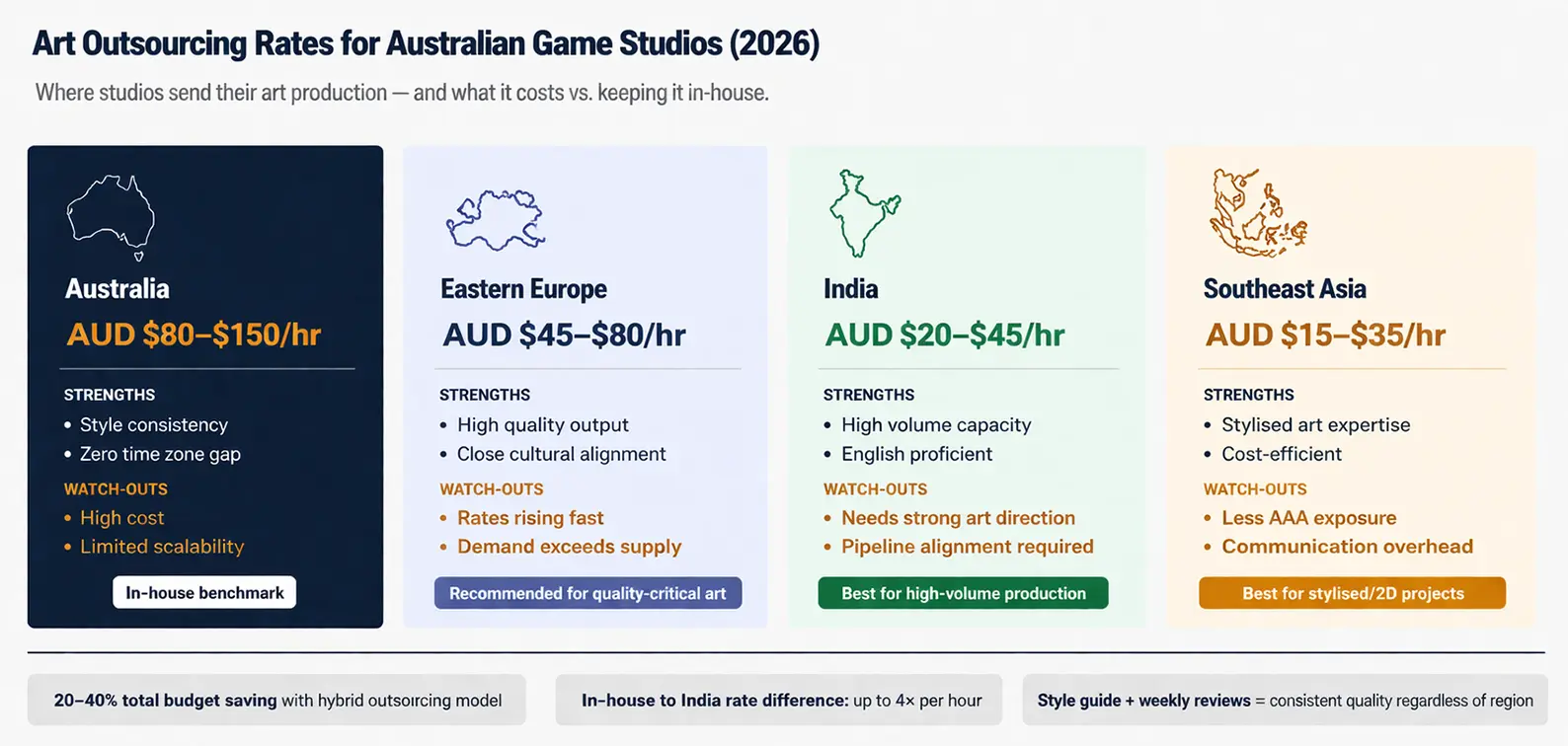
| Region | Hourly Art Rate | Strengths | Watch-outs |
| Australia (in-house) | AUD $80–$150 | Style consistency, zero time zone gap | High cost; doesn’t scale quickly |
| Eastern Europe | AUD $45–$80 | Strong quality, close cultural alignment | Rates rising; demand high |
| India | AUD $20–$45 | High volume capacity, English proficient | Requires thorough art direction process |
| Southeast Asia | AUD $15–$35 | Strong stylised art output, cost-efficient | Less AAA pipeline exposure |
Marketing Budget Planning for Australian Game Developers
Marketing is the budget line that determines whether the game you’ve spent a year building actually finds an audience. The rule of thumb — allocate 25–50% of your production budget — isn’t arbitrary. It reflects what it costs to generate meaningful visibility in a market where thousands of games launch on Steam every month.
App Store Optimisation (ASO)
ASO for a mobile title — covering icon and screenshot creative testing, keyword strategy, and rating management — costs AUD $4,000–$12,000 for initial setup and AUD $1,000–$4,000 per month to maintain. For studios releasing into multiple global markets, keyword strategies and creative preferences differ enough between regions that market-specific ASO is a separate line item.
User Acquisition (UA)
A mobile launch in 2026 needs a minimum test budget of AUD $25,000–$60,000 to get statistically valid data on CPI and Day-7 retention. Scaling to a profitable UA funnel requires AUD $100,000–$500,000+ depending on the category. Casual puzzle and hyper-casual genres have particularly demanding efficiency requirements — the cost per install benchmarks in these categories leave very little margin for poorly converting creatives.
Trailers and Press Materials
A gameplay trailer for a mid-size title runs AUD $10,000–$30,000 from a professional studio. A complete press kit — screenshots, B-roll, review builds, and press release distribution — adds AUD $3,000–$10,000. For studios targeting PAX Australia or GDC, event presence, travel, and showcase costs need to be planned at least six months in advance.
Classification and the Australian Market
Studios releasing domestically should be aware early of the Australian classification system. Video games banned in Australia have historically faced Refused Classification (RC) decisions for content exceeding the R18+ threshold — a consideration that needs to be addressed in pre-production content design, not during store submission.
Soft Launch and Community Building
Building a Discord server, maintaining a dev-log on YouTube or TikTok, and running a Steam wishlist campaign starting 6–12 months before launch are largely free — but they require time and consistency that should be treated as a real resource cost. Studios that invest in pre-launch community building consistently outperform those that start marketing at launch.
Australian Funding and Financial Incentives
Australia’s incentive structure for game development is genuinely one of the best in the world right now. The combination of federal and state-level programs means that studios who plan around these instruments from the start can materially reduce their effective development costs.
The Federal Digital Games Tax Offset (DGTO)
The DGTO is a 30% refundable tax offset on Qualifying Australian Development Expenditure (QADE). It applies to development costs incurred from 1 July 2022 and requires a minimum of AUD $500,000 in QADE per project to trigger. The offset is capped at AUD $20 million per connected company group per income year — a ceiling that only the largest Australian studios approach.
To access it, studios need to apply to the Minister for the Arts for a certificate. Three certificate types exist: Completion (for a new game completed in the income year), Porting (for bringing an existing game to a new platform), and Ongoing Development (for live-service updates to a shipped title). The key operational trap is timing — the certificate must be in hand when the company tax return is lodged. Studios waiting on their certificate need to formally request a lodgment deferral from the ATO; failing to do so creates amendment complications that can delay or prevent the claim.
Planning Around the AUD $500,000 Threshold
The threshold creates a real planning decision for studios whose projects sit near it. If development expenditure is likely to land below AUD $500,000, the DGTO is unavailable and budget planning should instead focus on Screen Australia funding and state grants. If expenditure is likely to clear the threshold, scope and team structure should be designed to maximise eligible QADE — and the 30% offset should be modelled explicitly in cash flow planning before production begins.
State-Based Incentives That Stack on Top
Australia’s state incentive programs don’t replace the DGTO — they add to it. Queensland’s Digital Games Incentive offers a 15% rebate on eligible local expenditure. NSW’s Digital Games Rebate adds 10%. Victoria’s Screen Incentive provides approximately 10%. In Queensland specifically, a studio combining the federal offset, the state incentive, and standard tax deductions can see total benefit approaching 55 cents per eligible dollar spent — a cost advantage that few development markets globally can match.
Screen Australia’s Games Expansion Pack
For projects below the DGTO threshold, Screen Australia’s Games Expansion Pack provides direct grant funding for Australian studios producing original interactive entertainment content. This is particularly relevant for early-stage studios building their first title — the kind of project where the financial risk is highest and the incentive value of a non-recoupable grant is greatest.
Crowdfunding and Early Access
Several of Australia’s most successful independent titles have used Kickstarter to fund their early development phase, with Team Cherry’s Hollow Knight being the most widely cited example (AUD $57,000 raised, more than five million copies sold). Steam Early Access offers a complementary mechanism — revenue that comes in before a game is finished, used to fund the remaining production. Both channels work best when supported by a pre-existing community, which circles back to the pre-launch marketing investment discussed earlier.
Layering Multiple Sources
Studios that perform best in the Australian market rarely rely on a single funding source. A common structure among well-capitalised indie studios looks like: Screen Australia grant funding pre-production, DGTO recovering 30% of eligible production spend, with crowdfunding or publisher advance covering the production gap. This kind of layered model can reduce the equity capital needed to greenlight a project by 30–50% — a meaningful reduction for any studio managing multiple titles in parallel.
When Should You Hire In-House vs. Outsource?
This is the question most Australian studios circle around for weeks before making a call. The honest answer is that neither option is universally right — but the conditions that favour each are specific enough that you can usually resolve the decision in a single planning session if you’re asking the right questions.
When to Hire In-House
You’re building something that requires sustained, deeply embedded creative ownership. If your game’s identity depends on a small group of people who live inside the work every day — who shape it instinctively, catch problems before they’re problems, and carry institutional knowledge that can’t be documented — those roles need to be in-house. Game Directors, Technical Directors, Lead Engineers, and Art Directors almost always fall into this category. These are not roles where you want handover risk or knowledge gaps.
You’re also better served hiring locally when you’re in a long production cycle of eighteen months or more, where team continuity compounds into a structural advantage. A team that has shipped a game together is materially more efficient on the next one. That kind of accumulated workflow knowledge doesn’t transfer through documentation — it lives in the people.
Finally, hire in-house when you have the time to do it properly. Australian recruitment for senior roles takes four to twelve weeks from job posting to first productive sprint. If your timeline has that space and your studio has the budget to carry the overhead between production phases, building a permanent local team is the right long-term investment.
When to Outsource
Your production requires volume that your core team can’t deliver without adding headcount you’ll need to shed after launch. Art production at scale — environments, characters, UI, animation sets — is the clearest example. The deliverables are well-defined, quality is controllable through style guides and sprint-aligned reviews, and the cost differential between Australian in-house rates (AUD $80–$150/hr) and offshore partners (AUD $15–$80/hr depending on region) is large enough to make a meaningful budget difference on any project over AUD $200,000.
Outsource when you’re on a timeline that can’t accommodate local recruitment delays. If you need a team operational in two weeks rather than twelve, an established co-development partner with a proven onboarding process is the only realistic option.
Also outsource when the function is specialist and infrequent. Platform certification compliance, QA regression at launch, localisation, and specific technical art passes all require deep expertise used in concentrated bursts. Hiring full-time for these functions means carrying expensive overhead between the moments you need them. Contracting or outsourcing delivers the expertise without the permanent cost.
The Decision in One Question
Ask yourself: if this person left tomorrow, would the project’s creative direction or technical architecture be at serious risk? If yes, that role needs to be in-house. If no — if their output is deliverable-based and their replacement could be onboarded in days rather than months — outsourcing is almost always the smarter financial decision.
Cost Comparison: Local Team vs. Hybrid vs. Full Outsourcing
Numbers make this clearer than any framework. The table below models a mid-size indie PC game — twelve months of production, ten people at full capacity — under three different staffing structures. All figures use 2026 Australian market rates and reflect true employer cost, not gross salary.
| Cost Element | Full Local Team | Hybrid Model | Full Outsourcing |
| Core creative/tech leads (3 people, local) | AUD $390,000 | AUD $390,000 | AUD $0 |
| Engineering (5 people) | AUD $575,000 | AUD $250,000 (offshore) | AUD $200,000 (offshore) |
| Art production (6 people equivalent) | AUD $660,000 | AUD $180,000 (offshore) | AUD $150,000 (offshore) |
| QA (2 people) | AUD $148,000 | AUD $45,000 (outsourced) | AUD $40,000 (outsourced) |
| Recruitment and onboarding | AUD $80,000 | AUD $25,000 | AUD $10,000 |
| Total production cost | ~AUD $1,853,000 | ~AUD $890,000 | ~AUD $400,000 |
| DGTO-eligible expenditure (30% offset) | AUD $555,900 back | AUD $195,000 back | AUD $0 — threshold not met |
| Net effective cost after DGTO | ~AUD $1,297,100 | ~AUD $695,000 | ~AUD $400,000 |
Note: Full outsourcing produces no DGTO-eligible local expenditure and falls below the AUD $500,000 QADE threshold, making the offset inaccessible. Hybrid figures assume core leads and partial engineering remain Australian-based and QADE-eligible. All estimates exclude marketing, certification, LiveOps, and contingency.
What This Table Tells You
Full local is the most expensive option in absolute terms, but the DGTO significantly closes the gap for projects that qualify. A fully local team at AUD $1.85M drops to approximately AUD $1.3M net after the 30% offset on eligible spend — a meaningful difference for a studio managing cash flow across multiple projects.
The hybrid model delivers the best risk-adjusted outcome at this scale. It cuts total production cost roughly in half compared to a fully local team, retains enough Australian-based expenditure to access the DGTO, and preserves the creative and technical leadership structure that determines whether the game actually ships to a competitive standard.
Full outsourcing is the lowest absolute cost, but it sacrifices DGTO eligibility entirely, removes creative control from the studio, and is most appropriate for work-for-hire or enterprise gamification projects where the client’s brief is fixed and the studio’s role is purely executional. For studios building original IP with any commercial ambition, full outsourcing of the core production is a false economy — the savings on development are frequently lost to inconsistent creative direction, rework cycles, and a shipped product that doesn’t reflect what the studio intended to build.
The Takeaway by Budget Range
Under AUD $500,000: The DGTO is not in play, so pure cost efficiency matters most. Keep scope tight, use a fixed-price or milestone-based engagement for any outsourced work, and treat every dollar as a decision about what matters most to the game.
AUD $500,000–$2,000,000: The hybrid model is almost always the right architecture. Design it so your Australian-based expenditure clears the DGTO threshold, outsource the production functions where offshore quality is proven, and use the 30% offset to fund your contingency reserve or the next pre-production phase.
Over AUD $2,000,000: Decisions at this scale depend on your studio’s ownership structure, publisher relationships, and state of residence. A conversation with a DGTO specialist and a co-development partner who understands Australian production economics is the right next step — not a blog guide.
The Hybrid Development Model: What Australian Studios Are Actually Doing
For most studios building games in the AUD $300,000–$2,000,000 range in Australia, the question isn’t whether to involve an external development partner — it’s where and how. A fully local team in Sydney or Melbourne is financially unsustainable for many mid-size projects. The combination of high salaries, mandatory entitlements, and a tight talent market means that hybrid models aren’t a compromise — they’re the standard operating structure for competitive studios.
Why Hybrid Works
A well-executed hybrid model delivers three real advantages. First, cost reduction: outsourcing art production and QA to specialist partners while keeping creative direction and engineering leadership local typically reduces total production costs by 20–40% without affecting the quality of what ships. Second, speed: an established outsourcing partner can be integrated into your Jira and Slack workflow within days, versus four to twelve weeks of local recruitment from job posting to productive first sprint. Third, elasticity: you can scale an outsourced art team from five to fifty people for a DLC crunch and back down afterward, without triggering Australian employment law entitlements or carrying headcount you don’t need between production peaks.
What to Keep Local, What to Outsource
Keep local: Game Director, Technical Director, Art Director, Senior Producer, and Lead Engineers. These roles hold the creative vision, manage stakeholder relationships, and make decisions that compound through every sprint. They need to be present, invested, and deeply embedded in the project.
Outsource or augment: 2D/3D art production at volume, environment art, QA regression testing, device compatibility testing, and localisation QA. These functions have clear deliverables, quality is controllable through well-structured style guides and sprint-aligned review cycles, and the cost differential between Australian and offshore rates is large enough to make a real budget difference.
The Quality Control Reality
Hybrid models fail at process, not talent. The studios that produce inconsistent results from outsourcing partners are typically the ones treating them as order-takers rather than production collaborators. The non-negotiables for a working hybrid model are: a detailed visual style guide signed off before any outsourcing begins, weekly art reviews with the partner’s lead, shared milestone dates, and a clear escalation path to the internal Art Director. Get these right and the quality difference between local and offshore art production becomes negligible at the shipped product level.
Engagement Models and How They Affect Your Budget
Choosing the wrong engagement structure with an external partner can produce cost overruns that have nothing to do with the quality of the work. These are the main options and when each makes sense.
| Engagement Model | Best For | Budget Implication | Risk Profile |
| Fixed-Price / Milestone-Based | Well-defined, locked scope | Predictable; scope changes are expensive | Low if scope is genuinely locked |
| Time & Material (T&M) | Iterative development, evolving requirements | Can escalate; requires active burn-rate management | Flexible but demands discipline |
| Dedicated Team / Staff Augmentation | Long-term production, ongoing co-development | Predictable monthly cost; scales cleanly | Low; team continuity protects quality |
| Managed Outsourcing (Turnkey) | Full-cycle offload with defined output | Higher unit cost; lower management overhead | Vendor selection is the primary risk |
| External Development Centre | Large-scale, long-duration production | High setup cost; highly efficient at sustained scale | Appropriate for AUD $500K+ engagements |
For studios at the concept-to-launch stage, the dedicated team model tends to produce the best risk-adjusted outcome. Monthly costs are predictable, the team integrates deeply into your pipeline, and the continuity it provides across a twelve to twenty-four month production is something neither T&M nor fixed-price arrangements can match in practice.
The Best Development Model for Australian Studios in 2026
Given where the Australian market sits right now — high talent costs, strong incentive structures, a tightening mid-level talent pool, and increasing international co-development interest — there is a model that consistently outperforms the alternatives for studios in the AUD $300,000–$2,000,000 range. It’s not fully in-house. It’s not fully outsourced. It’s a structured hybrid with a clear architecture for which work stays local and which goes offshore.
Keep Your Creative Core Local and Small
A Game Director or Lead Designer, a Technical Director or Senior Engineer, and an Art Director — three to five people in total who own the vision, make the calls, and hold accountability for what ships. This group should be permanent, well-compensated, and not asked to do production work that distracts from direction. Their job is to make the game good. Everyone else’s job is to execute.
Augment Engineering With a Dedicated External Team
Junior and mid-level engineering tasks — feature implementation, UI systems, audio integration, optimisation passes — can be handled by a dedicated partner team that works inside your Jira and Slack environment. Eastern European partners at AUD $45–$80/hr deliver strong technical quality with a manageable time zone gap. This structure keeps your local engineers focused on architecture and the technically complex problems that require the most context.
Scale Art Offshore
2D and 3D asset production, environment art, character modelling, animation sets, and UI assets are all well-suited to offshore production when the brief is well-specified. Indian and Southeast Asian partners at AUD $15–$45/hr can handle volume that would require three to four additional Australian hires to match — at a fraction of the cost and with no permanent overhead after the production peak passes.
Outsource QA Entirely
Device compatibility testing, regression cycles, and localisation QA are functions where specialist firms — particularly those with large device labs for mobile — are simply more efficient than any in-house setup a mid-size studio could justify building.
Why This Model Fits Australia Specifically in 2026
The DGTO applies to Australian development expenditure, which means your local team’s salaries and overhead are QADE-eligible if the project meets the threshold. Offshore partner costs do not count toward QADE. This creates a deliberate planning incentive to keep the right work local — not just for quality reasons, but because those local costs are the ones generating the 30% tax offset. The hybrid model, designed correctly, maximises both production efficiency and DGTO-eligible expenditure simultaneously.
The state incentive stacking in Queensland amplifies this further. For studios based in or willing to operate through Brisbane, the combination of federal DGTO and state incentive means the effective cost of eligible local expenditure is substantially reduced — making the case for keeping a larger local core team than pure market rates would otherwise support.
Budget Planning for Specific Game Types
Mobile Casual Games
The economics of mobile casual development in Australia are driven primarily by UA efficiency. A game that costs AUD $80,000 to build but requires AUD $300,000 in user acquisition to reach profitability is not a viable product — it’s a well-made one with broken unit economics. Budget planning for mobile should begin with target CPI and Day-7 retention benchmarks and work backwards to determine the maximum defensible production spend. Sub-100MB APK size, Australian Privacy Act-compliant data collection, and modular live event architecture are production requirements for competitive mobile releases, not optional improvements.
PC Indie Titles Targeting Steam
Steam rewards discoverability, quality, and community engagement over raw marketing spend. Games set in Australia or drawing on distinctly Australian narratives and settings have found receptive global audiences in recent years — originality of setting is a genuine competitive advantage at this scale. Key budget priorities for PC indie: allocate AUD $10,000–$25,000 to wishlist campaign building starting at least six months before launch, and maintain a funded post-launch runway of at least six months to respond to community feedback and patch cycles.
Console Co-Development Projects
Console development introduces budget lines that are often invisible to studios making their first transition from PC or mobile. Devkit access, platform holder development licences, TRC/TCR compliance engineering, and submission management time are all real and recurring costs. Plan AUD $25,000–$60,000 additional for the certification and submission phase per platform, independent of production costs.
VR / AR and Serious Games
Australia has a quietly strong serious games sector — healthcare simulation, defence training, education, and corporate learning are all active commissioning markets, often with clearer revenue visibility than consumer entertainment projects. VR titles require a dedicated performance optimisation phase (maintaining 90+ FPS is non-negotiable for comfort compliance on consumer headsets), which typically adds four to six weeks and AUD $20,000–$40,000 to a standard production timeline.
Games-as-a-Service (GaaS) / LiveOps-Driven
Live-service architecture carries upfront technology costs that non-GaaS titles don’t — server-driven content delivery, feature flagging, A/B testing frameworks, analytics integration, and economy management systems. The technology overhead adds 20–35% to development cost compared to an equivalent single-release title. The payoff, for titles that execute well, is substantially higher lifetime revenue — but the investment needs to be in the plan from day one, not added as a retrofit when the game is already in beta.
How AI Tools Are Changing Game Development Costs in Australia
AI tools are moving from novelty to budget planning variable. For Australian studios where every dollar of production spend has to work harder than in larger markets, the practical impact is already worth factoring into project economics.
Asset Creation
AI-assisted tools are reducing the time and cost of specific art production tasks — concept generation, texture creation, background environments, and placeholder assets for early production phases. In some categories, the cost reduction per asset is 30–50% compared to fully manual production. For a mid-size project with a AUD $200,000 art budget, that’s a potential saving of AUD $60,000–$100,000. The catch is that this reduction doesn’t eliminate the need for skilled art direction — it reduces production time, not creative oversight.
Animation and Technical Art
Tools like DeepMotion and Cascadeur are making procedural animation and motion retargeting significantly faster. Unity’s ML-Agents framework allows dynamic NPC behaviour without the manual scripting overhead that traditionally made AI-driven characters expensive to implement at small-studio scale.
Dialogue and Narrative Systems
AI-assisted dialogue generation and narrative branching tools are reducing the time required to produce first-draft scripts and branching structures. The outputs are rarely production-ready without human editing, but as a starting point for iteration they’ve compressed what used to be weeks of work into days for some studios.
The Limit of AI Cost Savings
AI tools reduce the cost per unit of output — they don’t replace the need for quality control, artistic direction, and final human judgment. Studios that have attempted to ship AI-generated art without a strong review process have consistently produced visually inconsistent results that undermine a game’s identity and market positioning. The budget saving is real; the risk of misapplication is also real.
Common Budget Mistakes Australian Studios Make
Mistake 1: Treating LiveOps as Someone Else’s Problem
This is the single most common financial failure in the Australian indie market. A game that ships with no post-launch operational budget is a game on a timer. Players today expect bug patches within days, community responses within hours, and event cadence within weeks. Studios that spend all their capital getting to launch and nothing on operating afterward don’t fail loudly — they just quietly lose their playerbase before word-of-mouth has time to build. Budget six months of LiveOps costs — AUD $15,000–$40,000/month — before you greenlight the production that precedes it.
Mistake 2: Skipping Pre-Production to Save Time
The studios that skip pre-production to start production faster almost always end up slower. Decisions that take a day in pre-production take a week in production and a month in post-production — because in production, every decision is connected to code that’s already been written, art that’s already been produced, and timelines that are already locked. A AUD $25,000–$50,000 pre-production investment on a mid-size project routinely prevents AUD $100,000–$250,000 in production rework.
Mistake 3: Underestimating Certification as an Engineering Problem
Platform certification isn’t a checklist QA exercise — it’s a specialised engineering function. TRC/TCR compliance for Sony or Nintendo requires someone who has been through the process before and knows exactly where submissions fail. A first rejection adds four to eight weeks and AUD $12,000–$30,000 in specialist time to your schedule. On a publisher-contracted project with milestone penalties, that delay can cost more than the certification budget itself. Assign platform compliance ownership from month one and budget for one rejection cycle per platform as a standard line item.
Mistake 4: Hiring Into a Crisis
When a project falls behind schedule, the instinct is to hire. In Australia, that instinct consistently makes things worse before it makes them better: recruitment takes four to twelve weeks, agencies charge 15–20% of first-year salary, and new hires need four to eight weeks of onboarding before they contribute meaningfully to production. The net result is typically an additional AUD $20,000–$30,000 in costs and three to four months of delay before the new hire is net-positive. Address timeline slippage through scope reduction and milestone renegotiation before reaching for headcount.
Mistake 5: Presenting a Budget Without Contingency
Any budget presented without a 15–20% contingency reserve is a document that will need to be revised. Scope adjustments happen. Certification submissions fail. Key engineers leave. SDK integrations break. These aren’t edge cases in game development — they’re the expected distribution of events on any project over six months. If the number you present to stakeholders has no buffer, you will either run over budget or you will cut scope in the worst possible circumstances, under time pressure, with money already spent.
How to Select the Right Development Partner for Your Budget
For Australian studios bringing in an external partner, the hourly rate is rarely the most important variable. The factors that determine whether a co-development relationship succeeds are pipeline compatibility, communication discipline, and whether the partner’s quality standards and working process actually fit your production.
In-House vs. Outsourced: The Real Cost Comparison
| Factor | In-House (Australia) | Outsourced Partner |
| Hourly equivalent cost | AUD $55–$100 (true employer cost) | AUD $20–$70 (depending on region) |
| Ramp time | 4–12 weeks (recruitment) | 1–2 weeks (dedicated team) |
| Knowledge retention | High (if staff stay) | Medium (depends on continuity) |
| Scalability | Low (hiring is slow) | High (on-demand scaling) |
| IP risk | Low | Low (with proper NDA structure) |
| Attrition cost | High | Low (absorbed by partner) |
What to Evaluate in a Co-Development Partner
- Pipeline integration: Can they operate in your existing Jira, Slack, and Perforce environment, or will you be managing a parallel workflow? The integration overhead of a misaligned toolstack is a real production cost.
- Engine specificity: There’s a meaningful difference between a studio that knows Unity and one that knows your version of Unity with your current project architecture. Ask for specifics — engine version, render pipeline (URP/HDRP), and whether they’ve shipped on your target platform before.
- Art direction experience: A partner that has worked directly with Art Directors produces different results than one that executes briefs at arm’s length. References from comparable projects matter here.
- IP protection protocols: ISO 27001 certification, segregated client repositories, and NDA structures with clear consequences aren’t bureaucratic extras — they’re basic professionalism at commercial production scale.
Structuring the Initial Scoping Conversation
Before reaching out to hire game designers or a video game development studio, prepare a brief that covers: platform targets, engine version, art style reference (not just words — actual visual examples), required team size, key milestone dates, and the specific problem you’re trying to solve — whether that’s a capacity constraint, an expertise gap, or a timeline acceleration need. A partner who responds with a production-oriented resource plan rather than a generic rate card is demonstrating the right instincts from the first conversation.
How Juego Studios Maps to These Criteria
For Australian studios that have worked through the evaluation above, here is how Juego Studios maps directly to each criterion:
| Evaluation Criterion | Juego Studios |
| Pipeline integration | Operates natively in Jira, Perforce, Git, Slack, and ShotGrid — no parallel workflow required |
| Engine specificity | Unity and Unreal Engine specialists across URP, HDRP, Nanite, and Lumen; platform-certified for mobile, PC, and console |
| Art direction experience | Senior art directors embedded in client pipelines; referenced by Sony, Tencent, Warner Bros., and Disney on production-scale projects |
| IP protection | ISO 27001 protocols, segregated client repositories, NDA with liquidated damages clauses, and milestone-based asset delivery as standard |
| Ramp time | Dedicated art pods onboarded in 1–2 weeks; staff augmentation integrated in 48–72 hours |
| Engagement flexibility | Fixed scope, managed art pod, staff augmentation, and retainer models — DGTO-aligned for Australian studios |
| Coverage for Australian time zones | US, UK, and India-based teams providing AEST morning and afternoon overlap windows |
Juego Studios operates as a full-cycle game development and co-development partner with a dedicated game art production capability — with over a decade of experience and 200+ delivered projects across mobile, PC, console, AR/VR, and web. The studio supports the full spectrum of art disciplines: 2D/3D asset production, character and environment pipelines, animation, UI/UX design, VFX, and concept art.
Conclusion
Building a game in Australia in 2026 is a genuinely viable commercial ambition — but only for studios that go in with an honest understanding of what it costs and a plan that accounts for all of it. The salary benchmarks are higher than most global comparisons suggest. The mandatory employer contributions add a layer most first budgets miss. The platform certification cycle has its own timeline and its own specialist cost. And the post-launch operational phase needs funding before the game ships, not after the revenue starts coming in.
What Australia offers in return is substantial. The Digital Games Tax Offset is one of the most generous development incentives in the world at its qualifying threshold. The state incentives in Queensland, Victoria, and NSW can stack additional savings on top of it. Screen Australia provides accessible funding for early-stage projects that haven’t yet reached DGTO scale. And the domestic talent market, while competitive, produces developers who have shipped work that competes on the global stage.
The game development services landscape in Australia has also matured considerably — studios no longer have to choose between local quality and international cost efficiency. Hybrid models, dedicated outsourcing partnerships, and co-development arrangements mean that a well-structured Australian production can access the best of both.
The studios that succeed here are consistent in one thing: they treat budget planning as a serious production discipline, not an administrative step between the idea and the kickoff. Lock your scope. Know your true costs. Plan for what goes wrong. And build with a partner who understands what it actually takes to ship.
Frequently Asked Questions
Costs range from AUD $5,000 for basic mobile titles to AUD $2 million or more for mid-size indie PC and console games, depending on scope, team size, and platform targets.
Senior developers earn AUD $100,000–$130,000+ gross annually. The true employer cost — including mandatory 12% superannuation and leave entitlements — adds a further 15–25% on top.
The DGTO provides a 30% refundable tax offset on qualifying development expenditure above AUD $500,000. Studios apply to the Minister for the Arts for a certificate and claim the offset through their company tax return.
Hybrid models that keep creative and engineering leadership local while outsourcing art production and QA offshore typically reduce total production budgets by 20–40% without compromising final quality.
Platform certification cycles, Australian Privacy Act compliance setup, post-launch LiveOps reserves, agency recruitment fees, and the 15–20% contingency buffer are the lines that most first budgets leave out entirely.
Related Posts
Outsourcing Game Art in 2026: Models, Costs, and Risks
Outsourcing game art in 2026 looks nothing like it did a few years ago. What once functioned as a cost-saving shortcut has become a core production strategy tied directly to scale, speed, and live-ops continuity. Studios now rely on outsourcing game art to keep up with rising content demands without slowing internal pipelines or bloating permanent teams.
Console Certification Failures: Platform Standards
The outsourced build looked clean. The art was approved, the gameplay was stable on PC, and the vendor had shipped builds on schedule through every milestone.
IP Protection: Outsourcing Game Development
You spent months – maybe years – building the concept. The game design document is sharp. The mechanics are original. The art direction is something you’ve never seen anywhere else. And then you sign a contract with an offshore studio, hand over your materials, and hope for the best.