


 Unity
Unity Unreal
 Godot
Godot
 Mobile
 PC
PC Console
 Full-Cycle
 Co-Development
 Outstaffing




-
 Game Development, Gaming Industry
 Dec 15th, 2025
- Share:
Table of Contents
- What Is a Game Business Model?
- The Complete List of Game Business Models
- Why Do Business Models Matter for Studios, Publishers & Funded Indies?
- Business Models for Mobile Games
- How to Choose the Right Game Business Model for Your Studio
- How Co-Development, Full-Cycle Development, & LiveOps Support Each Business Model
- Common Mistakes Studios Make When Choosing a Business Model
- Summary: Which Game Business Model Fits Your Studio Best?
- Final Thoughts
Choosing the right game business model has become one of the most defining decisions for modern studios. In 2024, more than 70% of the global game industry’s $184+ billion revenue came from titles operating under long-tail business models such as GaaS, Early Access, and ecosystem-driven development. Meanwhile, over 68% of mobile studios report that shifting their game development business model – not just monetization – had the biggest impact on production velocity and launch success.
These shifts reflect an industry where development structure, content cadence, and LiveOps readiness increasingly determine a game’s sustainability. Whether a team is building a premium console title, scaling a service-based mobile game, or exploring a new business model for mobile games, choosing the right development framework influences budgets, staffing, timelines, and long-term viability.
This guide breaks down the major game development business models studios use today, focusing on how games are built, supported, and sustained throughout their lifecycle. While monetization strategies like in-game purchases and subscriptions are crucial, they are covered in a dedicated game monetization guide to keep this discussion focused on the production and operational frameworks.
What Is a Game Business Model?
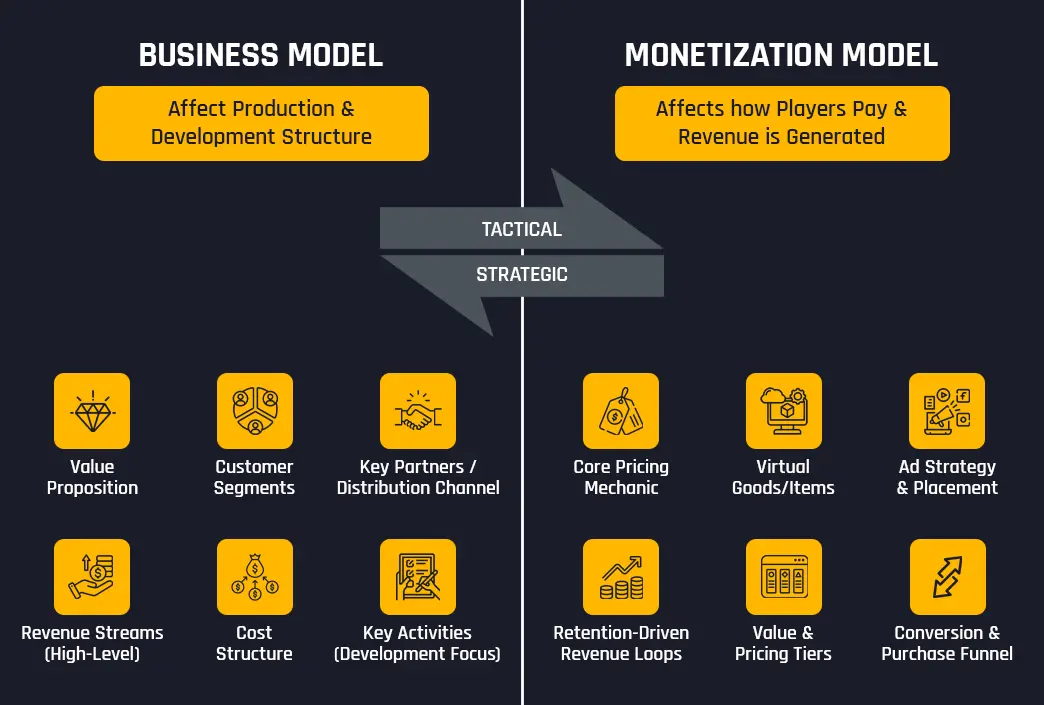
A game business model defines how a game is built, produced, launched, and supported over its lifecycle. It guides decisions around team structure, technology, budgets, content cadence, and LiveOps readiness long before monetization strategies come into play.
The State of Mobile Gaming 2024 Report by data.ai states that more than 65% of studios reported that choosing the right development model had a greater impact on launch success than monetization design itself. This reflects a shift in how modern teams plan production: the game development business model now shapes whether a project can scale, hit milestones, and sustain long-term updates.
Difference Between Business Models And Monetization Models
In contrast to a business model, a monetization model defines how the game earns revenue once players experience it. This includes pricing, in-game purchases, ad strategy, subscriptions, hybrid systems, and retention-driven revenue loops.
The Complete List of Game Business Models
Below are the most widely adopted game development business models across mobile, PC, console, and cross-platform production.
1. Premium Game Business Model
The premium model revolves around a one-time purchase, making production quality and launch readiness critical. Titles like Elden Ring, God of War Ragnarök, and Hades exemplify this model, where high production value and a polished 1.0 release drive success.
Studios building premium titles often prefer full-cycle game development services because consistent engineering, game art quality, and unified pipelines are essential for delivering a seamless final product.
2. Games-as-a-Service (GaaS)/LiveOps-Driven Model
The GaaS model is seen as one of the best business models for games requiring long-term engagement. Successful examples include Fortnite, Genshin Impact, and Apex Legends, all of which rely on continuous content updates, seasonal events, and strong LiveOps pipelines.
Teams scaling GaaS titles often turn to game co-development to scale feature production, run events, or accelerate art pipelines while internal teams focus on core systems and product vision.
3. Early Access Business Model
Early Access allows a studio to release an in-progress build and iterate with community feedback. Games like Baldur’s Gate 3, Hades (early access phase), and Subnautica refined their mechanics, UI, and content through player-driven updates before full launch.
Teams often rely on full-cycle development support or selective co-dev for engineering, game art, and optimization to maintain frequent update milestones while preparing for a 1.0 release.
4. Episodic or Chapter-Based Development Model
This model delivers the game in structured episodes or chapters. Popular examples include Life is Strange, Telltale’s The Walking Dead, and Kentucky Route Zero.
Episodic development pairs well with external art and engineering support because co-development enables parallel creation of future chapters while the internal team polishes earlier releases. Narrative planning, asset continuity, and production cadence are central to this approach.
5. Platform Ecosystem Model (Roblox, UEFN, Meta Horizon Worlds)
Ecosystem platforms offer built-in audiences and clear revenue-share structures. Successful titles include Adopt Me! on Roblox, OnlyUp! UEFN Edition, and numerous creator-led experiences in Meta’s Horizon Worlds.
The game development business model here centers on rapid iteration, user-generated content loops, and constant updates. Hybrid pipelines – combining internal oversight with external co-dev – boost content velocity. Studios hire 3D artists to support their teams by producing stylized assets optimized for each platform’s constraints.
6. Crowdfunded Game Business Model
Crowdfunding finances early development through community support. Games like Star Citizen, Shovel Knight, and Pillars of Eternity exemplify this model. Because backers expect regular updates, this approach benefits from structured workflows and predictable milestone delivery.
Teams may use external partners for full-cycle development of core systems or specialized needs like concept art, trailers, prototyping, or optimization.
7. Publisher-Funded/Revenue Share Model
Under this model, the publisher funds development and may support marketing, QA, distribution, or LiveOps. Major releases like Destiny, Call of Duty, and Alan Wake 2 were built under publisher-funded structures.
This model requires strict milestone delivery, where co-development and full-cycle development provide scalability and predictability. An external game art studio can also help maintain consistency across multiple platforms.
8. Hybrid Production Business Model (Internal + External Co-Dev)
The hybrid model is one of the best business models for games requiring scalability and rapid iteration. Large franchises like Assassin’s Creed, Call of Duty, and Halo Infinite regularly use a combination of internal direction and external co-development studios across art, engineering, systems design, and LiveOps support.
This blended pipeline allows internal teams to focus on high-impact creative decisions while game development outsourcing partners handle volume-heavy production tasks.
Why Do Business Models Matter for Studios, Publishers & Funded Indies?
A game business model directly shapes how a project is staffed, scheduled, funded, and supported after launch. In a market where development timelines continue to grow, studios face more production pressure than ever. At the same time, production costs for mid-core and AAA titles have risen sharply over the last decade.
AAA budgets that once averaged $100–200 million in the early 2010s now often reach $300–600 million or more, driven by larger teams, expanded content scopes, and extended 6-10+ year development cycles.
With stakes this high, studios can’t afford structural inefficiencies.
A well-defined game development business model influences:
-
Team Capacity & Skill Requirements
Studios must determine whether internal teams can manage full production or whether co-development and scalable art/engineering support are required to hit key milestones.
-
Budgeting & Production Forecasting
Different models – Premium, GaaS, Early Access, Hybrid – have radically different cost curves. Premium titles front-load cost, while GaaS and ecosystem games distribute investment across LiveOps, updates, and content cycles.
-
Technology & Platform Strategy
Business models determine engine choices, cross-platform requirements, backend infrastructure, and the long-term need for optimization or porting.
-
LiveOps Readiness
Service-driven games require continuous content, monitoring, and tuning. Studios often bring in LiveOps specialists or external partners to sustain cadence.
-
External Collaboration Strategy
Many studios now blend internal direction with full-cycle development, co-dev, or external game art pipelines to increase velocity, especially when targeting multi-platform or GaaS structures.
Because the business model sets the foundation for every downstream decision, including monetization, roadmap planning, and game LiveOps services, it is one of the most critical early choices a studio makes.
Business Models for Mobile Games
Mobile game development follows different production dynamics compared to PC and console. Shorter iteration cycles, rapid content updates, and platform-driven constraints mean studios must choose a business model for mobile games that aligns with their resources and long-term goals.
Mobile teams commonly adopt:
-
GaaS/LiveOps-Driven Models
Mobile titles like Clash Royale or AFK Arena rely on weekly or monthly updates, requiring strong LiveOps pipelines and sometimes external co-development teams to support continuous content delivery.
-
Hybrid Production Models
Many mobile studios keep core design internal but use co-development for engineering, game art pipelines, feature pods, and scaling LiveOps needs, especially during high-volume content cycles.
-
Ecosystem/Platform-Based Models
Hypercasual and creator-driven ecosystems (e.g., UEFN mobile experiences) allow faster prototyping and rapid publishing, appealing to smaller teams or studios exploring new verticals.
Choosing a mobile-first game development business model helps studios stay competitive in a market where speed, scalability, and LiveOps-readiness define long-term success.
How to Choose the Right Game Business Model for Your Studio
Selecting the best business model for games is ultimately a strategic decision shaped by resources, timeline, team composition, and audience expectations. Studios often evaluate models using the following criteria:
-
Team Size & Internal Expertise
If your internal team can’t cover all disciplines – engineering, art, design, UI, backend – full-cycle development or co-dev becomes essential.
-
Budget & Funding Structure
Premium titles require heavy upfront investment, while Early Access, episodic, or publisher-funded models allow for staged production.
-
Content Cadence Requirements
GaaS models demand ongoing features, updates, and LiveOps events. Premium titles need high polish at launch but fewer post-launch commitments.
-
Platform Strategy
Mobile demands rapid iteration; console and PC require long production cycles; ecosystem platforms reward fast experimentation.
-
IP Ownership & Creative Control
Crowdfunding and self-funded Early Access offer full autonomy. Publisher-funded models come with milestone accountability and shared direction.
-
Ability to Manage Multi-Track Production
Hybrid production models allow studios to parallelize development by integrating external co-development teams into their pipeline.
By aligning these factors with your long-term vision, the right game business model becomes much clearer.
How Co-Development, Full-Cycle Development, & LiveOps Support Each Business Model
These specialized models empower game studios to scale efficiently across indie, mid-core, and AAA business structures by leveraging external expertise.
- Full-cycle development: External teams handle the entire project end-to-end (engineering, art, design, QA).
- Co-development: Internal and external teams collaborate side-by-side on specific features, art, or LiveOps.
- LiveOps: Ongoing post-launch operations including events, updates, balancing, and player engagement.
- Game art support: External specialists create assets like characters, environments, UI, and VFX for consistent visuals.
Modern studios rarely operate in isolation. As production complexity grows, external partnerships become critical to delivering consistent quality, predictable timelines, and long-term content support.
Full-Cycle Game Development
Best for: Premium, Early Access, Mid-core PC/Console, Indie AA
Full-cycle teams handle everything end-to-end – engineering, game art, design, UI, QA, optimization – making them ideal when studios need complete ownership and seamless execution.
Co-Development
Best for: GaaS, Hybrid, Ecosystem, Multi-platform games
Co-dev models allow internal and external teams to work side-by-side across features, modes, tools, art pipelines, and LiveOps updates. This is especially valuable for studios scaling up production without expanding permanent headcount.
LiveOps Support
Best for: GaaS, Mobile, Battle Pass-driven, Seasonal content
LiveOps specialists manage content updates, performance tuning, event planning, and analytics-driven iteration. Long-term LiveOps readiness is foundational to sustaining service-based game business models.
Game Art Support
Best for: Premium, GaaS, Ecosystem, Hybrid production
Large content pipelines require continuous asset creation – environments, characters, UI, VFX. External art teams ensure visual consistency while accelerating delivery.
Each business model has unique operational needs, and choosing the right support structure is often as important as choosing the model itself.
The table below shows how well each business model aligns with common external support structures:
🟢 = Strong Fit
🟡 = Partial Fit
⚪ = Rare/Not Typical
| Business Model | Full-Cycle | Co-Dev | Game Art | LiveOps |
| Premium | 🟢 | 🟡 | 🟢 | ⚪ |
| GaaS / LiveOps | 🟡 | 🟢 | 🟢 | 🟢 |
| Early Access | 🟢 | 🟢 | 🟢 | 🟡 |
| Ecosystem (Roblox/UEFN/Meta) | ⚪ | 🟢 | 🟢 | 🟡 |
| Hybrid Production Model | 🟡 | 🟢 | 🟢 | 🟡 |
Common Mistakes Studios Make When Choosing a Business Model
Even experienced studios encounter friction when selecting a production framework. The most common pitfalls include:
- Confusing monetization models with business models
Monetization decisions (F2P, subscriptions, etc.) come after defining the core game development business model. - Underestimating the cost and complexity of LiveOps
GaaS-driven games require dedicated support teams, tooling, analytics, and long-term update pipelines. - Choosing a model that doesn’t match team capacity
Studios may choose GaaS or ecosystem models that require rapid iteration but lack the internal resources to sustain them. - Relying exclusively on internal teams for large productions
AAA-lite, multi-platform, or fast-moving mobile projects often fail without co-development or external art support. - Lack of production forecasting
Premium titles demand heavy front-loaded investment; GaaS titles distribute cost over many years – each requires different budgeting logic.
Avoiding these mistakes ensures your game business model remains realistic, sustainable, and aligned with your goals.
Summary: Which Game Business Model Fits Your Studio Best?
There’s no universal best business model for games – only the model that best aligns with your studio’s resources, goals, and production reality.
Final Thoughts
Your choice of game business model shapes everything – from production pacing to content cadence to how your team scales. Matching your model to your capabilities, timeline, and long-term vision gives your project the foundation it needs to succeed in an industry where scope, player expectations, and development cycles continue to rise.
If you’re evaluating the right approach for your next title or need support in building or scaling production, explore how our game development studio partners with teams worldwide through full-cycle development, co-development, LiveOps, and art production. Discuss your next project with us!
Frequently Asked Questions
The most common gaming business models include:
- Premium: One-time purchase with a defined launch and post-launch scope
- Free-to-play: Ongoing development funded through long-term player engagement
- Live service: Continuous content updates and service-based operations
- Subscription: Recurring access to games or content libraries
- Hybrid: Combinations of multiple approaches tailored to studio goals
Each game business model shapes how a studio plans, funds, launches, and supports games over time, rather than focusing only on how players are charged.
The business model for mobile games typically falls into a few clear structures:
- Free-to-play live services focused on long-term engagement
- Premium paid apps targeting niche or high-value audiences
- Hybrid models blending premium access with ongoing content support
These models directly influence content cadence, LiveOps investment, and decisions around external production or technology partners.
The best business model for games that need to scale is usually built around live service and ongoing content delivery. These models support:
- Long-term player retention
- Predictable operational planning
- Sustainable revenue over extended lifecycles
Studios often pair these models with co-development or full-cycle external teams to expand production capacity without overextending internal resources.
Co-development and LiveOps operate as enabling layers within a game development business model, particularly for free-to-play and live service games. They help studios:
- Extend internal teams without permanent hiring
- Maintain frequent updates and live content
- Support multiple titles in parallel
Rather than being standalone models, they reinforce and scale the core business structure.
Related Posts

US-Based Unreal Partners: How the Top 5 Compare in 2026
Picking a US-based Unreal partner matters most for teams building high-fidelity, performance-driven games. Visual standards keep climbing, console and PC pipelines keep getting stricter, and LiveOps readiness is no longer optional. Plenty of teams talk up their Unreal experience. Few deliver at a production-grade level once a title has to ship and stay live.
How Game Porting Works: Process, Stages, and Cost Breakdown (2026 Guide)
How does game porting work? This is one of the most frequent questions game developers ask as they look to expand their reach and take advantage of the different platforms available today. The game porting process is an important part of how developers can leverage the different platforms for their game, allowing them to reach a […]

Cost of Game Development in Australia
This blog talks about what it costs to build a video game in Australia in 2026 — covering developer salaries, project-type budgets, phase-by-phase cost breakdowns, Australian tax incentives like the Digital Games Tax Offset (DGTO), hybrid outsourcing strategies, and common budget mistakes studios make.