


 Unity
Unity Unreal
 Godot
Godot
 Mobile
 PC
PC Console
 Full-Cycle
 Co-Development
 Outstaffing






-
 Game Development, Thought Leadership
 Dec 31st, 2025
- Share:
Table of Contents
- The Evolution of Gamer Expectations
- Beyond Visuals: Building Games With Intent and Vision
- The Authenticity Imperative
- Rethinking Visual Fidelity as a Creative Tool
- The Rise of Immersive and Intelligent Gameplay Technologies
- The Production Reality: Building Games Efficiently
- Strategic Imperatives
- Final Thought
What does it take to stand out when half of all player spending goes to fewer than ten active games?
You read it right, according to The Bain Gaming Survey, the top ten games capture 50-60% of spending on active games. This is a reality the entire industry is being forced to confront, because technical mastery alone no longer guarantees relevance, let alone success.
For studios that have built their reputation on technical mastery across PC and console gaming, this concentration of value demands a fundamental reassessment of how we allocate resources and define success.
The Evolution of Gamer Expectations
Look at what players are actually telling us. The Bain Gaming Survey sampled over 5,000 participants across six countries, and the findings should make every studio pause and reconsider its priorities. Only 7% of players say high-quality graphics or audio drives their game choices.
So what are they prioritizing instead?
Gameplay. Community. Personalization.
Think back to every console cycle for the past two decades.
Visual breakthroughs defined those launches. The industry operated on a simple belief: better graphics equal more excitement. Push the tech, and players will follow.
That’s not how engagement works anymore. Rather, it stems from something more profound: ownership of experience and meaningful connection.
Market signals make the shift undeniable:
| Trend | Past Era | Today |
| Graphics priority | Core differentiator | Secondary to experience |
| Story structure | Mostly linear | Branching and adaptive |
| Cultural representation | Surface-level | Authentic and researched |
| Community | Marketing channel | Central to experience |
| Player identity | Predefined | Expressive and customizable |
Here’s the number that should really get attention: in 2025, over 80% of the top 20 rated games on Metacritic came from indie studios. Clair Obscur: Expedition 33 and Split Fiction each moved over a million copies within three days of launch—without AAA budgets or marketing spend. Budget is no longer a proxy for quality.
Beyond Visuals: Building Games With Intent and Vision
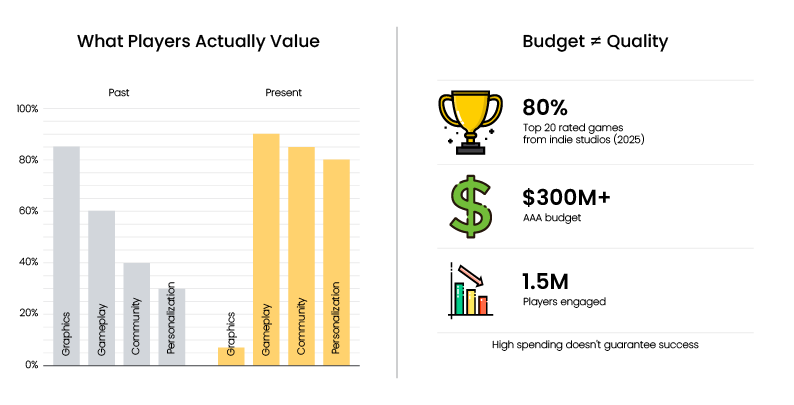
Spider-Man 2 reportedly exceeded $300 million in production costs. Call of Duty: Black Ops Cold War reached $700 million in sales when marketing is included. Yet Dragon Age: The Veilguard engaged around 1.5 million players, falling short of expectations. The pattern is clear: visual fidelity alone cannot compensate for experiences that fail to align with player motivations.
So what separates the studios that succeed from those that stumble despite massive budgets?
The strongest teams excel in PC game development, where flexibility, mod culture, feature depth, and iterative systems often define player expectations.
At the same time, they approach console game development with equal rigor, prioritizing accessibility, optimization, and a unified experience across standardized hardware.
What unites both approaches is not technology, but clarity of intent.
Successful developers lead with understanding, mapping design and mechanics to players’ emotional needs. This is development driven by purpose, not production habit.
The Authenticity Imperative
Authenticity has become non-negotiable.
Players can tell the difference between experiences that genuinely engage with their subject matter and those that just adopt superficial trappings for commercial appeal. There’s no faking it anymore.
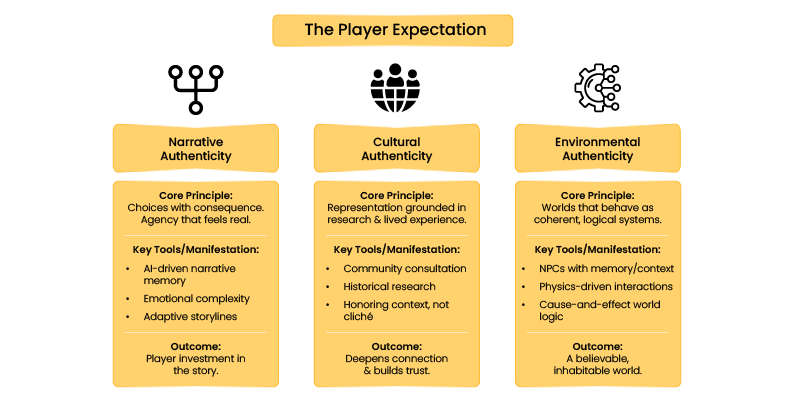
This demand for authenticity shows up across three interconnected dimensions.
-
Narrative Authenticity
Modern players expect stories that respect emotional complexity and player agency. Titles like The Last of Us, Red Dead Redemption 2, and Disco Elysium succeed because choices meaningfully affect relationships and outcomes, rather than offering the illusion of control. AI-driven narrative systems are increasingly ensuring that decisions are remembered, consequences persist, and agency feels real.
-
Cultural Authenticity
Global audiences expect representation grounded in research, consultation, and lived experience. Games such as Never Alone (Kisima Inŋitchuŋa) and Assassin’s Creed Origins demonstrate how engaging with communities and honoring history builds trust. When culture is treated as visual flavor, credibility collapses, but when treated as lived context, connection deepens.
-
Environmental Authenticity
Worlds must behave as coherent systems, not static backdrops. Players expect NPCs and environments to react logically through emotion, context, and memory of interaction. Juego Studios’ work on Ghostbusters: Spirits Unleashed exemplifies this approach, where haunt mechanics, ghost AI, and physics-driven interactions follow intuitive cause-and-effect rules, creating a world that feels responsive and believable.
Authenticity across narrative, culture, and environment creates belief. When systems align, and worlds respond consistently, players stop questioning the experience and begin inhabiting it. In 2026, that sense of trust is one of the strongest differentiators a game can achieve.
Rethinking Visual Fidelity as a Creative Tool
Visual quality still matters, but what defines “good graphics” has fundamentally changed. Advances in photogrammetry, real-time rendering, and ray tracing now allow visual fidelity on par with Hollywood CGI, as seen in titles like Cyberpunk 2077, Alan Wake II, and Black Myth: Wukong. Used intelligently, these technologies enhance immersion rather than simply displaying technical prowess.
The real shift, however, is economic. AI upscaling technologies such as DLSS 4 and FSR 4 have redefined how fidelity is achieved, allowing higher perceived resolution while freeing GPU resources for physics, AI behavior, and world reactivity. For many players, 1440p with AI upscaling has become the preferred balance between visual quality and performance, while native 4K remains a niche choice.
The implication for development is clear. Visual spectacle must align with audience expectations and gameplay needs. Studios succeeding today understand that fidelity is a creative tool in service of experience, not a metric to be maximized for its own sake.
You Might Find This Useful: Game Art Clarity vs Visual Fidelity
The Rise of Immersive and Intelligent Gameplay Technologies
The rapid evolution of VR, AI, and cloud architecture goes beyond just changing how games are played—it’s reshaping how they’re designed, delivered, and experienced from the ground up.
Artificial Intelligence in Game Development
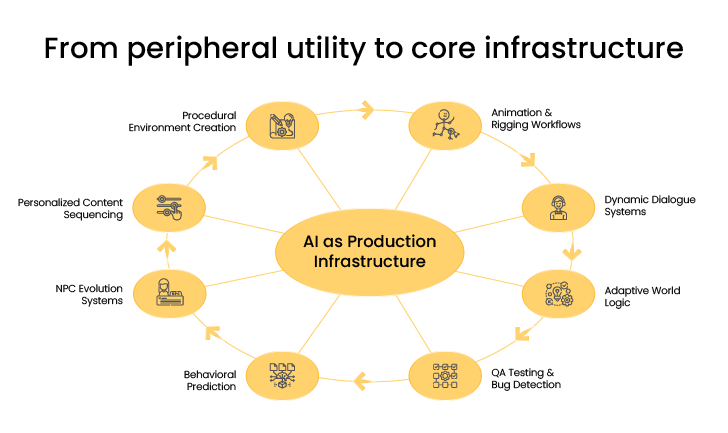
AI is no longer a peripheral utility; it has become the core infrastructure powering modern game production.
AI usage is becoming more visible across modern game development, with a growing number of studios incorporating AI-assisted tools into specific parts of their pipelines. Rather than signaling uniform adoption, this trend reflects an industry-wide exploration of how AI can complement existing workflows while preserving creative control.
The applications span the entire production cycle:
- Procedural environment creation that generates diverse, believable spaces
- Animation and rigging workflows that compress production timelines
- Dynamic dialogue systems that respond intelligently to player choices
- World logic that adapts in real-time to player actions
- QA testing that identifies bugs faster than human teams ever could
- Retention and monetization prediction based on behavioral patterns
But the most transformative applications? Non-player characters that evolve based on interaction history. Adaptive difficulty that responds to skill level without manual adjustment. Personalization of content sequences tailored to individual preferences. Gameplay pacing that shifts based on how someone actually plays, not how the designer assumed they would.
The Production Reality: Building Games Efficiently
The economics of game production have reached a critical threshold. Development budgets continue to accelerate faster than revenue growth. By 2030, it’s expected that 30% of large-scale games may exceed $500 million in production cost if current trends continue.
This trajectory is not sustainable. The industry must recalibrate.
Successful studios now embrace disciplined resourcing and iterative release philosophies across both PC and console.
They employ globally distributed teams, utilize best-in-class tools, apply scope boundaries intentionally, and incorporate mid-development player feedback rather than waiting until after launch to discover what works.
Crucially, studios have recognized that players value:
- Meaningful gameplay over spectacle
- Contextual storytelling that resonates emotionally
- Personalization that reflects their choices
- Community engagement that creates shared experiences
These elements surpass hyper-fidelity graphics in creating lasting engagement. Understanding this hierarchy of value is what separates efficient production from wasteful spending.
Strategic Imperatives
Looking into the coming decade, several console & PC gaming trends will define player expectations, and these three priorities will separate leaders from laggards:
- Audience depth over technical breadth – Understanding player motivation at granular levels matters more than maximizing every technical specification. Map design, mechanics, and art direction to emotional and experiential needs, not production habits.
- Intelligent cost discipline – Rising budgets demand surgical precision in resource allocation. Visual spectacle must align with audience expectations and gameplay needs. Fidelity is a creative tool in the service of experience, not a metric to maximize independently.
- Technology as an enabler, not a signal – AI, cloud infrastructure, and immersive interfaces succeed when they enhance the experience rather than demonstrate capability. Players care about the result, not the method.
Final Thought
Gaming shaped by evolving PC & console gaming trends requires a recalibration of how production quality, fidelity, and authenticity are delivered. Technical excellence remains essential, but only when it serves a purpose rather than spectacle.
The studios that will define the next era are those that understand their audiences deeply, apply cost discipline intelligently, and use technologies like AI, immersive interfaces, and cloud infrastructure as creative tools rather than marketing signals. The future belongs to teams that build with focus and intention, creating experiences that foster lasting connection, not just commercial success.
Frequently Asked Questions
Players want meaningful gameplay, authentic storytelling, cultural and environmental realism, community engagement, and personalised experiences beyond just graphical fidelity.
Budgets continue rising steadily, with AAA titles exceeding hundreds of millions, but high spending alone no longer ensures commercial or critical success without clear audience alignment.
AI enhances procedural content, NPC behaviour, animation, dialogue, testing, and personalisation, making development efficient and gameplay more adaptive and immersive.
Accessibility is essential and expected, with many studios integrating scalable UI, control remapping, assistive input, and inclusive character representation from the design phase onward.
Cloud gaming lowers hardware barriers, enables instant access, cross-device play, and seamless multiplayer, changing how games are designed and distributed as a mainstream platform.
Related Posts

Game Art Clarity vs Visual Fidelity: Guide to Production Success for Studio Leaders
Across internal teams, distributed co-development groups, and multi-studio collaborations, the same issue shows up again and again: teams optimize for how art looks, but underestimate how art behaves once real production pressure begins.

What PC & Console Gamers Expect: Production Quality, Fidelity & Authenticity
As player expectations evolve, technical excellence alone no longer defines success. In 2026, production quality is measured by intent, authenticity, and alignment with player motivation. Studios that understand their audience, apply discipline to scale, and use technology purposefully will shape gaming’s next era.