


 Unity
Unity Unreal
 Godot
Godot
 Mobile
 PC
PC Console
 Full-Cycle
 Co-Development
 Outstaffing





-
 Game Co-Development
 Dec 31st, 2025
- Share:
Table of Contents
The journey from a rough concept to a thriving, profitable game is rarely linear. Whether you’re an indie developer working from your garage or a studio managing a team of 50, the path to scaling demands strategic planning, technical flexibility, and a relentless focus on player experience. Partnering with expert game development services can streamline this process and help bring your vision to life.
This guide walks you through every phase of that journey, addressing the challenges that arise when your game grows from a promising MVP into a full-fledged product that can sustain itself through content, community, and revenue.
Overview of Scaling Challenges and Opportunities
Scaling a game means growing it smarter, not just bigger. You need systems that can handle 10x the load, team structures that support creativity, and operations that drive engagement and revenue.
The biggest challenge is technical debt. When building an MVP, you prioritize speed over perfection. Quick networking solutions, placeholder art, and rough game balance work initially but become problems later. A matchmaking system that handles 100 players may fail at 10,000.
Beyond code, team dynamics shift as you grow. Single-channel conversations become structured meetings. Your shared vision fragments across disciplines. Feature creep accelerates without clear priorities, leading to work that doesn’t serve your core game loop.
Community management also changes. Small player bases build culture organically. Large ones need intentional design—moderation, events, communication channels, and responsive feedback systems.
The opportunities are significant. A well-scaled game reaches millions of players. Live operations create continuous revenue instead of one-time launch spikes. Strong teams multiply creative output and enable specialization. And proper feedback loops become your best tool for improvement.
Laying the Foundation: From Idea to MVP
Before scaling, you need something worth scaling. An MVP is a stripped-down, playable version that proves your core loop works and players are interested.
Conceptualizing the Game and Market Fit
Start with a clear vision, not a feature list. Ask yourself: What is the player doing at the core of this game? What problem does it solve, or fantasy does it fulfill? If you can’t answer in one sentence, you’re not ready to build.
From day one, think about scalability:
- Can your core mechanic support more players?
- Will your art style work across platforms?
- Can your narrative expand without losing coherence?
Research your market. Study similar games on your platform—how they monetize, how communities engage, and what gaps you can fill.
Prototyping Core Gameplay Mechanics
Build a rough prototype to test if your core loop is fun. This is the moment-to-moment interaction players will repeat hundreds of times.
Use tools like Unity or Unreal for rapid prototyping. Start with placeholder art and simple mechanics. The goal is clarity, not polish—figure out if the loop is worth pursuing before investing further.
MVP Development and Early Player Feedback
Build a vertical slice: 20% of features at 80% quality, not 80% of features at 20% quality.
Define your MVP ruthlessly:
- Identify the 3-5 features that define your game
- Everything else goes into a “Phase 2” backlog
- Use MoSCoW prioritization (Must have, Should have, Could have, Won’t have)
Test with real players immediately:
- Analytics show what players actually do
- Surveys reveal what they think
- Observation uncovers where they struggle
This feedback determines whether to scale or pivot.
Building Up: Scaling the Game Product
Once your MVP proves market fit, it’s time to expand into a polished, feature-rich product.
Expanding Features and Content Without Losing Focus
Feature creep kills scaling projects. Every new feature multiplies complexity in testing, balancing, and maintenance.
Stay focused:
- Create a Game Design Document (GDD) that defines your core loop
- Evaluate new features against your GDD—does it strengthen the core experience?
- Develop in clear phases: Phase 1 (MVP) proves viability,
- Phase 2 expands core features, Phase 3 adds secondary content
Think in systems, not isolated features. Instead of “add a weapon,” build “a weapon progression system that supports dozens of weapons.” Systems scale; one-off features don’t.
Evolving the Tech Stack for Growth and Performance
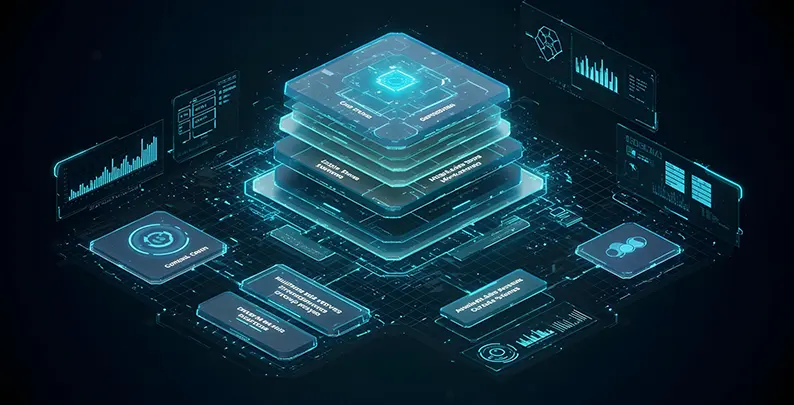
Your initial tech choices determine what’s possible later. An engine handling 100 players may fail at 10,000.
Key considerations:
- Engine choice: Unity and Unreal are industry standards with modular architectures
- Backend services: PlayFab, GameSparks, or custom AWS/Azure solutions
- Horizontal scalability: Build systems that distribute work across multiple servers, not single machines
- Modular architecture: Keep combat, progression, and UI systems independent so teams can work in parallel
Optimize performance continuously:
- Use level-of-detail (LOD) systems for lower-end devices
- Implement asset streaming to load only what players need
- Profile regularly to catch bottlenecks early
- Prioritize stable frame rates over maximum visuals
Cross-Platform and Genre Considerations
Multiple platforms multiply your audience and complexity. Build one game that works everywhere, not separate games per platform.
Platform strategy:
- Perfect your primary platform first, then adapt to others
- Adjust controls, UI, and graphics for each platform
- Implement cloud saves and cross-progression from day one
Understand your genre’s scaling needs:
- Roguelikes need a different architecture than MMOs
- Battle royales require robust server infrastructure
- Single-player games don’t need matchmaking systems
If your title is built for mobile-first platforms, collaborating with a mobile game development team ensures you meet performance and platform expectations.
Ensuring Performance and Stability at Scale
Performance issues at scale are existential. Lag, crashes, or server outages can kill your game.
Build reliability:
- Automated testing: Run unit, integration, and performance tests on every code change
- Stress testing: Simulate your target concurrent players before launch
- Auto-scaling infrastructure: Cloud services that add servers automatically under load
- Redundancy systems: If one server fails, traffic reroutes automatically
Monitor everything in production with real-time dashboards tracking player counts, error rates, latency, and revenue. Set up alerts to catch problems before players complain.
Growing the Team: Scaling Development and Quality
As your game grows, so does your team. Managing that growth determines whether you build something great or something that collapses under its own complexity.
Hiring and Team Expansion Strategies
Small teams move fast with frictionless communication. As you scale, this breaks down.
Hiring strategy:
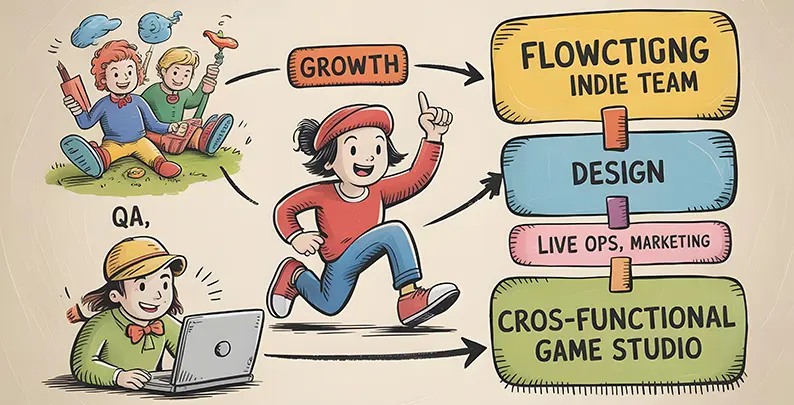
- Start with generalists who wear multiple hats
- Add specialists as you grow (network engineers, animators, UI designers)
- Maintain a core who understand the whole project
- Consider hybrid teams: in-house for strategy, contractors for specialized work
Hire for culture fit, not just skills. A talented person who hates your culture will drag everyone down.
Start QA and community management early—catching bugs before launch is cheaper than fixing them after.
Process Maturity: From Ad-Hoc to Agile Development
When you’re five people, decisions happen over lunch. At fifty, you need structure without bureaucracy.
Agile frameworks work well for games:
- Sprints: Fixed 2-week cycles with clear goals
- Daily standups: 10-15 minute check-ins to surface blockers
- Sprint reviews: Show what was accomplished
- Retrospectives: Discuss what worked and what didn’t
Use a backlog for new ideas mid-sprint instead of adding them immediately. This prevents constant context switching.
Track progress with metrics:
- Velocity (work completed per sprint)
- Burndown charts (sprint progress visualization)
- Cycle time (idea to shipped feature)
Quality Assurance and Testing Processes at Scale
Testing becomes harder as complexity grows. A new feature might break something from three weeks ago.
Modern QA approach:
- Shift left: Bring testing into development, not just at the end
- Automated testing: Verify core functionality on every code change
- Manual testing: Focus on player experience and balance
- Live service testing: Test patches internally, then on small player groups before full rollout
Use community testing (beta phases) for real-world feedback, but manage carefully—public bugs damage perception.
Preserving Creative Vision in a Larger Team
As teams grow, creative vision fragments. Everyone has ideas, but without clear leadership, you get a committee-designed game.
Maintain vision:
- Clear creative leadership: One person (game director) owns the vision and makes final calls
- Communicate constantly: Write down your vision, share it in meetings, reference it in decisions
- Design docs with “why”: Explain what player fantasy a feature serves, not just what to build
- Empower teams: Give objectives (“create a weapon that rewards precise aiming”) and let them solve it creatively
Foster psychological safety—people need to feel safe proposing ideas, even bad ones. A culture where people hide ideas kills creativity.
Company Evolution: Scaling Culture and Operations
Beyond the game itself, you’re building a company. And companies have needs that don’t ship in games.
Leadership Roles and Organizational Structure
Traditional studios are organized by discipline (design, art, programming), but this creates communication overhead.
Modern approach—organize by outcome:
- Cross-functional teams (5-9 people) own specific player experiences
- One team owns combat (designers, programmers, artists, QA), another owns progression, another owns social features
- Each team ships their outcome end-to-end without waiting on other departments
Leadership layers:
- Executive Producer/Studio Lead: Owns overall vision and big-picture decisions
- Directors (Game, Art, Tech): Own their discipline and quality standards
- Leads (Combat, Progression): Manage specific systems and outcome teams
- Individual Contributors: Execute the work
This structure scales by adding teams, not inflating departments.
Cross-Functional Departments: Marketing, Community, Support
Your game needs functions beyond development to reach players.
Marketing:
- Generates awareness before launch
- Attracts new players and re-engages lapsed ones post-launch
- Even small efforts (social media, YouTube, press outreach) expand reach significantly
Community Management:
- Small communities self-organize; large ones need moderation
- Enforces conduct, removes toxic behavior, creates safe spaces
- Bridges players and developers, surfacing valuable feedback
Player Support:
- Directly impacts perception—unheard players become public critics
- Quick responses to account issues and technical problems are essential
Community Events:
- Tournaments, challenges, seasonal events, streamer collaborations
- Keep the game feeling alive and give players reasons to return
These functions don’t need large teams, but treating them as afterthoughts guarantees they’ll be ineffective.
Maintaining Company Culture and Communication
Culture is how people treat each other when things go wrong and whether they feel safe speaking up.
Protect culture as you scale:
- Hire for cultural fit, not just skills
- Run retrospectives to reflect on how teams work together
- Celebrate successes together, own failures collectively
Communication strategies:
- Asynchronous communication: Document decisions, record meetings for distributed teams
- All-hands meetings: Monthly or quarterly to share updates, celebrate wins, and reinforce vision
- Feedback loops: Regular one-on-ones and team check-ins to address problems quickly
Culture compounds over time—invest in it deliberately.
Launch and Beyond: Scaling Up Live Operations
Launching is not the finish line—it’s the beginning of the real journey for a live game.
Launch Strategies: One-Time Release vs. Live Service
Two fundamental approaches exist, each requiring different planning:
One-time releases (indie games, story-driven experiences): Build a complete experience, ship it, and support with patches or DLC. You have one shot at a first impression. Focus on polish before launch.
Live-service games (multiplayer, free-to-play): Launch is the beginning, not the end. The game evolves for months or years through content updates, balance changes, and events. Focus on solid fundamentals at launch, then iterate rapidly based on player feedback.
The mindset differs: One-time releases ask “Is it finished?” Live-service asks “What should we build next?”
Choose deliberately. Live-service needs the right infrastructure, team, and monetization model. Forcing live-service mechanics into a one-time release alienates players.
Live Ops: Post-Launch Content Updates and Support
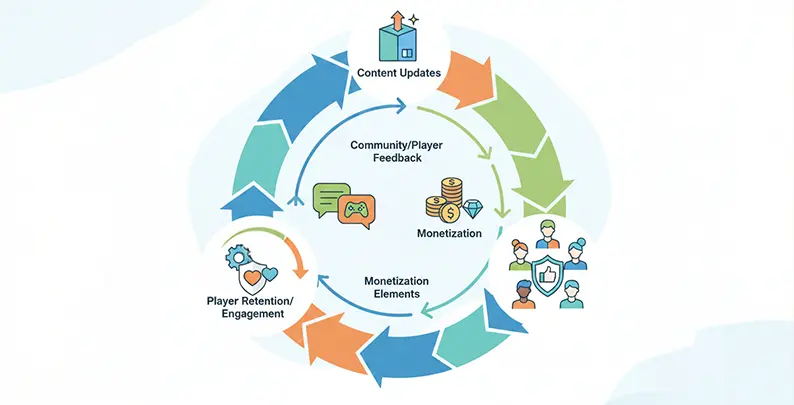
Live operations blend data (understanding player behavior) with feedback (responding to what players want) and content (keeping the game fresh).
Post-launch content includes:
- Balance patches to maintain fairness
- Bug fixes
- New features and content (levels, characters, modes)
- Events (limited-time challenges, seasonal themes)
Update frequency matters. Silent months lose momentum.
Predictable schedules (e.g., “new content first Thursday of every month”) keep players returning. But quality beats quantity—a bad event is worse than no event.
Monetization through live ops:
- Battle passes: Seasonal progression tracks
- Cosmetics: Skins, emotes, weapon skins
- Limited-time bundles: Urgency drives purchases
- Events: Players spend to participate
Balance is key. Aggressive monetization without content drives churn. Content without monetization can’t sustain development. Offer real value—great-looking cosmetics, rewarding battle passes, genuinely fun events.
Player Retention and Community Building
Players stay because your game offers something they want. Retention is a symptom of a good game, not a goal in itself.
- Regular content: Predictable cadence (seasonal drops, monthly events)
- Progression systems: Battle passes, seasonal challenges, ranks
- Social features: Clans, guilds, cooperative play create bonds
- Competitive modes: Difficulty scales with skill, keeping engaged players coming back
- Alternative modes: Casual vs. competitive, co-op vs. solo
Community building requires structure:
- Moderation: Clear codes of conduct, enforced fairly
- Events: Tournaments, challenges, community showcases
- Feedback channels: Discord, forums, in-game systems—and act on feedback
- Recognition: Highlight achievements, feature community content
Monetization Strategies and Revenue Scaling
Revenue funds development and sustains operations. Most failed games fail financially, not creatively.
Common models:
- One-time purchase: Pay upfront, own the game—requires exceptional word-of-mouth
- Free-to-play with cosmetics: No cost to play, but appealing cosmetics available
- Battle pass: Pay for seasonal progression track with rewards
- Premium currency: Buy in-game currency for cosmetics or convenience
Key principles:
- Avoid pay-to-win: Players accept cosmetic spending but resent paying for gameplay advantages
- Psychological pricing: £9.99 feels cheaper than £10
- Scarcity and urgency: Limited-time offers drive purchases
- Value perception: Battle passes must feel rewarding—meaningful cosmetics, not filler
Games that balance monetization with fair gameplay, offer real value, and respect player time generate sustainable revenue. Greedy tactics (forced purchases, aggressive pop-ups, manipulative difficulty) create short-term revenue and long-term churn.
Conclusion
Scaling a game is a continuous act of balancing ambition with constraints. You want to build something extraordinary without breaking your team or product. You want to respond to player feedback without losing your creative vision. You want to monetize without exploiting. The games that scale successfully respect their players, invest in their teams, and remain adaptable without losing focus. They build systems that scale, not features that bloat. They launch iteratively, learning from each step. Whether you’re scaling solo or leading a studio, Juego Studios can help you hire game developers with the right experience to match your project scope.
Frequently Asked Questions
Scaling a game means evolving it from a basic playable version into a full-featured, polished product with strong tech, content, team structure, and user support systems.
Indie devs should prioritize core gameplay, use agile methods, gather user feedback early, and scale content and systems gradually without sacrificing performance or player experience.
Successful studios scale by hiring purposefully, implementing efficient workflows, maintaining clear communication, and building cross-functional teams like marketing, support, and community management.
Live service games require ongoing content, server stability, player retention strategies, and community support, whereas one-time releases focus on launch readiness and long-term discoverability.
Related Posts

Game Development Outsourcing Works in 2026
This blog explores how game development outsourcing has evolved into a strategic production decision in 2026 rather than a simple cost-saving tactic, outlining the engagement models, execution risks, cost structures, and best practices studios must understand to scale without losing technical or creative control. It breaks down project-based, dedicated team, co-development, and hybrid models; examines average outsourcing costs across features, art, full-cycle production, and milestones; and provides a practical, end-to-end framework covering scoping, onboarding, sprint governance, QA, LiveOps, and IP protection. The article also compares leading outsourcing companies, explains how to evaluate vendor fit based on pipeline maturity and engine alignment, and positions outsourcing as a long-term production system where ownership, milestone validation, and architectural control determine ROI more than hourly rates.

8 Common Mistakes When Choosing the Right Co-Development Partner for Your Game
Your next game holds incredible potential. It could be a massive success or a costly failure. The key? Choosing the right co-development partner for your game. This blog helps you avoid critical mistakes. Successful collaboration ensures your game’s vision thrives. Let’s make your next game a winner.

Cost of Game Development in Australia
This blog talks about what it costs to build a video game in Australia in 2026 — covering developer salaries, project-type budgets, phase-by-phase cost breakdowns, Australian tax incentives like the Digital Games Tax Offset (DGTO), hybrid outsourcing strategies, and common budget mistakes studios make.