


 Unity
 Unreal
 Godot

 Mobile
 PC
 Console

 Full-Cycle
 Co-Development
 Outstaffing




-
 Game Development
 Oct 29th, 2026
- Share:
Table of Contents
- TL;DR (Quick Summary)
- What is the difference between a prototype, a vertical slice, and an MVP?
- What do publishers want to see before they sign?
- What do investors want to see, and is a game prototype enough for investors?
- Which one should you build first?
- What goes into each build, and what can you leave rough?
- What drives the cost of each one?
- What mistakes make a pitch build fail?
- Should you build it yourself or bring in a studio?
- Conclusion
You have a pitch coming up, and you’re not sure what to show the people across the table.
A prototype, a vertical slice, and an MVP each prove something different, and the right one depends on who you’re pitching. Here’s how to choose before you spend weeks on the wrong build.
Veronica has a publisher call in three weeks. She’s a solo founder with a rough prototype: the combat feels good, there’s a main menu with animated transitions, and a second level that crashes about half the time on anyone else’s laptop.
She can’t decide what to do next. Part of her wants to polish what exists. Part of her wants to throw it out and build a “proper” vertical slice. She spent most of last month on the menu, and she’s now fairly sure nobody will care about it.
Veronica isn’t a real person. She’s a made-up founder, built from a situation small studios and solo developers end up in before a pitch. If it sounds familiar, the rest of this post is about picking the build that suits the person you’re pitching.
TL;DR (Quick Summary)
What is a vertical slice in game development? It’s a small, playable piece of the game built to final quality, and it proves your team can deliver the finished experience. A prototype proves the core idea is fun, and an MVP, the smallest version real players can use, proves they’ll play it and come back. Publishers usually want to play a vertical slice or at least an easy-to-run build, while investors care more about player data or production risk, depending on the deal. Build the one that answers the question the person you’re pitching is asking.
Key Takeaways
- Test the build on a computer that isn’t yours before you send it.
- A vertical slice is short but finished. It isn’t a rough version of the whole game.
- An MVP is about player behavior, so it needs analytics and a build real players can install.
- Publishers usually ask for a vertical slice or an easy-to-play build, so read each publisher’s submission page before you build.
- Early on, a good prototype can be enough for some investors, depending on the team’s track record and the size of the ask.
What is the difference between a prototype, a vertical slice, and an MVP?
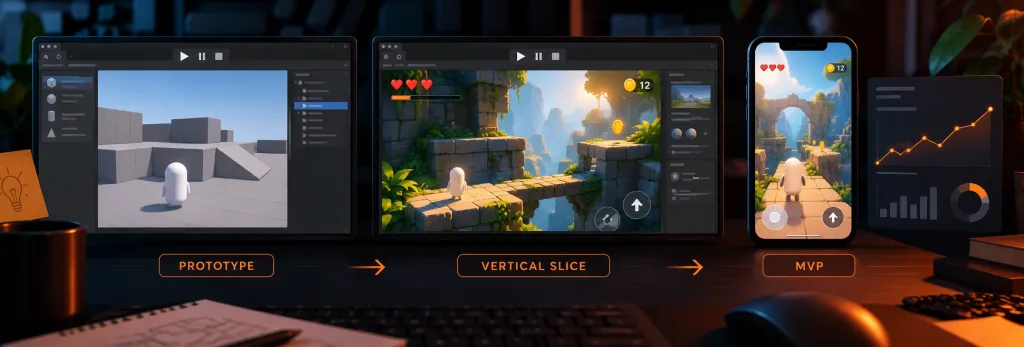
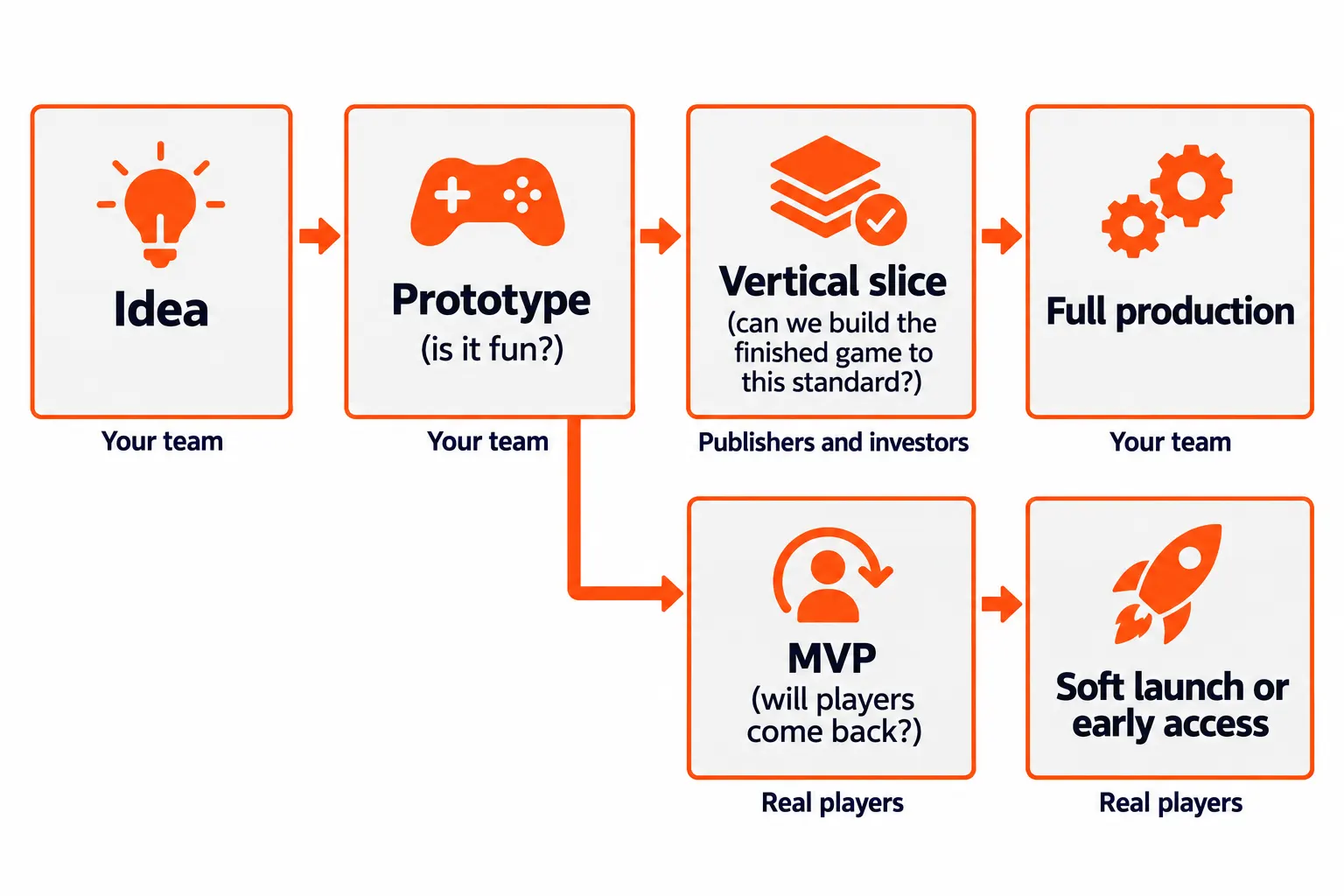
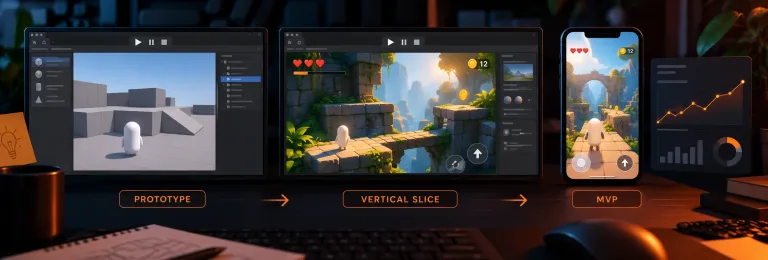
They answer three different questions. A prototype asks whether the core idea is fun. A vertical slice asks whether your team can build the game to one finished standard. An MVP asks whether real players will use the game and come back to it.
| Build | Question it answers | Art and audio | Code | Who it’s for |
| Prototype | Is the core idea fun? | Placeholder art or untextured blocks | Thrown away or rebuilt | Your team and a few testers, and sometimes a publisher or investor at a first meeting |
| Vertical slice | Can this team build the finished game to this standard? | Final quality, for one stretch of play | Usually written to be kept | Publishers, investors, and playtesters who judge the finished experience |
| MVP | Will real players use it and come back? | Good enough to ship, with limited content | Shippable, with analytics added | Real players, often in a soft launch or early access, and investors who want player data |
What is a vertical slice in game development?
A vertical slice is a small, fully playable part of the game built to final quality, so people can see what the finished game would look, sound, and play like. It’s called vertical because it cuts through every layer at once: design, code, art, animation, audio, effects, and UI, for one level, mission, or gameplay loop. A horizontal approach would build one layer across the whole game instead, such as the code for every level, with no final art.
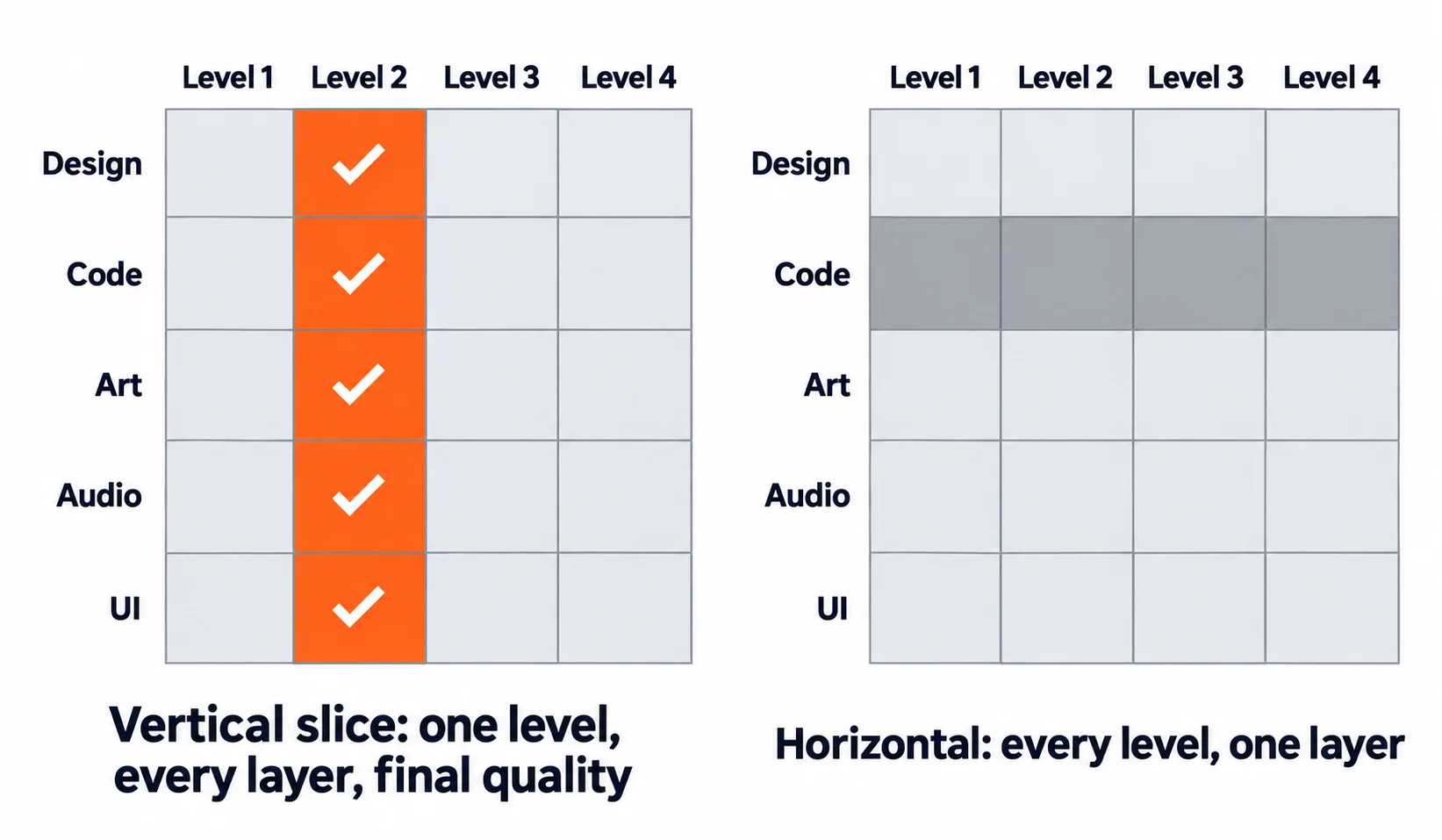
A slice is one stretch of play that a person can start and finish in a short sitting. If the budget can’t cover final-quality art, a smaller slice is better than a stretched one.
What is an MVP in game development?
An MVP in game development is the smallest version of a game that real players can play and that teaches you something about them. The idea comes from software startups, where Eric Ries, author of The Lean Startup, defines a minimum viable product as the version that lets a team learn the most about its customers with the least effort.
For a game, that means a working core loop, a tutorial, saving, a build players can install, and analytics so you can see where people quit. It’s most common on mobile, where studios often soft launch in a few small markets and watch retention before spending on marketing. It suits premium story games less well, because those lean on a strong first impression.
What counts as a game prototype?
A prototype is a rough, playable test of the riskiest idea in the game, built quickly with placeholder art. It answers one question, such as whether a grapple feels good or whether a puzzle mechanic stays interesting past the first level. Many teams make several small, throwaway prototypes rather than one big build.
Vertical slice vs prototype
A prototype can look ugly and still do its job. A slice can’t: its features and systems have to work together with final-quality assets, which is also why it takes longer to build. You’re no longer testing one mechanic, you’re showing that art, code, audio, and UI hold together.
Vertical slice vs MVP
A slice is short and curated, so you control what the viewer sees, often with you sitting next to them. An MVP has to survive strangers: a tutorial that makes sense without you, saves that work, and a build that doesn’t fall over on a phone you’ve never tested. A slice can’t tell you whether players come back after day one, and an MVP can’t show a publisher how good the finished game will look.
Game prototype vs MVP
A prototype tests whether something is fun, which a few people on your team can answer. An MVP tests whether someone who isn’t your friend plays it twice, which needs a store-ready build and a way to measure what they do. You can throw a prototype away without anyone noticing. An MVP has players, reviews, and sometimes revenue, so it’s harder to walk back from.
What do publishers want to see before they sign?
Publishers want to play something before they sign. For a publisher, a vertical slice is usually the strongest thing you can send, though what counts as enough varies from one publisher to the next.
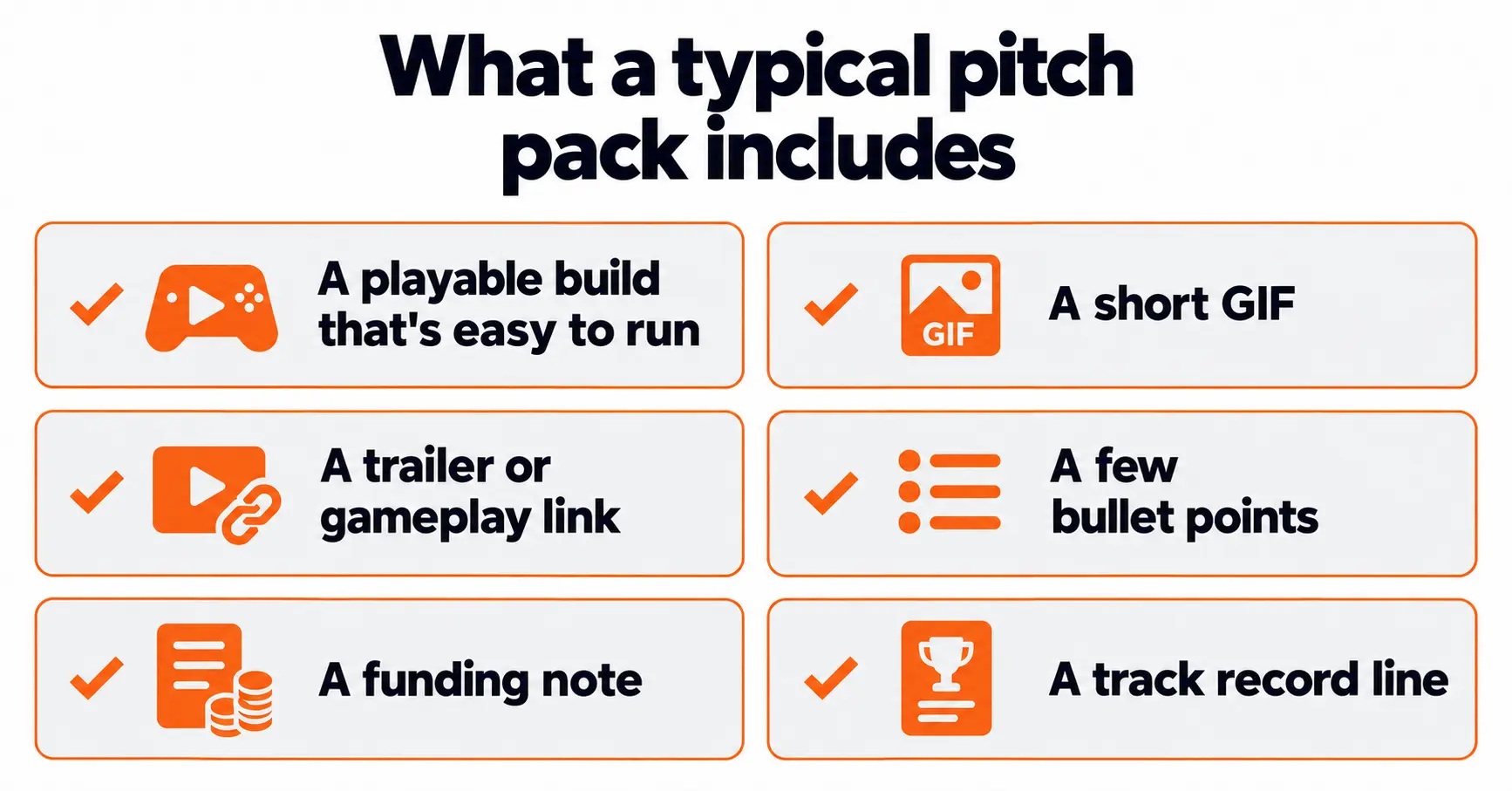
A typical pitch pack, such as the one tinyBuild asks for, is an easy-to-play build with a vertical slice of gameplay, a short GIF, a trailer or gameplay link, a few bullet points, and a note on any funding you need. Past releases help too, because they show you can finish a project.
A slice is meant to be final quality, but publishers know a pitch build won’t have every asset finished, so some placeholders are fine. Polish the part that carries your hook, and leave the secondary screens and levels rough.
Some publishers will talk to you at the prototype stage, before you’ve built a slice. Rami Ismail, co-founder of Vlambeer, argues that a publisher’s interest in the idea changes little between prototype and slice and that what changes is their belief that you can make it.
Submission rules differ, and some publishers want a form, a link, or a video before they ask for a build. Read each publisher’s page before you decide what to build.
What do investors want to see, and is a game prototype enough for investors?
Sometimes. A playable prototype can change how an investor sees your game, as long as it’s fun right away and you’re clear about what the money will build. Investors often hold back at the very start, though, unless the founders already have a track record or a high profile.
Beyond the build, investors will want the business basics: burn rate, staffing plan, porting costs, post-launch plan, and marketing. What they need from the build itself depends on what they’re worried about. An investor worried about production risk wants proof the team can build the finished game, which points to a vertical slice. An investor worried about demand wants player behavior, which points to an MVP with real retention numbers.
If you don’t know which one you’re talking to, ask what they’d want to see before you build anything.
What does each audience judge?
| Audience | What they’re really asking | What to show | What to leave rough |
| Publisher | Is it fun, can this team finish it, and will it sell? | Vertical slice, short gameplay video, a build that’s easy to run | Secondary screens, extra levels |
| Investor worried about production risk | Can this team build the finished game on this budget? | Vertical slice, plus a budget and staffing plan | Features that aren’t in the slice |
| Investor worried about demand | Will players use it and come back? | MVP with retention and early player numbers | Content breadth, extra polish |
| Early angel with a small ask | Is the founder credible, and is the idea fun? | A strong prototype, a short video, your track record | A full production plan |
| Grant or fund | Does the project meet our criteria, and can the team deliver? | Prototype or slice, shaped around the fund’s own application | Anything the application doesn’t ask for |
| Studio partner estimating the job | How big is the work, and what will it take? | Prototype or slice, plus a short design outline | A full design document for every system |
| Crowdfunding backers | Will it be fun, and will it actually ship? | A short gameplay trailer and a playable demo | Systems you can’t show yet |
Which one should you build first?
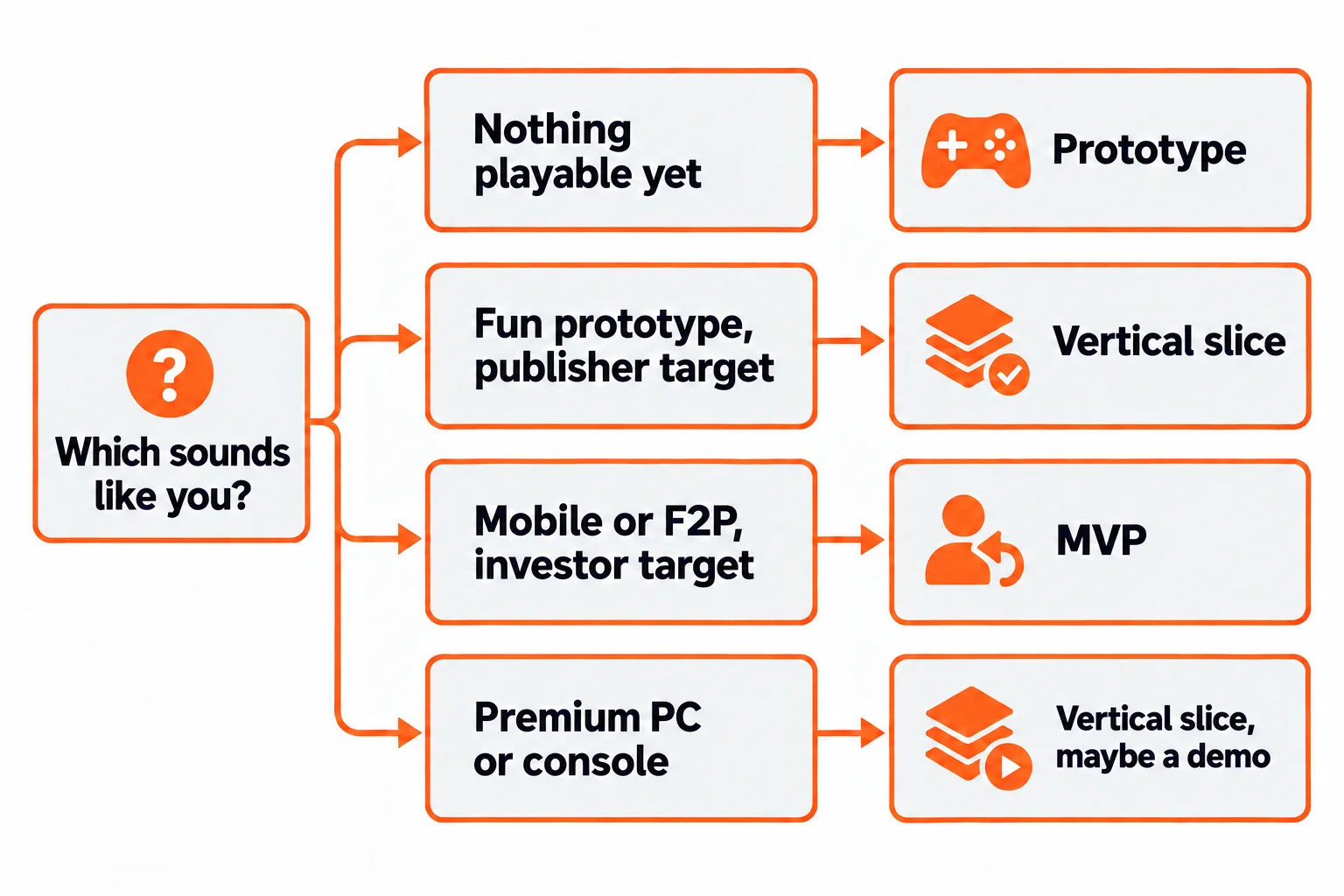
If you have nothing playable yet, build a prototype. If the prototype is fun and you’re pitching a publisher, build a vertical slice. If you’re pitching an investor and the game is mobile or free-to-play, an MVP with real player data may carry more weight.
| Your situation | Build this | Why | What to skip |
| You have an idea and nothing playable | Prototype | It’s the quickest way to find out whether the core mechanic is fun, and there’s nothing to pitch without it | Final art, menus, story |
| Your prototype is fun and you’re targeting a publisher | Vertical slice | Publishers want to play something that shows the finished experience | Extra levels, side systems, content breadth |
| Mobile or free-to-play game, and you want seed money | MVP in a soft launch | Retention and spend data answer questions a slice can’t | Polish beyond the core loop |
| Premium PC or console game with a strong visual hook | Vertical slice, then possibly a public demo | The first impression is a big part of the product, and a rough MVP can hurt it | Systems that aren’t in the slice |
| You want a studio to estimate the full game | Prototype or vertical slice, depending on how firm the design is | A working build gives anyone estimating the full game something to measure against | A full design document for every system |
Not sure which build fits your pitch?
Tell us about the game and who you're pitching, and we'll help you work out what to build first.
What goes into each build, and what can you leave rough?
Build the part your audience will judge, and keep the rest rough on purpose. Each of the three needs different things.
For a prototype, untextured blocks for levels, placeholder art, hard-coded values, and debug menus are all fine. Skip saving, settings, and menus. Aim each prototype at one question, so you know what the result means.
For a vertical slice, build one stretch of play from start to finish with final art, animation, audio, effects, and UI, plus the systems the player touches, such as combat, movement, or progression, working together. Run it on the hardware you’re targeting, since frame rate problems and loading hitches show up there and not on your development machine. Some things can be scripted or hand-held, like a fixed enemy spawn or a locked camera, as long as you say so in the pitch.
For an MVP, you need a working core loop, a tutorial that makes sense without you, saving, crash reporting, and analytics events so you can see where players quit. Decide what you’ll measure before you ship, because you can’t recover data you never logged.
One decision to make early is which code you’ll keep. A slice built on prototype-quality code can leave you rebuilding foundations before full production.
What drives the cost of each one?
It depends on the game. The main drivers are team size, art style, engine, target platform, and how much of the code you want to keep.
| Build | What drives the cost |
| Prototype | Quickest and cheapest, because it’s meant to be rough |
| Vertical slice | Costs more, because the art and polish are final quality |
| MVP | What surrounds the game: store setup, backend, analytics, and testing on real devices |
What mistakes make a pitch build fail?
Five mistakes come up again and again.
Polishing the wrong thing is Veronica’s menu. Publishers have limited time, so hours spent on screens nobody reaches are hours not spent on the hook.
Slicing the wrong part of the game happens when the slice is the tutorial level. A slice should contain what makes your game different, because a tutorial with no hook only shows a publisher that you can build menus.
A build that only runs on your machine is common. Test on a clean computer that isn’t yours. Missing dependencies, a different screen resolution, or no controller are the usual reasons a build works for you and for nobody else, and publishers ask for a build that’s easy to play.
An MVP with no analytics leaves you with a game that’s live and nothing to show an investor.
Passing off a prototype as a slice doesn’t help either. If your build is a prototype, say so and show the plan for the slice, because a prototype isn’t made for people outside the team.
Should you build it yourself or bring in a studio?
You can build the prototype yourself; a vertical slice is where a team that has shipped before helps most, and sometimes the right answer is not to hire anyone. If one programmer on your team can test the idea quickly, an outside studio adds cost and handoff time for little gain.
A studio starts to make sense when you have the design but not the engineers or artists to hit final quality, when the pitch date is fixed, or when you want someone who has built a slice before to tell you which part to cut. It also helps when you want a firmer estimate for the full game, since a finished slice gives any team something to measure against. If you’d rather hand the heavier production work to an outside team that can take a game from prototype to launch, ask to see slices it has built before.
Whoever builds it, make sure the contract says you own the code and assets from the start, and ask for the project in a repository you control.
Conclusion
Veronica cut the menu work, picked the opening fight as her slice because it was the part of the game nobody else had, and tested the build on a laptop that wasn’t hers before sending it. She isn’t real, but the order she worked in is worth copying: decide who you’re pitching, then decide what to build for them. In the pitch itself, tell them which parts are scripted and which are final.
If you’re choosing between a prototype, a vertical slice, and an MVP for a pitch that’s coming up, we’re happy to look at what you have.
Frequently Asked Questions
A prototype is a rough test of one idea, made for your own team, and a vertical slice is a small piece of the game built to final quality for outsiders to judge. A prototype can use placeholder art and throwaway code. A slice has final art, audio, and UI, with the systems working together.
Some do, but a vertical slice or a playable, easy-to-run build is the more common ask. An MVP with real player data can support a pitch, particularly for mobile games. Check the submission page of each publisher before you decide.
Sometimes. It depends on whether the prototype’s code and structure can hold final-quality content. Many teams keep the learning from the prototype and rebuild the foundations, so decide this before you start the slice.
There’s no fixed rule. For a build shown at an event, Rebekah Saltsman of publisher Finji has suggested a complete playthrough of about 7 to 13 minutes. Aim for the shortest stretch of play that shows your hook.
They do different jobs. A vertical slice is built for decision makers such as publishers and investors, and a public demo is built for players. A good slice can be the starting point for a demo, but a demo also needs a clear tutorial and a stable build for strangers.
When the ask is small, or when the team has shipped something before. A fun prototype can carry an early pitch, but a bigger raise needs more than that: a vertical slice, player data, or a clear production plan.
Not in the software-startup sense. Premium games lean on first impressions, so a vertical slice, and later a public demo, fit better than a stripped-down MVP.
Related Posts
Vertical Slice vs Prototype vs MVP: What to Build Before You Pitch Publishers or Investors
A prototype, a vertical slice, and an MVP each prove something different, and the right one depends on who you’re pitching. Here’s how to choose before you spend weeks on the wrong build.

Have a Game Idea but No Development Team? How to Get It Built
This guide walks you through every realistic way to get your game made, what each one really costs you in time and control, and how to pick the right one before you spend a dollar finding out the hard way.
Top 10 Game Development Companies in USA (2026 Update)
In this blog, we’ll discuss the top 10 game development companies in USA, along with how to evaluate them beyond surface-level claims, so you can identify partners who actually align with your vision, technical needs, and long-term growth goals.