


 Unity
Unity Unreal
 Godot
Godot
 Mobile
 PC
PC Console
 Full-Cycle
 Co-Development
 Outstaffing




-
 PC Game Development, Virtual Reality
 Feb 10th, 2026
- Share:
Table of Contents
- Why Traditional Hospitality Marketing Is Breaking Down
- AR and VR: From Novelty to Essential Infrastructure
- Mapping Business Problems to XR Solutions
- Why This Is Happening Now
- How Leading Hospitality Brands Are Using AR and VR Today
- A Strategic Implementation Framework for Hospitality Leaders
- The Road Ahead: XR as Standard Practice
- Conclusion
Here’s a startling reality: 81% of online travel bookings are abandoned before payment—a dropout rate higher than general retail’s 71%. The primary culprit? Poor visualization and lack of immersion.
The numbers tell a stark story:
- 40% of travelers abandon bookings due to inadequate property previews
- 71% of hotels aim for personalization, but only 15% execute well
- 65% of guests are willing to pay 25% more for tailored, immersive experiences
- US hospitality revenue approaches $250 billion in 2025, yet occupancy rates (63.38%) still trail pre-2019 peaks
Hospitality faces a fundamental disconnect: travelers demand immersive, personalized previews before booking, but most providers still deliver static photos and generic descriptions. This gap isn’t just frustrating customers—it’s costing the industry billions in abandoned bookings and missed revenue opportunities.
This blog explores how augmented reality and virtual reality in the hospitality industry are closing this experience gap. We’ll examine practical applications, real business outcomes, and a strategic framework for implementing immersive technology that drives measurable results.
Why Traditional Hospitality Marketing Is Breaking Down
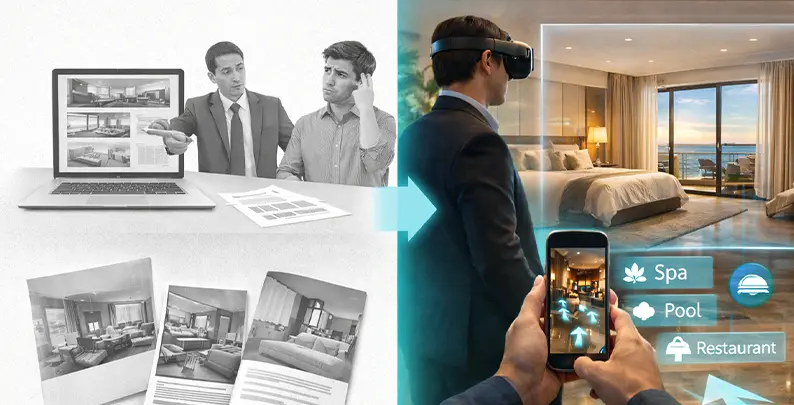
For decades, the hospitality industry relied on a familiar playbook:
- Websites with room photos and amenity lists
- In-person property tours conducted by sales staff
- Printed or digital brochures for upselling services
- Standard training programs for new employees
- Uniform guest journeys from booking through checkout
This model worked when digital expectations were modest. Today, it’s collapsing under the weight of modern traveler demands.
The Four Critical Failures
1. Static Content Can’t Communicate Experience
A photo of a suite doesn’t convey how spacious it feels, what the view looks like at sunset, or the ambiance of the space. This visualization failure directly contributes to the 40% of travelers who abandon bookings due to inadequate previews. The advantages of augmented reality in the hospitality industry become clear here: guests can virtually place themselves in rooms, explore 360-degree views, and understand spatial relationships in ways static images never could.
2. Physical Walkthroughs Waste Resources
Sales teams spend hours conducting property tours for prospects who could have explored remotely. This inefficiency drains staff time and slows the sales cycle. AR in the hotel industry enables remote property exploration without compromising the experiential quality that drives booking decisions.
3. Training Lacks Standardization
Traditional training methods struggle to simulate real guest scenarios, emergency procedures, or service standards consistently. This inconsistency explains why only 15% of hotels successfully execute the personalization that 71% aspire to deliver. VR in the hospitality industry offers repeatable, scalable training simulations that ensure every staff member receives identical, high-quality instruction.
4. Upselling Relies on Imagination
Without visualization tools, guests struggle to understand the value of spa packages, dining experiences, or event venues. This leaves massive revenue on the table—especially from the 65% willing to pay premium prices for personalized experiences.
The Cost of Inaction
| Metric | Current State | Impact |
| Booking abandonment | 81% | Massive conversion loss |
| Preview-related dropoffs | 40% | Direct revenue impact |
| Personalization execution gap | 71% aim, 15% deliver | Broken guest expectations |
| Occupancy rates | 63.38% | Below pre-pandemic levels |
| Premium pricing opportunity | 65% willing to pay 25% more | Untapped revenue potential |
The result? Friction at every touchpoint—booking hesitation, operational inefficiencies, and missed revenue opportunities that keep the industry from reaching its full potential.
AR and VR: From Novelty to Essential Infrastructure
Augmented reality for hotels and virtual reality hospitality solutions aren’t just emerging technologies anymore. In hospitality, they’re becoming the experience layer that spans the entire guest journey—from discovery and booking to on-site navigation and post-stay engagement.
This shift represents something fundamental: the ability to digitally replicate and enhance the experiential nature of hospitality itself.
What Makes This Different
Traditional marketing shows guests what a property looks like. AR in the hospitality industry and VR solutions let guests feel what it’s like to be there.
This distinction matters because:
- Hospitality sells experiences, not products
- Static images can’t convey atmosphere, scale, or emotional impact
- Travelers make booking decisions based on how they imagine feeling, not just what they see
- The gap between imagination and reality is where bookings are lost
Augmented reality in the hospitality industry bridges this gap by allowing hotels, resorts, cruise lines, and tourism brands to present spaces and services as they’re meant to be experienced, not just described.
Mapping Business Problems to XR Solutions
The value of immersive technology becomes clear when aligned with specific hospitality challenges. Understanding augmented reality in the hospitality industry examples helps illustrate these practical applications:
| Business Challenge | XR Solution | Measurable Outcome |
| 81% booking abandonment due to poor visualization | VR property walkthroughs and 360° room previews | Reduced decision friction, higher conversion rates |
| Inconsistent staff training and service delivery | VR training simulations for service scenarios, safety drills, and procedures | Faster onboarding (30-50% time reduction), improved standardization |
| Guest confusion navigating large properties | AR wayfinding through smartphone cameras | Fewer staff interruptions, higher satisfaction scores |
| Low conversion on premium upsells | AR previews of spa, dining, and event experiences | Increased per-guest spend, better monetization of premium offerings |
| Difficulty communicating destination value | VR destination experiences for tourism boards and resorts | Stronger emotional connection, improved travel intent |
| The gap between personalization goals and execution | End-to-end immersive guest journey customization | Closing the 71% vs 15% execution gap |
Use-case Examples
Pre-Booking Confidence
- Hotels using VR in the hospitality industry for room previews report 15-25% increases in booking conversion
- Virtual property tours reduce back-and-forth questions by 40%
- Prospects spend 3-5x longer engaging with VR content vs. photo galleries
Staff Training Efficiency
- Virtual reality hospitality training modules cut onboarding time by 30-50%
- Service quality scores improve by 20-30% with simulation-based training
- Safety drill completion rates increase to near 100% with VR scenarios
Upselling Success
- AR in hotels experience previews boost spa package bookings by 35-45%
- Event venue conversions improve 20-30% with immersive walkthroughs
- Average per-guest spend increases 15-20% with AR menu and activity previews
Why This Is Happening Now
Several forces have converged to make immersive experiences not just viable, but necessary. The evolution of AR/VR trends has accelerated dramatically over the past few years:
1. Technology Maturation
- Affordable VR headsets: Devices like Meta Quest 3 cost under $500, making them practical for sales centers and travel agencies
- WebAR accessibility: Guests access augmented reality in hotels directly through smartphone browsers—no apps or hardware required
- 5G connectivity: Faster networks enable high-quality streaming of immersive content
- Advanced VR development tools: Modern platforms have simplified creation, reducing both cost and complexity
2. Shifted Consumer Expectations
- Immersive content is normalized: Social media filters, 3D product views, and virtual try-ons have made immersive experiences expected, not novel
- Experience economy dominance: Travelers prioritize unique, memorable experiences over generic amenities
- Digital-first decision making: 95% of travelers research online before booking; they expect that research to be immersive
3. Competitive Pressure
- Alternative accommodations: Airbnb, luxury homestays, and themed hotels use compelling visual storytelling
- Cruise experiences: Lines like Royal Caribbean already use virtual reality in hospitality industry applications for ship tours and excursion previews
- Direct booking challenges: OTAs invest heavily in visualization tools, forcing hotel brands to compete
4. Proven ROI
Early adopters have demonstrated clear returns:
- Booking conversion improvements: 15-25%
- Training cost reductions: 30-50%
- Guest satisfaction increases: 10-20 percentage points
- Upsell revenue growth: 15-45%, depending on category
The ecosystem is ready. The business case is proven. Working with an experienced VR development company can accelerate implementation and ensure quality outcomes. The question is no longer if but how to implement effectively.
How Leading Hospitality Brands Are Using AR and VR Today
Across the industry, immersive technology has moved from pilot to production. These augmented reality in the hospitality industry examples demonstrate the breadth of applications:
-
Hotels and Resorts
Booking Enhancement
- VR walkthroughs integrated into booking engines and sales presentations
- 360° room previews are accessible via WebAR from any device
- Virtual property tours for MICE (meetings, incentives, conferences, exhibitions) sales
- Augmented reality in hotels allows guests to preview room upgrades with actual views
On-Site Experience
- AR navigation systems guide guests through sprawling resort properties
- Interactive AR concierge services providing activity recommendations
- Virtual reality relaxation experiences in spa facilities
-
Training and Operations
Staff Development
- Hospitality VR modules for housekeeping standards and procedures
- Front desk scenario training with realistic guest interactions
- Emergency response and safety drill simulations
- Cultural sensitivity and language training in immersive environments
Operational Efficiency
- Virtual property inspections for multi-site managers
- Remote collaboration for renovation planning
- Pre-opening training before property launches
-
Event and Conference Venues
Sales Tools
- Immersive walkthroughs of ballrooms and meeting spaces
- AR in the hotel industry, visualization of different seating layouts and décor options
- Virtual site inspections for remote event planners
- Real-time customization previews for lighting, staging, and setup
-
Tourism and Destination Marketing
Destination Promotion
- Virtual reality in the hospitality industry experiences of beaches, landmarks, and cultural sites
- Virtual tours of local attractions and activities
- Seasonal previews (e.g., autumn foliage, winter sports, summer festivals)
- Integration with travel agency sales processes
Revenue Management
Dynamic Upselling
- AR previews of room upgrades showing actual views and amenities
- Virtual tours of premium suites and villas
- Immersive spa and dining experience previews
- Activity and excursion visualization before booking
These aren’t experimental initiatives. They’re operational tools delivering measurable improvements in conversion, satisfaction, and revenue.
A Strategic Implementation Framework for Hospitality Leaders
For executives ready to move beyond exploration to execution, here’s a practical roadmap for implementing AR in the hospitality industry and virtual reality hospitality solutions:
Step 1: Identify High-Impact Use Cases
Start by mapping your biggest pain points:
Ask these questions:
- Where do we lose the most bookings? (Likely: visualization failures)
- Where is staff training most inconsistent? (Likely: complex service scenarios)
- What premium offerings have low conversion? (Likely: experiences that are hard to imagine)
- Where do guests express confusion or dissatisfaction? (Likely: navigation, understanding amenities)
Prioritize based on:
- Revenue impact potential
- Implementation complexity
- Time to value
- Measurability of outcomes
Step 2: Start Small, Think Big
Phase 1: Pilot (3-6 months)
- Choose one high-impact use case for augmented reality in the hospitality industry
- Set clear, measurable KPIs
- Test with a subset of guests or properties
- Gather quantitative and qualitative feedback
Phase 2: Optimize (6-12 months)
- Refine based on pilot learnings
- Expand to additional use cases
- Integrate with existing systems
- Train staff on the effective deployment of AR in hotels
Phase 3: Scale (12+ months)
- Roll out across properties or markets
- Build internal expertise and capabilities
- Explore advanced applications
- Continuously measure and improve
Step 3: Set Measurable Success Criteria
Don’t implement technology without clear metrics. Understanding the advantages of augmented reality in the hospitality industry requires quantifiable outcomes:
| Use Case | Key Metrics | Target Improvement |
| VR booking previews | Conversion rate, time to decision, inquiry volume | 15-25% increase in conversion |
| Hospitality VR training | Onboarding time, service quality scores, and retention | 30-50% faster onboarding |
| AR navigation | Guest satisfaction, staff interruptions, app engagement | 20% fewer navigation requests |
| AR upselling | Average spend, conversion on premium offers | 15-20% revenue increase |
| VR destination marketing | Travel intent, inquiry volume, and booking lead time | 10-15% increase in bookings |
Step 4: Avoid Common Pitfalls
Don’t treat AR/VR as marketing gimmicks
- Trade show demos without operational integration deliver no lasting value
- Focus on solving real problems, not generating buzz
Don’t build disconnected experiences
- Every XR initiative for virtual reality in the hospitality industry should tie to clear business objectives
- Integrate with existing booking systems, CRM, and operational workflows
Don’t ignore user experience fundamentals
- Poor quality VR experiences create negative impressions
- Ensure intuitive navigation and quick load times
- Test extensively before launch
Don’t skip change management
- Staff need training to effectively use and promote augmented reality for hotels
- Build internal champions who understand the value
- Create clear processes for when and how to deploy experiences
Step 5: Think XR-First
Fundamentally rethink your guest journey through an immersive lens:
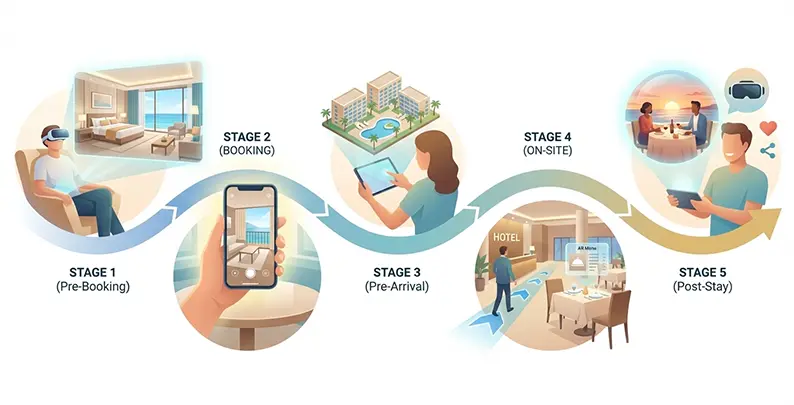
Pre-Booking
- Where can virtual reality hospitality replace or enhance traditional property tours?
- How can AR help guests visualize their specific room and view?
- What destination experiences would benefit from immersive previews?
Booking Process
- Can AR previews of room categories reduce decision paralysis?
- Would virtual tours of amenities increase ancillary bookings?
- How can immersive content personalize the booking experience?
Pre-Arrival
- Can guests virtually explore the property before arrival using VR in the hospitality industry?
- Would AR navigation previews reduce check-in confusion?
- How can VR build excitement and set accurate expectations?
On-Site Experience
- Where does augmented reality in hotel wayfinding add the most value?
- What upselling opportunities benefit from immersive previews?
- How can AR enhance existing activities and amenities?
Post-Stay
- Can VR experiences encourage rebooking or referrals?
- Would immersive content support loyalty program engagement?
- How can AR/VR memories extend the guest relationship?
This strategic lens transforms AR and VR from technology purchases into competitive differentiators.
The Road Ahead: XR as Standard Practice
The hospitality industry stands at an inflection point. Immersive technology is transitioning from innovation to infrastructure—from competitive advantage to competitive necessity.
The trajectory is clear:
Just as online booking replaced phone reservations in the 2000s, and mobile check-in replaced front desk queues in the 2010s, augmented reality in the hospitality industry and virtual reality hospitality are becoming the standard for how hospitality is discovered, evaluated, and experienced in the 2020s.
The brands that move early will:
- Capture a disproportionate share of the 65% willing to pay premium prices
- Reduce the 81% booking abandonment rate through better visualization with AR in the hotel industry
- Close the execution gap between personalization goals and delivery
- Drive occupancy rates back above pre-pandemic levels through superior conversion
- Build operational efficiencies that compound over time
The brands that wait will:
- Cede market share to competitors offering superior digital experiences
- Continue losing 40% of potential bookings to visualization failures
- Struggle with the widening gap between guest expectations and delivery
- Miss the opportunity to capture premium pricing from experience-focused travelers
- Face increasing pressure from OTAs and alternative accommodations with better tools
- The experience gap is real. The data proves it’s costing billions. The solution exists and is being proven daily by early adopters implementing virtual reality in hospitality industry applications.
Conclusion
Augmented reality in the hospitality industry and VR in the hospitality industry aren’t changing what hospitality fundamentally is—they’re changing how those experiences are discovered, understood, and delivered at every stage of the guest journey.
With $250 billion in annual US hospitality revenue at stake and occupancy rates still recovering, the cost of maintaining the status quo has never been clearer. The hotels and resorts that embrace AR and VR as essential infrastructure will operate more efficiently, convert more guests, and deliver experiences that match modern expectations. Partners like Juego Studios help hospitality brands bridge the experience gap through customized immersive solutions that drive measurable results. The question isn’t whether immersive experiences belong in your strategy—it’s whether you’ll lead this transformation or be forced to follow it.
Frequently Asked Questions
VR property walkthroughs and AR room previews allow guests to experience spaces before booking, reducing the visualization failure that causes 40% of booking abandonments. Early adopters report 15-25% increases in conversion by letting travelers explore properties immersively from any device.
The primary applications include VR property tours for booking confidence, immersive staff training simulations that reduce onboarding time by 30-50%, AR wayfinding for guest navigation, AR previews for upselling premium experiences, and VR destination marketing that influences travel decisions.
WebAR technology makes immersive experiences accessible through smartphones without special hardware, while VR headsets now cost under $500. Mid-sized properties can start with single high-impact use cases like virtual room previews or training modules, then scale based on proven ROI.
Most hotels see measurable results within 3-6 months of pilot deployment. Quick wins include reduced property tour time for sales teams, faster training completion, and improved booking conversion. Full ROI typically manifests within 12-18 months across booking revenue, operational efficiency, and guest satisfaction.
Related Posts
AR and VR in the Hospitality Industry: What’s Changing and Why It Matters
Hospitality faces an $81 billion problem: 81% of travel bookings are abandoned before payment due to poor visualization. While 65% of guests will pay 25% more for immersive experiences, only 15% of hotels deliver effective personalization. This comprehensive guide explores how AR and VR technology are closing the experience gap—transforming booking conversion, staff training, and guest satisfaction with proven strategies and measurable outcomes.
The Role of VR in Manufacturing: Boosting Efficiency and Reducing Downtime
Virtual reality is reshaping the manufacturing industry by offering many benefits that can help companies significantly reduce downtime costs. It’s become a must-have tool providing solutions to many of the long-standing problems manufacturers face globally.

VR in enterprise – How is VR revolutionizing training and simulation across industries
Think VR is only for gaming? It’s time to look again. In today’s competitive day and age, Virtual Reality (VR) is no longer just a tool for gaming companies; it has evolved into a powerful tool for enterprise training and simulation across different industries.