


 Unity
 Unreal
 Godot

 Mobile
 PC
 Console

 Full-Cycle
 Co-Development
 Outstaffing




-
 Game Design
 Sep 17th, 2026
- Share:
Table of Contents
- TL;DR
- How can social features increase player engagement?
- Why do competitive features heighten player engagement?
- What are the top in-game social hubs for player interaction?
- Social vs. competitive features: which one earns its dev cost first?
- Player engagement techniques worth prioritizing in 2026
- Leading solutions for deeper engagement in games
- How to amplify player engagement and community for a live game
- What this means for your roadmap
- Conclusion: pick both levers, just not all at once.
Every roadmap planning session eventually runs into the same question: what do we build next to keep players coming back? For most live games, the honest answer sits in one of two buckets. Social features turn the game into a place to hang out with people you already know. Competitive features turn it into a place to prove something against people you don’t. Both increase player engagement, but they get there differently, cost differently to build and moderate, and fit different genres. This piece breaks down what each lever actually delivers, backed by current data, and gives you a framework for deciding which one earns its place on your next sprint first.
TL;DR
- Player engagement runs on two major levers: social features (chat, guilds, and hubs) that build reach and retention, and competitive features (leaderboards, ranked ladders, and tournaments) that build session frequency.
- 212.3 million Americans, 67% of the U.S. population, play video games every week, and 70% of players have played with others. That’s a large, already-social player base to build on.
- Esports and competitive titles help studios keep players engaged with established games between major content updates, not just draw a separate spectator crowd.
- Many long-running live games combine both levers, sequenced by genre, team size, and budget, rather than bolting on everything in one release.
- The comparison table below breaks down dev cost, moderation load, and which lever pays back faster for a given game.
- Many teams can build the features themselves but not the ongoing operations behind them. Live-ops and player-retention systems cover that gap once the features ship.
How can social features increase player engagement?
Social features increase player engagement by turning solo play into a shared habit. Once a player’s friends are inside the game with them, they show up more often, stay longer per session, and can be harder to churn than a player with no social ties in-game.
The scale here isn’t niche. 212.3 million Americans, or 67% of the U.S. population, play video games every week, and 70% of players have played with others. It gets more specific once you look at why: 47% of players say games have introduced them to people they otherwise wouldn’t have met, and 49% say games have helped them stay connected to people they already know. For a live-service team, that second figure matters more than it looks. A player who logs in to talk to a specific person is a different retention problem than one who logs in because a notification told them to.
Chat, guilds, and clans: the retention layer
Persistent group structures do the heaviest lifting here. Clash of Clans is a widely cited example: Supercell built clans and clan wars as a core feature, giving solo players a reason to belong to something rather than just play something. Guilds work because they create obligations, showing up for a clan war, donating troops, and defending a ranking, that a single-player loop never generates on its own.
The cost is real, though. A guild or clan system needs its own moderation, its own backend state, and usually its own onboarding flow, so it’s rarely the first thing a small team should ship. Game retention strategies break down where guild systems tend to land on the retention-versus-cost curve.
Social hubs and party spaces: the reach layer
Where guilds retain, hubs recruit. A social hub, a lobby, a party space, or a shared world players can hang out in without an active match running lowers the bar for a player to bring a friend in. Fortnite‘s Party Royale popularized the format. More recently, Genshin Impact‘s move into user-generated creation tools in late 2025 and Fortnite’s 2026 crossover with 99 Nights in the Forest, a hit game built on Roblox, show the same logic spreading well past battle royales. The hub is becoming a standard feature, not a novelty.
Hubs are cheaper to justify than guilds because they don’t need deep backend systems, but they still need active moderation once real-time voice or text is involved. That’s the trade you’re making.
Why do competitive features heighten player engagement?
Competitive features heighten engagement by giving players a reason to open the game today specifically: a ladder reset, a tournament window, and a rank at risk. That’s a different trigger than anything social features create on their own.
The scale backs this up. Newzoo’s 2026 Global Games Market Report puts the global games market at $213.9 billion this year, up 6.1% year on year, growth that’s increasingly coming from sustaining existing players rather than only acquiring new ones. Long-running esports titles like Mobile Legends: Bang Bang, Counter-Strike, League of Legends, Dota 2, PUBG Mobile, and Valorant are commonly cited examples of how competitive scenes keep players engaged with the same game for years between major content updates.
Leaderboards and ranked ladders
The mechanic is simple, and that’s the point. Rank can be public, and many systems use decay to keep it current, letting players compare themselves across the whole player base in a way a private high score never allows. Ranked systems are cheap to prototype but expensive to get right: matchmaking quality, season-reset pacing, and anti-smurfing all have to work together or the ladder stops meaning anything, and players notice fast.
Live tournaments and limited-time competitive events
Tournaments compress the same incentive into a deadline. There’s a start time, a bracket, and a reason to show up that week specifically rather than whenever.
The operational cost here is the real constraint. A tournament needs bracket logic, anti-cheat coverage for whatever is at stake, and usually live moderation for the event window, which is why this is a feature studios may hand to a LiveOps partner when event operations exceed internal capacity. The ways this breaks down when the operational side is under-resourced, such as brackets that stall, moderation gaps during peak hours, or rewards that arrive late, are the exact failure points covered in where live events go wrong operationally.
What are the top in-game social hubs for player interaction?
In-game social hubs come in five recognizable formats, each solving a different interaction problem rather than competing for the same one. Four live inside a single game; the fifth extends the same social logic across titles.
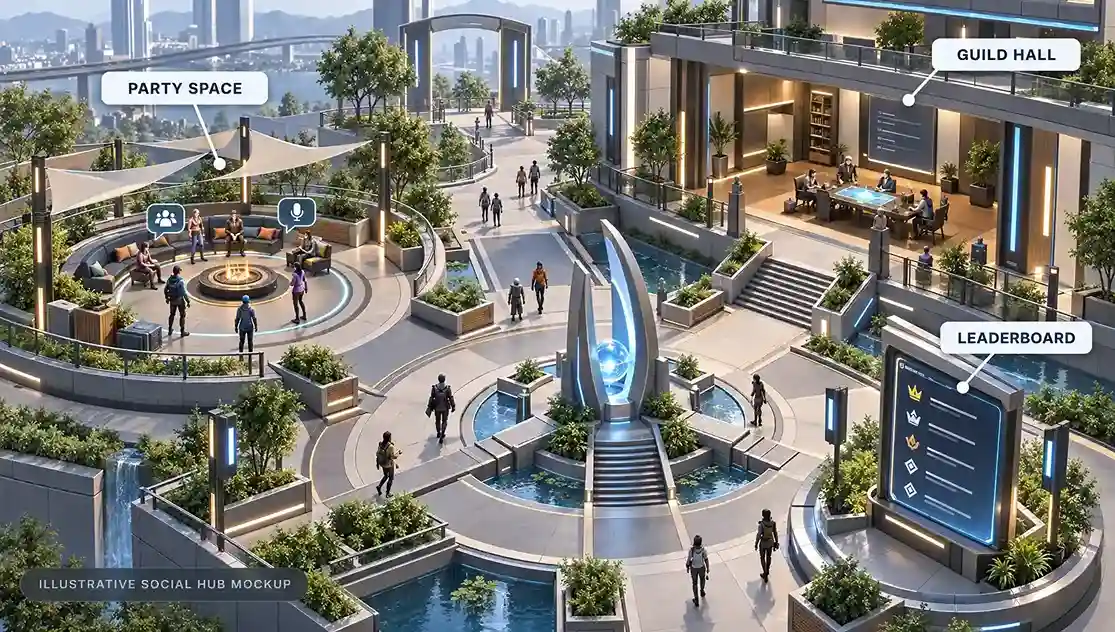
| Hub type | What it does | Example |
| Party spaces & lobbies | Low-stakes hangout space between matches | Fortnite Party Royale |
| Guild halls / clan bases | Persistent home base for a player group | Clash of Clans, most MMOs |
| Spectator & co-op hubs | Lets players watch or join in-progress activity | Co-op domains, watch-to-join lobbies |
| Creator / UGC hubs | Players build and share content inside the game | Roblox; Genshin Impact’s 2025 creation platform |
| Cross-game social layers | Friend lists and community features that extend beyond a single hub, spanning titles or platforms | Fortnite’s cross-title collaborations, like 99 Nights in the Forest |
Player engagement techniques worth prioritizing in 2026
The strongest player engagement techniques don’t pick one lever. They compound social and competitive into a single mechanic.
- Seasonal FOMO events. A time-boxed event that pairs a leaderboard with a guild-level reward gives both an individual and a group reason to log in before it ends.
- Guild wars. Clan-versus-clan competition is the clearest example of the two levers merging into one system. It needs the guild backend and the ranking logic to both already work.
- Creator-hub integration. Letting players build and share content inside a social hub can create organic discovery and referral loops that complement paid acquisition.
- Matchmaking-based social pairing. Matchmaking that nudges players who play well together toward becoming friends, not just teammates for one match, turns a competitive system into a social one without adding a separate game mode.
Leading solutions for deeper engagement in games
The leading solutions for deeper engagement split cleanly into what you build once and what you have to keep running.
What to build in-house vs. what to hand to a LiveOps partner
Chat and multiplayer backend platforms reduce the amount of infrastructure a team needs to build from scratch: real-time messaging, matchmaking, and session state have mature SDKs behind them. Production integration still means handling scale, latency, identity, platform compliance, safety and moderation, cross-play, and observability, and what those platforms don’t do at all is run the feature after launch: tuning season length, moderating a guild dispute, rebalancing a leaderboard that’s gone stale, or staffing a tournament weekend.
That ongoing layer is what LiveOps actually covers, and it can become the capacity bottleneck for in-house teams before the build stage does. If an engagement roadmap leans on real-time backend systems specifically, multiplayer backend and social systems cover the infrastructure side in more depth.
How to amplify player engagement and community for a live game
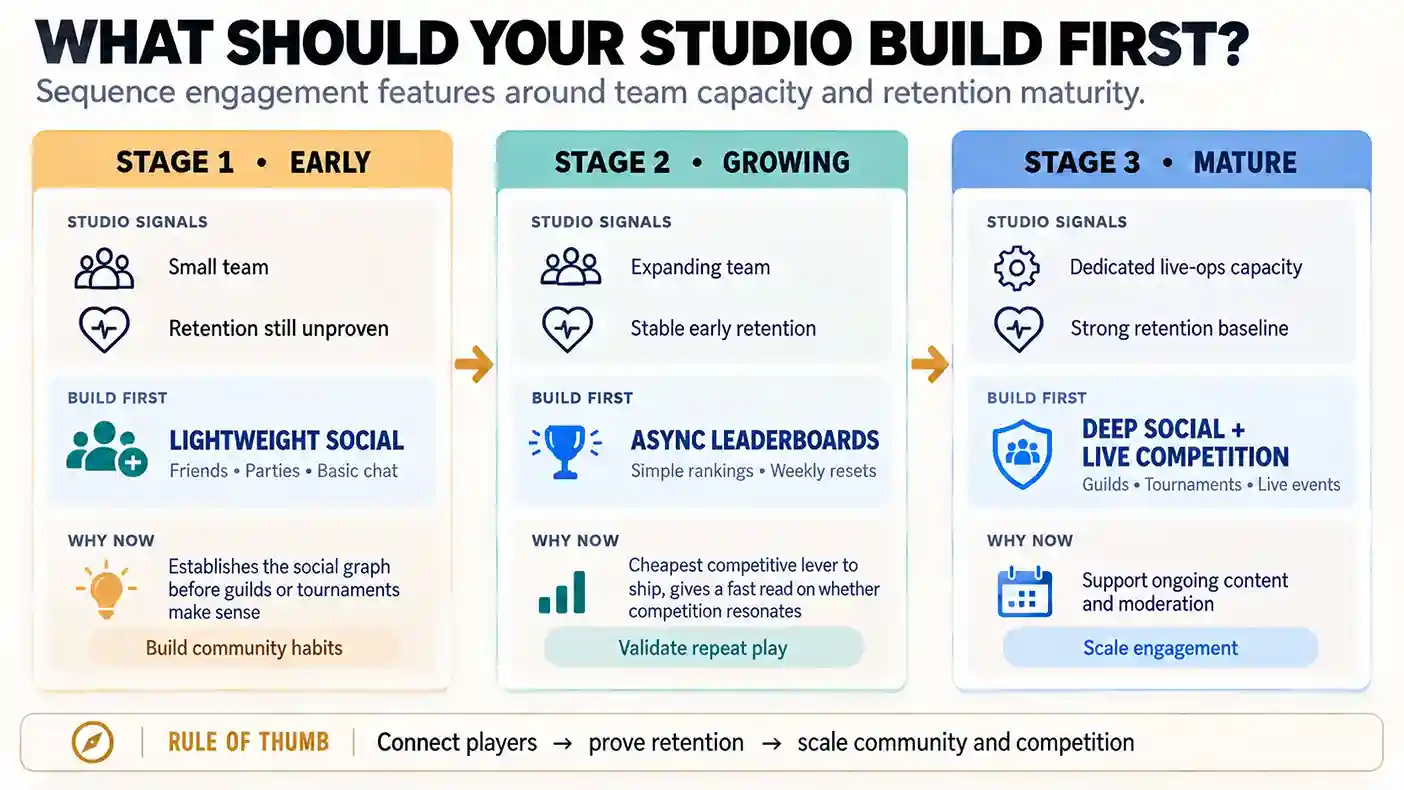
There’s no single feature that guarantees engagement. The sequencing is what actually matters, and it should follow your genre, team size, and budget rather than a generic checklist.
- Small team, pre-launch or early live: start with chat and lightweight social, friends lists and party invites, not a full hub or guild system yet. It’s the cheapest way to establish the social graph you’ll need before hubs, guilds, or tournaments make sense.
- Stable core loop, growing DAU: add an asynchronous leaderboard first. It’s the cheapest competitive lever to ship and gives a fast read on whether competition resonates with the player base; a full ranked mode, with matchmaking, rating logic, anti-smurfing, and anti-cheat, is a meaningfully bigger build and worth holding until the leaderboard proves the demand.
- Established retention, dedicated LiveOps capacity: invest in guilds and live tournaments. Both pay back well, but only once there’s the operational bandwidth (moderation, event staffing, backend support) to run them properly.
What this means for your roadmap
If a team can build the social or competitive features themselves but the ongoing cadence (events, moderation, economy tuning, season resets) has no clear owner, that’s the specific gap live-ops and player-retention systems are built to close. It’s worth scoping that conversation before the feature ships, not after the first season goes stale.
Conclusion: pick both levers, just not all at once.
Social and competitive features aren’t competing priorities. They’re answering two different questions. Social features answer why I would bring someone else into this game, and competitive features answer why I would open this game today. Many mature live games eventually combine both, but the ones that get engagement right rarely ship them together on day one. They sequence by genre, by team size, and by how much operational capacity they actually have for what comes after launch.
Weighing that sequencing against a roadmap and budget is a live-ops planning conversation as much as a feature-design one. It’s worth having before the build starts, not after.
Frequently Asked Questions
“Association games” most often refers to sports, club, and league-style titles, where a team’s or club’s identity carries the social layer and standings, seasonal ladders, or league tables carry the competitive layer. If you’re using the term more broadly for any game that leans on both levers at once, the same toolkit still applies: a social hub or group identity paired with a ranking system, just themed around a club or league instead of a generic guild.
No single feature guarantees it, and not every genre needs both levers. Choose mechanics that reinforce your core loop first, then validate them against retention, session, and return-rate metrics. Layer in social and competitive systems only where they fit your audience and operating model, and treat the ongoing operations (event cadence, moderation, tuning) as a continuing cost rather than a one-time build. The framework above walks through how to sequence that by team size and budget.
It depends on which ones. Guilds and social hubs generally carry more ongoing moderation costs. A simple leaderboard is comparatively cheap to build and maintain; a ranked mode with matchmaking carries meaningfully higher upfront engineering cost, and anti-cheat needs scale with what’s actually at stake. Tournaments are the most operationally expensive item in either category.
The timeline depends heavily on what’s already in the backend. Chat and a basic lobby are usually the fastest additions if the game already has real-time messaging infrastructure. Guild systems and ranked ladders take longer because they need new persistent state, balancing, and often a dedicated moderation flow, more so across multiple platforms or once voice chat is involved.
Yes, but usually not at the same time. The sequencing framework above is built for exactly this case: start with the cheaper lever, use the retention data it generates to justify the more expensive one, and bring in outside LiveOps support for the parts that need dedicated operational capacity.
Related Posts
Player Engagement in 2026: What Social and Competitive Features Actually Deliver
Every roadmap planning session eventually runs into the same question: what do we build next to keep players coming back? For most live games, the honest answer sits in one of two buckets. Social features turn the game into a place to hang out with people you already know.

Game Localization: What It Is, Why It Matters, & How to Do It Right
Game localization is the process of adapting a game for a specific region so it feels natural, relevant, and culturally familiar to local players.

Video Game Industry Trends in 2026 and Beyond
Gaming enters a new era in 2026, driven by AI-powered creation, accessible design, global market growth, and seamless multi-device play. These trends reveal how the industry is evolving—and what developers must prepare for as technology, players, and platforms mature together.
Social vs. competitive features: which one earns its dev cost first?
Player engagement features fall into two broad families, and neither is inherently better. The right one depends on your genre, your team size, and how much moderation capacity you actually have.
Expert Insights from Juego Studios to Help You Build Better