


 Unity
Unity Unreal
 Godot
Godot
 Mobile
 PC
PC Console
 Full-Cycle
 Co-Development
 Outstaffing




-
 Game Development
 Jan 13th, 2026
- Share:
Table of Contents
Ever pressed Start on a game cartridge, heard those iconic chiptune melodies, and felt yourself transported through decades of gaming magic? That satisfying click of a cartridge sliding into place, the warm glow of a CRT screen, the sound of quarters dropping into an arcade machine—these sensory memories connect generations of gamers.
Super Mario Bros. sold over 40 million copies worldwide, making it one of the best-selling retro games ever and single-handedly reviving the industry after the 1983 crash. If you’ve ever wondered which games truly shaped the industry and why grandparents and grandkids alike gather around the same vintage console, the answer lies in timeless titles like this—games that transcended their era to become cultural touchstones.
But Mario’s adventure is just one of many groundbreaking titles that changed gaming forever. From Pong’s simple paddles that started it all to Portal’s mind-bending puzzles that proved games could be art, the list below showcases the most influential titles across five decades. This comprehensive guide takes you through the top 10 retro games that defined gaming history, spanning from the 1970s to the early 2000s. Whether you’re a seasoned gamer reliving childhood memories or a newcomer curious about where your favorite franchises began, these best retro games of all time didn’t just entertain—they transformed the entire landscape of interactive entertainment.
Retro aesthetics are making a comeback — and players love them. We help studios recreate the feel of classic games with modern performance and cross-platform reach.
What is a Retro Game?
Before we dive in, let’s clarify what we mean by “retro.” Retro gaming refers to playing and enjoying video games from earlier generations of consoles, computers, and arcades. Retro games typically date back to the 1970s through the early 2000s—systems like the Atari 2600, Nintendo Entertainment System (NES), Super Nintendo (SNES), Sega Genesis, PlayStation, and Nintendo 64.
What makes a game “retro” isn’t just that it’s old; it’s that it represents a significant technological or creative milestone. These games are celebrated for their gameplay purity, distinctive visual aesthetics, and for pioneering genres and mechanics we still use today.
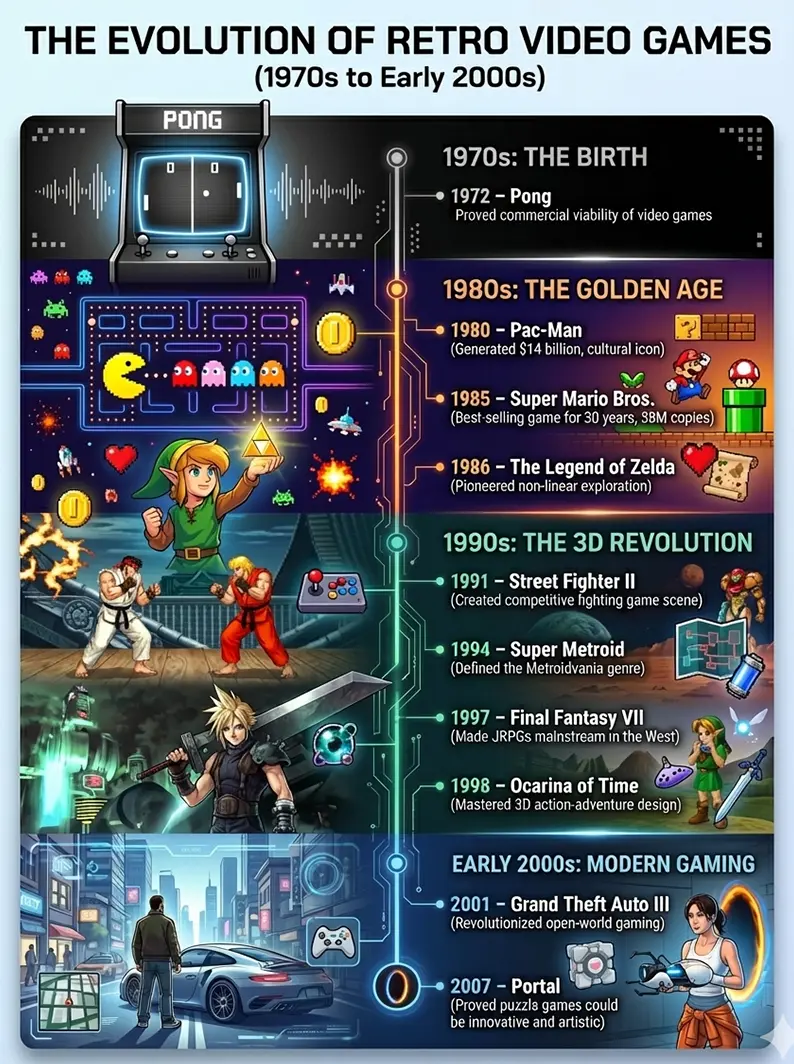
Retro Games Timeline: The Complete Visual Journey
Want to build a game that captures the nostalgia of retro classics while running on today's platforms? Our art and dev teams specialize in pixel-perfect recreation and remastering.
The Top 10 Retro Video Games That Defined Gaming
1. Pong (1972)
Developer: Atari | Platform: Arcade, Home Console | Genre: Sports Simulation
Pong revolutionized gaming by proving video games weren’t just niche curiosities—they were commercially viable entertainment. Designed by Allan Alcorn as a training exercise, this simple table tennis simulation became wildly popular in arcades. The original arcade machine literally broke down from being stuffed with too many quarters.
What made Pong extraordinary was its simplicity: two paddles and one ball—gameplay anyone could understand instantly. This accessibility established one of gaming’s most important principles: easy to learn, difficult to master. By 1975, Atari released a home version, bringing arcade gameplay into living rooms for the first time.
Today, Pong resides in the Smithsonian Institution’s permanent collection. It remains on every retro games list for good reason—it started everything. The game’s simple yet engaging concept demonstrated how creative video game ideas could captivate audiences with minimal complexity.
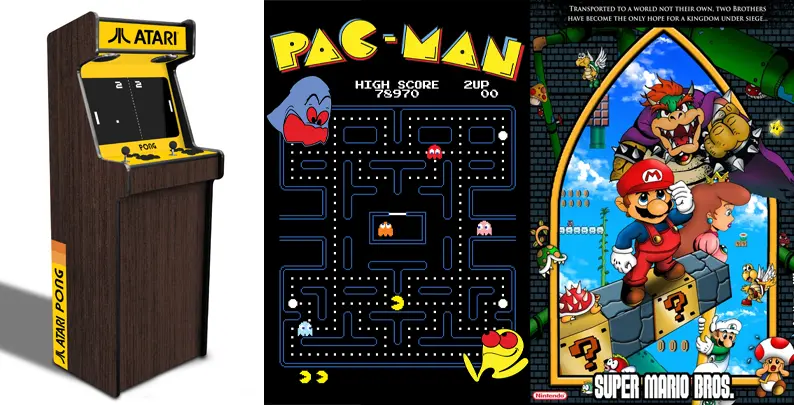
2. Pac-Man (1980)
Developer: Bandai Namco | Platform: Arcade | Genre: Maze Action
Originally called Puck Man in Japan, Pac-Man was designed to appeal to women as well as men, a revolutionary concept for an industry dominated by space shooters. Designer Toru Iwatani created cute, colorful characters rather than violent imagery.
Players guide Pac-Man through mazes while evading four distinctly colored ghosts (Blinky, Pinky, Inky, and Sue), each with unique behaviors. The distinctive visual style showcased early types of game art that prioritized charm and accessibility over realism.
Pac-Man generated over $14 billion in revenue and became a cultural icon, spawning merchandise, television series, and the hit song “Pac-Man Fever.” This is one of the most popular retro games that proved games didn’t need violence or complexity to captivate audiences—just smart design and appealing characters.
3. Super Mario Bros. (1985)
Developer: Nintendo | Platform: NES | Genre: Platformer
Directed by legendary designer Shigeru Miyamoto, Super Mario Bros. sold over 58 million copies worldwide and single-handedly revived the video game industry after the 1983 crash. Players control Mario (originally called Jumpman) through the Mushroom Kingdom to rescue Princess Toadstool from Bowser.
What made it revolutionary was Miyamoto’s attention to physics and control feel. Mario has weight—he doesn’t stop instantly, giving players genuine control over momentum. This “game feel” became a crucial game design elements for quality platformers.
The level design is a masterclass in tutorial gameplay. World 1-1 gradually teaches players every mechanic without a single word of instruction. Combined with Koji Kondo’s iconic chiptune soundtrack, Super Mario Bros. proved video games could be art. It’s consistently ranked among the top 10 retro games of all time for transforming level design and player experience.
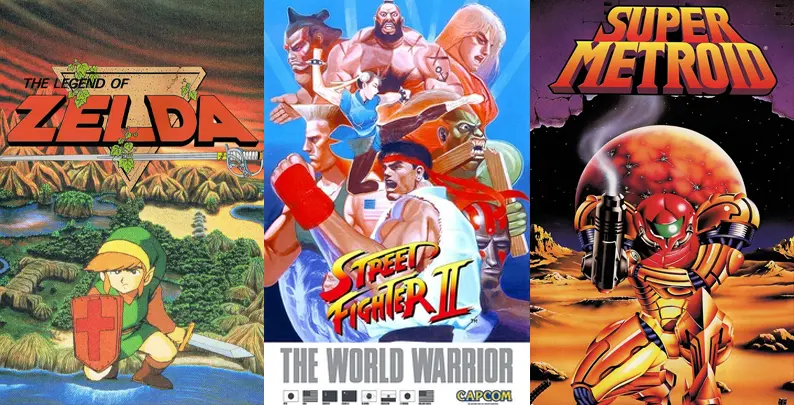
4. The Legend of Zelda (1986)
Developer: Nintendo | Platform: NES | Genre: Action-Adventure
Shigeru Miyamoto and Takashi Tezuka created another masterpiece with The Legend of Zelda, selling over 6.5 million copies and launching one of gaming’s most enduring franchises. Players control Link exploring Hyrule, solving puzzles, defeating enemies, and collecting items to defeat Ganon and rescue Princess Zelda.
The Legend of Zelda was revolutionary for its non-linear world design. Unlike games that forced predetermined paths, Zelda allowed players to explore and solve puzzles in any order, giving them genuine agency. The game mechanics introduced—finding keys, collecting power-ups, exploring interconnected dungeons—influenced the entire adventure game genre and persist in modern titles.
5. Street Fighter II (1991)
Developer: Capcom | Platform: Arcade | Genre: Fighting
Street Fighter II didn’t invent fighting games, but it perfected them and created competitive gaming as we know it. Released in arcades in 1991, the game featured eight playable characters, each with unique movesets, special attacks, and fighting styles.
The breakthrough was the combo system—players could chain attacks through precise timing, rewarding skilled play. Players gathered in arcades to settle rivalries, creating a global competitive community that thrives to this day.
Street Fighter II: Hyper Fighting and Super Street Fighter II Turbo are still played in tournaments 30+ years later. The game established Capcom as the fighting game king and proved arcade games could drive passionate, long-term communities, earning its spot among the best retro video games.
6. Super Metroid (1994)
Developer: Nintendo | Platform: SNES | Genre: Action-Adventure / Metroidvania
While the original Metroid started the “Metroidvania” subgenre, Super Metroid refined it to near perfection. Players control Samus through planet Zebes, using new weapons like the grappling beam and X-ray scope to explore interconnected environments and defeat space pirates.
Super Metroid’s atmospheric design, challenging boss battles, and satisfying combat set the standard for exploration-based action games. Games like Castlevania: Symphony of the Night, Hollow Knight, and countless indie titles draw inspiration from Super Metroid’s formula. The game proved that 2D games could deliver cinematic experiences rivaling early 3D.
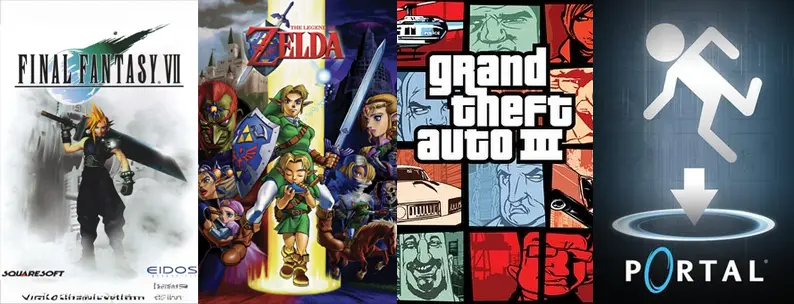
7. Final Fantasy VII (1997)
Developer: Square | Platform: PlayStation | Genre: Japanese RPG
Final Fantasy VII is a watershed moment in gaming history. This was the first numbered Final Fantasy with fully 3D graphics and pre-rendered backgrounds. The game’s scope was unprecedented: an epic 100+ hour narrative, memorable characters (Cloud, Tifa, Aerith, Sephiroth), stunning cinematic sequences, and the revolutionary Materia system.
Final Fantasy VII introduced millions of Western players to Japanese role-playing games, making anime-style storytelling and turn-based combat mainstream. The narrative explored themes of corporate corruption, environmentalism, and personal identity—proving games could tell stories as compelling as films.
The game demonstrated that PlayStation could deliver experiences Nintendo’s cartridge-based consoles couldn’t match, fundamentally shifting the console wars. This influence continues in modern mobile game development, where approaches prioritize expansive content and narrative depth.
8. The Legend of Zelda: Ocarina of Time (1998)
Developer: Nintendo | Platform: Nintendo 64 | Genre: Action-Adventure
Released for Nintendo 64 in 1998, Ocarina of Time frequently tops “greatest games ever” lists even today. The game pioneered 3D action-adventure gameplay, just as the original Zelda pioneered exploration-based gameplay.
The innovations were profound: the Z-targeting system (locking the camera on enemies) became the gold standard for 3D action games. The control scheme proved that analog sticks could deliver precise, responsive action. Hyrule was expansive, detailed, and rewarding to explore. Dungeons featured intricate puzzles requiring genuine thought. The story, music, and characters created an emotional journey that resonates to this day.
Ocarina of Time proved 3D games could deliver the magic of 2D classics while offering new possibilities, inspiring countless 3D action-adventure games.
9. Grand Theft Auto III (2001)
Developer: Rockstar Games | Platform: PlayStation 2 | Genre: Action-Adventure
Grand Theft Auto III revolutionized open-world gaming when it was released for PlayStation 2 in 2001. The game placed players in a fully realized city (Liberty City) with freedom to explore, complete missions, or cause mayhem. The shift from mission-based linearity to sandbox exploration changed how developers thought about game design.
GTA III proved games could offer unprecedented freedom while maintaining engaging narratives. The game’s success spawned numerous sequels and influenced countless open-world titles. Modern game development services continue drawing inspiration from the innovations pioneered during this era, particularly in creating living, breathing game worlds.
10. Portal (2007)
Developer: Valve | Platform: PC, Xbox 360, PS3 | Genre: Puzzle-Platformer
Portal demonstrated that puzzle games could be original, funny, and innovative. Players use a portal gun to create portals through walls, solving physics-based puzzles by creatively using 3D space. The game’s humor (delivered by AI narrator GLaDOS) and surprising emotional depth made Portal a critical darling and cult classic.
Portal proved indie-style games (it began as a student mod) could achieve mainstream recognition with strong concepts and execution. The game influenced puzzle game design for years and showed that games could be artistically ambitious and philosophically challenging while remaining accessible and entertaining.
From 8-bit aesthetics to remastered classics, we know what makes retro games feel authentic. Let us help you design a game that resonates with nostalgia-driven players.
Why These Games Matter Today
These popular retro video games remain relevant because they established fundamental design principles modern games still follow. Super Mario Bros. perfected level design and player feedback. The Legend of Zelda pioneered open exploration and puzzle-solving. Street Fighter II created the competitive gaming community. Final Fantasy VII proved games could deliver cinematic narratives. Ocarina of Time mastered 3D action-adventure controls.
The global retro gaming console market will reach $4.18 billion in 2026, growing at a 10% CAGR that significantly outpaces the broader gaming industry’s 3-5% growth, fueled by millennials and Gen X consumers seeking authentic nostalgic experiences through modern handhelds and re-releases. This surge reflects how classic design philosophies—tight controls, fair progression, satisfying mastery—translate directly to today’s mobile hits and indie successes that prioritize gameplay purity over graphical excess.
Retro influence thrives through pixel art revivals in games like Celeste and Shovel Knight, chiptune soundtracks across platforms, and arcade-derived mechanics powering roguelikes and competitive esports titles. Developers embrace “easy to learn, hard to master” formulas while VR/AR recreates classic arcade cabinets, proving these foundational games continue shaping 2026’s innovations and ensuring their legacy drives both commercial growth and creative evolution.
Conclusion
The journey from Pong’s simple paddles to Portal’s philosophical puzzles represents more than technological advancement—it’s a story of creative vision, bold innovation, and games that understood their unique strengths as interactive media. These best retro video games of all time defined gaming because they were uncompromising about quality, creative about design, and unafraid to take risks.
Whether experiencing these classics for the first time through emulation or reconnecting with childhood favorites, retro games offer something modern titles sometimes rush past: the satisfaction of mastery through practice, the joy of exploration without quest markers, and the magic of interactive storytelling in its purest forms.
The games that defined gaming history aren’t relics—they’re blueprints. Every game you play today stands on the shoulders of these classics, reminding us that great game design is timeless.
Frequently Asked Questions
Retro games are typically from the 1970s through early 2000s, played on obsolete systems like NES, SNES, or PlayStation. They represent significant technological or creative milestones that pioneered genres and mechanics still used today.
Retro games remain popular because they established fundamental design principles—responsive controls, fair difficulty curves, and satisfying gameplay loops—that modern games still follow. They offer pure, skill-based entertainment without excessive tutorials or microtransactions.
Super Mario Bros. (1985) is the best-selling retro game, with over 58 million copies sold worldwide. It held this record for approximately three decades and revolutionized platformer design with precise controls and masterful level design.
Yes! You can play retro games through original hardware, modern re-releases on current consoles, official emulation collections, or dedicated retro gaming systems. Many classic titles are available on digital storefronts like Nintendo Switch Online and PlayStation Store.
Related Posts
Have a Game Idea but No Development Team? How to Get It Built
This guide walks you through every realistic way to get your game made, what each one really costs you in time and control, and how to pick the right one before you spend a dollar finding out the hard way.
Top 10 Game Development Companies in USA (2026 Update)
In this blog, we’ll discuss the top 10 game development companies in USA, along with how to evaluate them beyond surface-level claims, so you can identify partners who actually align with your vision, technical needs, and long-term growth goals.

Top Game Development Companies in 2026: 10 Global Leaders Compared
Most game projects don’t fail because the idea was weak. They fail because the development partner couldn’t scale, adapt, or deliver when pressure peaked.