


 Unity
Unity Unreal
 Godot
Godot
 Mobile
 PC
PC Console
 Full-Cycle
 Co-Development
 Outstaffing




-
 PC Game Development
 Mar 16th, 2026
- Share:
Table of Contents
- Understanding AR and VR in the Metaverse
- Why AR and VR in the Metaverse Are Not Optional Infrastructure
- AR/VR Applications in the Metaverse: Where It's Happening Right Now
- The Technology Stack Behind AR and VR in the Metaverse
- Challenges That Still Need to Be Solved
- Virtual Reality Trends and the Road Ahead
- Final Thought
Imagine slipping on a headset and walking into a meeting room — your colleague in New York, your client in London, and you in Bangalore — all sitting around the same table, shaking hands through avatars that move exactly the way you do. No screen border. No muted mic. Just presence.
That scenario isn’t science fiction anymore. It’s where AR and VR in the Metaverse are taking us — and it’s happening faster than most people realize.
The global metaverse market was valued at over $165 billion in 2025 and is forecast to surpass $950 billion by 2030. The AR and VR market alone is projected to reach $200 billion in the same timeframe. As of February 2025, Statista reports that just 26% of U.S. adults used the metaverse in the past 12 months, rising to 80% among VR headset owners.
At the heart of this entire shift are augmented reality and virtual reality. Without them, the metaverse is just a social app with a 3D skin. With them, it becomes a genuinely new kind of internet — spatial, persistent, and immersive in ways flat screens can never be.
Understanding AR and VR in the Metaverse
Before exploring how these technologies are building the metaverse, it’s worth being clear about what each one actually does — because they serve different purposes and work in fundamentally different ways.
What Is Augmented Reality (AR) in the Metaverse?
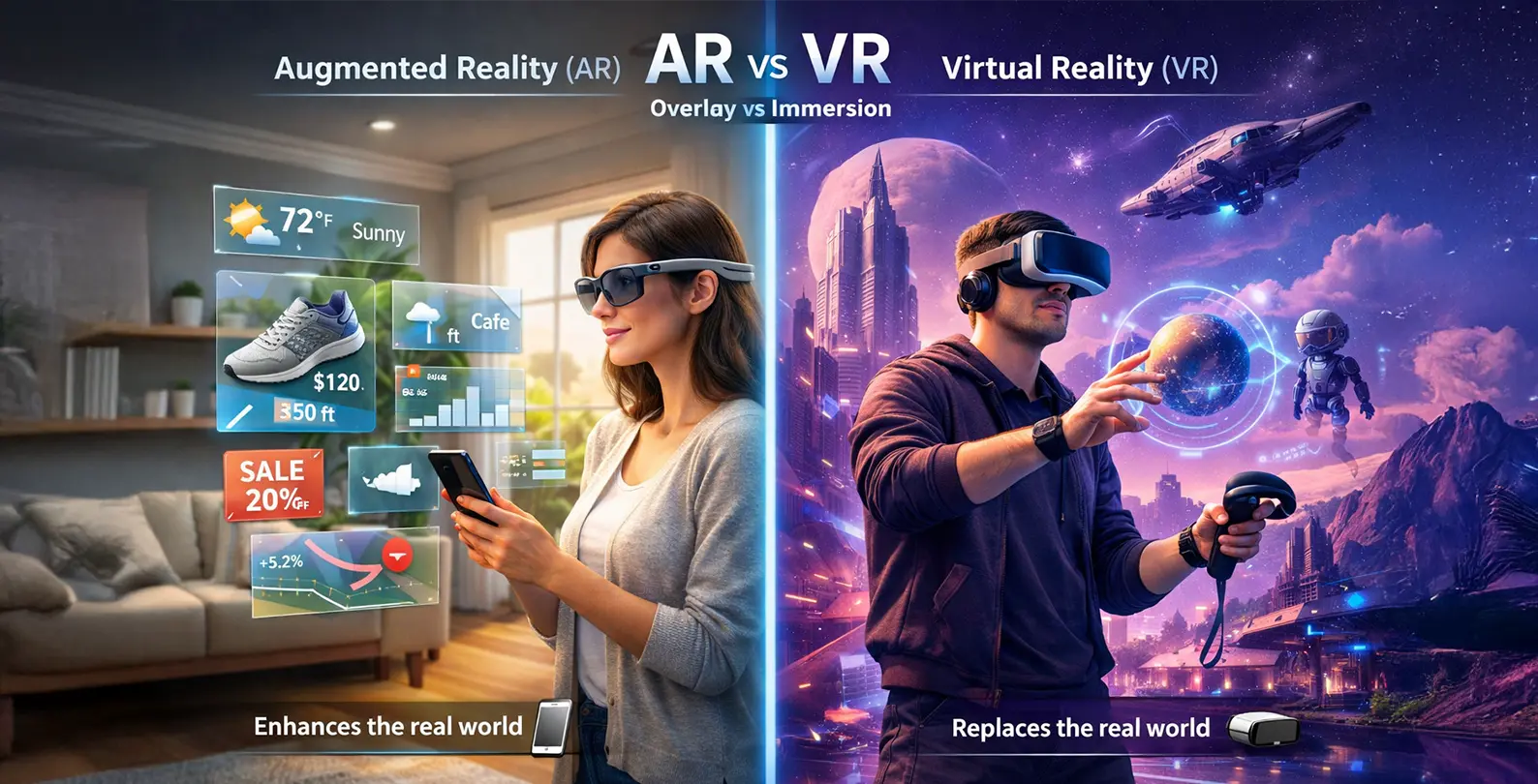
AR in the Metaverse works by layering digital content on top of the physical world. You remain in your actual environment, but digital objects, information, and characters are overlaid onto it through a smartphone, tablet, or AR glasses. The physical world doesn’t disappear — it becomes a canvas.
Apps like Pokémon GO gave millions of people their first real experience of AR in everyday life. But the deeper role of Augmented Reality (AR) in the Metaverse is more structural: it serves as the bridge between the real world and the virtual one. It allows the metaverse to bleed into physical spaces — putting digital storefronts on real streets, overlaying navigation cues on your actual surroundings, or letting you interact with a 3D product model sitting on your real desk.
Metaverse with AR doesn’t require you to leave the physical world to participate in the digital one. That’s a crucial distinction.
What Is Virtual Reality within the Metaverse?
Virtual Reality within the Metaverse does the opposite — it replaces the physical world entirely. Put on a VR headset, and the real room you’re sitting in disappears. In its place is a fully rendered 3D environment that you can move through, interact with, and feel genuinely present inside.
This sense of presence is what makes virtual reality in the metaverse fundamentally different from watching a video or using an app. High-quality VR triggers real emotional and physiological responses. Your brain registers spatial distance, depth, and social proximity in ways that flat screens simply can’t replicate. Platforms like Meta Horizon Worlds, VRChat, and Oculus are already hosting millions of users inside social VR platforms — meeting, playing, collaborating, and building — entirely inside virtual environments.
Metaverse: Augmented Reality vs. Virtual Reality — Which Matters More?
This is a question worth addressing directly: when it comes to the Metaverse, Augmented Reality vs. Virtual Reality isn’t really a competition. They’re complementary layers of the same ecosystem.
VR builds the deep immersive worlds — the virtual offices, the game universes, the training simulations. AR extends the metaverse into everyday physical life — the navigation overlays, the virtual try-ons, the interactive product displays layered over real environments. When these two are combined (often called Mixed Reality or MR), the result is a seamless flow between physical and digital that most people will eventually experience as simply “the internet” — just a version that you can step inside.
Why AR and VR in the Metaverse Are Not Optional Infrastructure
Exploring AR/VR in the metaverse reveals ongoing investments by major tech companies in immersive tech, though not always as the sole “foundational infrastructure of the next internet.” Meta invested $14.3 billion in 2025 for a 49% stake in Scale AI, hiring its CEO to advance general AI research like data labeling for model training, with indirect benefits for metaverse content creation. Disney committed $1.5 billion to Epic Games in 2024 to develop a persistent games and entertainment universe on Fortnite, integrating Marvel and Star Wars IP into virtual worlds. Microsoft pledged around $80 billion through 2028 (announced in 2025) for AI data centers and Azure cloud expansion to support AI workloads, enabling metaverse experiences like Mesh, but not exclusively focused on AR/VR.
The reason is simple: AR and VR in the Metaverse solve problems that existing platforms can’t. Remote work is still fundamentally disconnected. Online education is still largely passive. E-commerce still can’t replicate the experience of actually seeing and touching a product. AR/VR Applications in the Metaverse are what close those gaps.
AR/VR Applications in the Metaverse: Where It's Happening Right Now
Social Interaction: From Video Calls to Shared Virtual Worlds
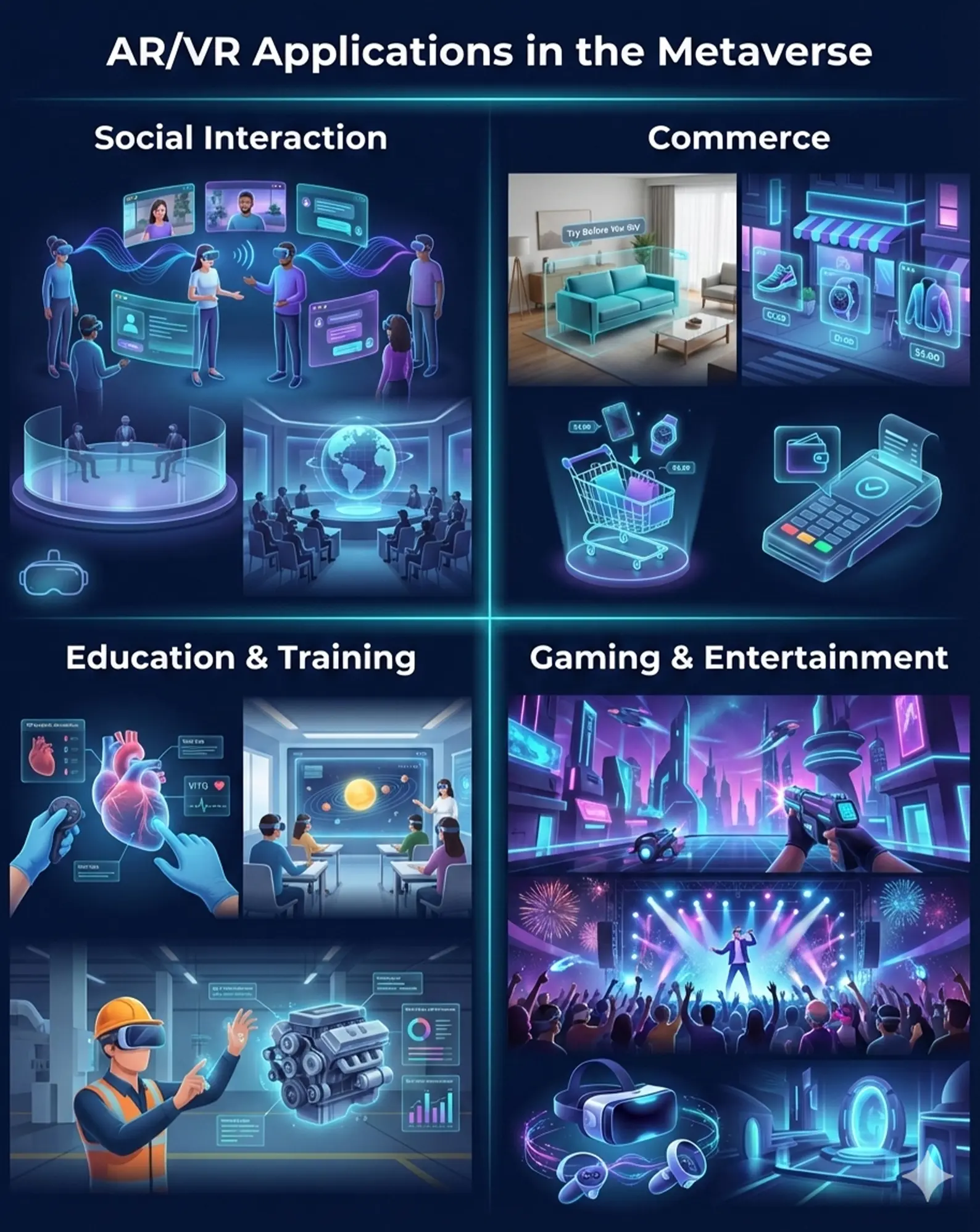
One of the most immediate and human applications of the metaverse and Virtual Reality is social connection. We’ve spent years substituting real interaction with flat video calls, and the limitations are obvious. You can’t read a room through a grid of thumbnails.
Using VR for the Metaverse changes the social equation. Users meet inside shared 3D spaces with spatial audio — where proximity and direction matter, just like in real life. Avatars communicate body language. You can gather around a whiteboard, sit in a virtual auditorium, or simply hang out in a digital space that feels like a real room.
Social VR platforms like Meta Horizon Worlds and VRChat are already operating at scale, hosting everything from casual meetups to professional conferences to live entertainment events. Epic Games’ Fortnite drew tens of millions of attendees to virtual concerts — a scale of live experience that no physical venue can match.
AR extends this social layer into everyday life. Rather than switching contexts to “enter” the metaverse, users can interact with digital elements layered into their real environments — making the metaverse feel less like a separate destination and more like an ambient part of daily life.
Commerce: Shopping That Actually Lets You Try Before You Buy
E-commerce has a persistent frustration: you can’t experience a product until it arrives. Augmented Reality in the Metaverse is solving that at a fundamental level. Retailers are deploying AR tools that let shoppers virtually try on clothing, place furniture inside their actual rooms, or preview a paint color on their real walls — all before making a purchase.
IKEA’s AR app lets users place virtual furniture in their actual homes. L’Oréal offers virtual makeup try-ons. These aren’t novelties; they’re reducing return rates and increasing conversion because they remove purchasing uncertainty.
In the full metaverse context, this goes further. Virtual storefronts exist inside persistent digital worlds. Brands host immersive experiences — product launches, community events, interactive showcases — that users can attend as avatars. The metaverse e-commerce segment is projected to capture between $2 and $2.6 trillion by 2030, with advertising alone expected to generate between $144 and $206 billion. AR/VR Applications in the Metaverse are at the center of all of it.
Digital goods are also emerging as a real product category. Virtual clothing, accessories, and in-world assets are actively traded — sometimes via NFTs — creating entirely new markets that have no physical equivalent.
Education and Training: Learning You Can Actually Do
Perhaps the most practically impactful category of AR/VR Applications in the Metaverse is education and training — particularly in professional and technical fields.
Medical students can practice procedures in VR surgical simulations before entering a real operating room. Engineering trainees can run through safety drills inside a simulated factory with zero real-world risk. History students can walk through ancient Rome and observe it in 3D rather than reading descriptions of it. Research consistently shows that immersive, experiential learning produces dramatically better retention than passive media.
Walmart uses VR to train employees for extreme situations like Black Friday crowds. The U.S. military uses VR simulations for combat training. Companies across manufacturing, logistics, and healthcare are adopting VR training because the ROI is quantifiable: 75% of industrial companies that have implemented large-scale VR report measurable operational efficiency improvements.
Meta collaborated with Victory XR since 2021 on digital twin “metaversities” for ~10 U.S. universities initially (e.g., Morehouse), enabling VR remote classes, expanding to dozens by 2024—not 130+. Virtual education in the metaverse is emerging, with VR/AR edtech projected at ~$13B by 2030, not $180–270B.
Gaming and Entertainment: The Proving Ground for Immersive Tech
Gaming has always been where immersive technology gets built, tested, and refined — and VR Gaming Trends confirm that this is still the case. VR gaming moves players from passive controllers to active participants inside the game world. Titles like Half-Life: Alyx and Beat Saber have shown that fully immersive VR gaming triggers emotional responses that flat-screen gaming simply can’t reach.
But entertainment applications extend well beyond games. Virtual concerts, interactive film experiences, live sports viewing in VR, immersive theme park–style narrative worlds — all of these are actively in development or already running inside metaverse platforms. Gaming in the metaverse is projected to reach $163 billion in revenue by 2030, with the broader entertainment sector driving some of the highest engagement rates across any digital platform.
The intersection of Metaverse and Virtual Reality in entertainment is also where new economic models are emerging. Players and creators can earn real value from virtual goods, in-world labor, and content creation — turning the metaverse into a digital economy as much as a digital experience.
The Technology Stack Behind AR and VR in the Metaverse
AR and VR in the Metaverse don’t operate in isolation. They depend on a stack of enabling technologies that are all maturing simultaneously — and the convergence of these is what’s creating the current inflection point.
- 5G networks provide the low latency and high bandwidth that real-time immersive experiences require. Without fast, stable connectivity, VR becomes nauseating and AR overlays become unresponsive. With 5G deployed at scale, spatial computing becomes practically viable for mass consumer use.
- Artificial Intelligence makes virtual worlds smart and responsive. AI powers realistic, expressive avatars. It dynamically adjusts content based on user behavior. Generative AI tools can now create entire virtual environments from text prompts — dramatically reducing the time and cost to build metaverse spaces. AI is also what will make the metaverse feel personal rather than generic.
- Hardware advances are continuously closing the experience gap. VR headsets now feature high-resolution displays, precise inside-out tracking, and haptic feedback that allows users to “feel” virtual surfaces and objects. AR hardware is getting lighter, more powerful, and more socially acceptable to wear. In Q1 2025 alone, AR/VR headset shipments grew 18.1% year-over-year — a clear signal that adoption is expanding from early adopters into a broader mainstream.
- Blockchain and digital asset infrastructure provide the economic foundation of the metaverse — enabling users to truly own digital assets, trade them transparently, and carry them across different platforms without platform lock-in.
A VR Development Company operating at the frontier of this space needs fluency across all of these layers — not just the experience design, but the networking, optimization, and backend infrastructure that make immersive experiences actually work.
Challenges That Still Need to Be Solved
Exploring AR/VR in the Metaverse also means being honest about what’s still holding the space back.
- Device cost and accessibility remain real barriers. While headsets are getting cheaper and more capable, they’re still not as accessible as smartphones. Mass adoption of VR in the Metaverse will ultimately depend on hardware that’s affordable, comfortable, and socially normalized.
- Data privacy and biometric risk are serious concerns. VR devices collect eye-tracking data, physiological responses, and behavioral patterns at a level no previous consumer device has approached. The regulatory frameworks to govern this data collection are still catching up to the technology — and that gap creates real risk for both users and platforms.
- Motion sickness continues to affect a meaningful portion of VR users, particularly during early sessions. Developers address this through 90+ FPS frame rate targets, comfort locomotion modes, and progressive exposure — but it’s not a fully solved problem, and it limits session length for some users.
- Platform fragmentation may be the most structurally significant challenge. Currently, the “metaverse” is really a collection of isolated platforms that don’t talk to each other. Your identity, assets, and progress in one virtual world don’t carry over to another. True interoperability — the ability to move seamlessly across metaverse spaces — is essential to the vision, and it’s still largely unrealized.
None of these is insurmountable. Each is being actively worked on. But understanding them is important for anyone building in or investing in this space.
Virtual Reality Trends and the Road Ahead
The current Virtual Reality trends point in one clear direction: deeper integration of immersive technology into the everyday fabric of work, education, healthcare, and commerce.
Virtual offices will become standard infrastructure for distributed teams, not a novelty perk. Remote medical consultations in VR will bring specialist care to patients regardless of geography. Brands will build experiential worlds rather than just product pages. Training will happen in simulated environments that are faster, safer, and more effective than traditional methods.
Looking further forward, the evolution of AR and VR in the Metaverse will likely lead to what many researchers describe as “ambient immersion” — where the boundary between the digital and physical isn’t a headset you put on and take off, but a continuous layer of intelligent, context-aware digital content woven into your physical environment.
The studios, developers, and organizations building toward that future now — with real technical depth in Unity, Unreal Engine, spatial audio, haptics, and real-time networking — are the ones who will define what that future actually looks and feels like.
Final Thought
The metaverse isn’t a product you buy or a platform you sign up for. It’s a direction of travel — toward a version of the internet that’s spatial, persistent, and experiential in ways that flat screens never could be.
AR and VR in the Metaverse are not features layered on top of existing technology. They are the architecture. They determine whether a digital space creates genuine presence or just another screen to scroll. As the enabling technologies — 5G, AI, better hardware, smarter software — continue maturing together, the experience gap between “virtual” and “real” will keep narrowing.
The organizations building in this space with genuine technical depth — understanding the rendering pipelines, the networking constraints, the user experience nuances, and the hardware limitations — are the ones who will define what immersive digital life actually becomes. Juego Studios operates at exactly that intersection, bringing full-cycle expertise in AR, VR, and immersive development to studios and enterprises building for the next era of digital experience.
Frequently Asked Questions
AR and VR serve as the primary interface layers of the metaverse. VR in the Metaverse builds fully immersive digital worlds where users can be present, interact, and transact. Augmented reality in the metaverse extends digital content into physical spaces, bridging the two realities. Together, they create the spatial, interactive experience that defines what makes the metaverse different from the traditional internet.
Augmented Reality (AR) in the Metaverse enhances the physical world by overlaying digital content on it — you remain in your real environment. Virtual Reality within the Metaverse replaces the physical world with a fully digital one. In practice, most complete metaverse experiences will involve both, with AR handling everyday ambient integration and VR delivering deep immersion for specific use cases like gaming, training, or virtual collaboration.
The most mature AR/VR Applications in the Metaverse currently include social VR platforms for remote collaboration, VR training simulations for professional development, AR-powered retail and commerce tools, immersive gaming and entertainment, and enterprise applications like virtual design reviews and digital twin visualization.
Using VR for the Metaverse still faces hurdles around hardware cost and comfort, data privacy and biometric security, motion sickness for some users, and the lack of interoperability between different metaverse platforms. These are active areas of development and investment, but they represent real constraints on mass adoption in the near term.
The Metaverse and Virtual Reality market is among the fastest-growing technology sectors globally. The metaverse market is projected to grow from $165 billion in 2025 to over $950 billion by 2030, at a CAGR of around 42%. The AR and VR market independently, is forecast to reach $200 billion by 2030. AR/VR headset shipments grew 18.1% year-over-year in Q1 2025, indicating accelerating consumer adoption.
Related Posts
Top 5 PC Game Development Companies in 2026 (Desktop Studios Reviewed)
PC games are back at the center of serious production investment, but choosing the right PC game development companies in 2026 is harder than it looks. As the PC game market grows from USD 35.51 billion in 2026 to a projected USD 47.76 billion by 2031 at a 6.11% CAGR, studios are no longer experimenting. They are committing to longer roadmaps, higher fidelity, and post-launch support that demands real execution depth, not surface-level capability.
AR and VR in the Metaverse: How Virtual Reality Is Shaping Immersive Spaces
This blog talks about how augmented reality (AR) and virtual reality (VR) are shaping the metaverse into a truly immersive digital ecosystem, moving beyond flat screens into spatial, interactive experiences. It explains the distinct roles of AR (overlaying digital content onto the real world) and VR (replacing the physical world with fully immersive environments), and how together they create seamless mixed-reality spaces. The article highlights current applications in social interaction, commerce, education, training, and entertainment, while also addressing challenges like hardware costs, data privacy, motion sickness, and platform fragmentation. It emphasizes that AR and VR are not optional add-ons but the core infrastructure of the metaverse, supported by enabling technologies such as 5G, AI, advanced hardware, and blockchain, with the market projected to grow rapidly toward 2030.
PC Game Development Guide in 2026: Studios, Process, Tools, and More
PC game development operates under very different rules than mobile or console games. The platform has no fixed hardware ceiling, which gives developers more freedom but also exposes every weakness. On PC, performance issues, clunky controls, or poor camera logic don’t get forgiven. They appear immediately in Steam reviews, and that feedback directly affects discoverability, sales, and long-term success. This is why game development PC projects demand a higher bar for execution.