
 Game Development
  Game Art
 Resource Augmentation
 VR/XR Simulation


-
 HTML5 Game Development
 Dec 6th, 2025
- Share:
Table of Contents
As we move into 2026, HTML5 trends are shaping the future of gaming, and it’s essential for game developers and game development companies to stay ahead. Cloud technologies, AI integration, and AR/VR are driving more immersive, accessible, and entertaining experiences. In this blog, we’ll explore the key trends transforming HTML5 games and how developers can leverage them to meet the evolving expectations of today’s players.
Exploring the Evolution of HTML5 Game Development
The evolution of HTML5 for game development began with the decline of Adobe Flash, which dominated internet gaming for years but was plagued by security flaws and the necessity for third-party plugins. Corresponding to these issues, HTML5 was released in 2008, bringing a more flexible, adaptable, and standardized approach to web programming. The <canvas> element, native multimedia support, and better scripting capabilities allowed HTML5 game developers to create interactive gaming experiences in web browsers without any external plugins. Early victories with basic games like BrowserQuest demonstrated HTML5’s potential, opening the way for more complex titles and guiding a new era of online gaming.
HTML5 has been enhanced with features like WebGL for 3D graphics, allowing developers to create visually stunning games that rival those on established gaming platforms. The increasing use of mobile devices has further boosted HTML5’s popularity, making it easy for games to adapt to various screen sizes and resolutions. With these advancements, 3D games in HTML5 are now more accessible than ever, delivering rich and engaging experiences across a wide range of devices.
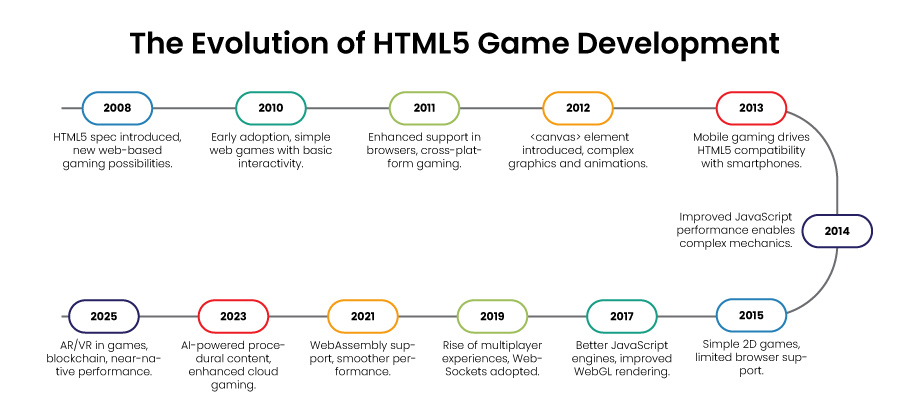
HTML5 has changed the web-based gaming landscape, allowing developers to create interactive and convincing experiences without additional plugins. Today, HTML5 games are a vital part of the gaming ecosystem, emerging on significant platforms and social networks. Moving towards 2026, we will look at new trends in HTML5 game development that can affect the future of gaming.
The Gaming Revolution on Web Browsers
The browser-based gaming landscape has transformed dramatically since HTML5’s introduction. What started with simple puzzle games has evolved into a platform capable of running complex multiplayer adventures and visually stunning experiences. Modern browsers now handle 3D graphics, real-time multiplayer connections, and sophisticated physics engines without breaking a sweat.
Game developers have embraced web browsers as a serious gaming platform, creating everything from casual time-killers to deep, story-driven experiences. Web-based game engines have matured, offering tools that rival traditional game development platforms. This growth has attracted both indie developers and major studios to the HTML5 space, leading to a rich variety of games that push the boundaries of what’s possible in a browser.
The rise of cloud gaming services has further validated browsers as gaming platforms. Companies now stream high-end games directly through browsers, showing that the gap between web-based and traditional gaming is smaller than ever. This convergence of technologies has created new opportunities for developers to reach players instantly, without the barriers of downloads or installations.
Key Trends for Modern HTML5 Game Development in 2026
1. Increased Use of Cloud Technology
Cloud computing is revamping the gaming industry, and HTML5 games are certainly not an exception. Using cloud infrastructure is allowing developers to improve performance, scalability, and accessibility.
- Real-Time and Instant Content Delivery: Cloud technology allows developers to instantly push updates and new content. This means games can introduce new levels, characters, or events without the players having to download patches or updates, considerably improving the user experience. By unloading processing to the cloud, developers can make more complex game mechanics and larger worlds while maintaining performance across various devices.
- Scalability and Optimized Performance: Cloud platforms can automatically adjust resources based on player demand. For instance, additional server resources can be allocated during peak times or special events to handle increased traffic without lag. Using cloud services with data centers worldwide guarantees low latency for players, irrespective of their geographical location.
2. Integration of Artificial Intelligence (AI)
AI enhances how players experience and interact with games. It affects both computer-controlled characters and how game content is created. As AI continues to evolve, it’s playing a key role in trending at the moment HTML5 games, providing more dynamic and personalized gameplay experiences that adapt to player actions and preferences.
- Dynamic Gameplay: Game characters controlled by AI can learn from how players behave and change their actions. In shooting games, computer-controlled enemies can study and respond to player strategies, making games more challenging. AI also creates custom experiences by tracking what players like, changing how hard the game is, and recommending content that matches their style.
- Content Generation: AI can automatically create game levels, missions, and environments based on player actions. Games like No Man’s Sky use this to build huge game worlds with different planets and wildlife. AI can also create stories that change based on player choices, making each game different.
3. Augmented Reality (AR) and Virtual Reality (VR) Integration
AR and VR technology is changing HTML5 gaming by creating more engaging experiences.
- Enhanced Player Interaction: HTML5 games can use AR to let players interact with game elements in the real world using phones or AR glasses. This leads to more complex games like Pokémon GO.
- Immersive Environments: Advances in WebVR let developers make VR games that work directly in web browsers without downloading extra programs. This helps create simple VR games that more people can play.
- Expanding Accessibility: HTML5-based AR and VR games work on many devices, from phones to computers, unlike traditional AR/VR games that need special equipment.
4. Cross-Platform Compatibility
One of HTML5’s biggest strengths is its ability to run effortlessly and smoothly across different devices and operating systems. This trend will continue to be a focal point in 2026.
- Seamless Experience Across Devices: HTML5 games can be played on different devices while keeping game progress. Players can save their games online and play with others no matter what device they use.
- Wider Audience Reach: Games that work on computers, tablets, and phones can reach more players. Popular games like Fortnite let friends play together even when using different devices.
- Improved Browser Support: Modern web technologies like WebAssembly enhance the performance of HTML5 games, making them comparable to native applications.
| Feature | HTML5 Games | Native Games |
| Platform Compatibility | Runs on all browsers & devices | Requires platform-specific coding |
| Performance | Can be optimized, but may lag for complex games | Higher performance due to direct hardware access |
| Development Speed | Faster development, write once & deploy everywhere | Longer due to platform constraints |
| Updates & Maintenance | Easier to update without downloads | Requires users to update manually |
| Monetization Options | Web-based ads, in-game purchases, subscriptions | In-app purchases, ads, one-time fees |
Cross- Platform Compatibility in HTML5
5. Focus on Multiplayer Experiences
Social gaming is a dominant trend, and HTML5 developers focus on building more interactive multiplayer experiences.
- Social Interaction: HTML5 games are adding more ways for players to play together in real time using WebSocket technology. This creates competitive gameplay similar to console games.
- Community Building: Game makers can host special events like tournaments or team challenges where players work together to reach goals.
- Cross-Device Multiplayer: Enabling multiplayer experiences that work seamlessly across devices allows friends to play together regardless of their platform.
6. Enhanced Graphics and Visual Effects
As browser capabilities improve, HTML5 games are achieving higher-quality visuals that rival traditional gaming platforms.
- High-Quality Visuals: WebGL 2.0 lets developers create beautiful graphics with advanced lighting, shadows, and textures that look as good as console games.
- Improved Performance Across Devices: Special techniques like Level of Detail rendering help games look good while running smoothly, even on less powerful devices.
- Higher FPS Support: HTML5 games can run at higher frame rates with optimized rendering engines, leading to a smoother gaming experience.
| Technology | Features & Benefits | Use Case in HTML5 Games |
| WebGL 2.0 | Improved 3D rendering, realistic lighting & effects | High-quality visuals, enhanced performance |
| WebAssembly | Faster execution, supports complex computations | Running heavy game logic efficiently |
| Canvas API | Efficient 2D rendering, smooth animations | Platformer & casual games |
| WebGPU | Advanced graphics processing, better than WebGL | Future high-performance gaming |
Comparison of HTML5 Game Development Technologies
7. Mobile-First Development Approach
With mobile gaming continuing to dominate the industry, developers are prioritizing mobile-first design principles.
- Prioritizing Mobile Experiences: Games are designed specifically for phones and tablets, with special attention to touch controls that feel natural and responsive. Developers spend extra time making sure the controls are easy to use and enhance the overall gaming experience on mobile devices.
- User-Centric Design: Games are built to automatically adjust their layout and interface to work perfectly on different screen sizes and orientations. This means players get the best possible experience whether they’re playing on a small phone or a large tablet, in portrait or landscape mode.
8. Faster Load Times and Performance Optimization
Slow load times can deter players from engaging with a game. Developers are focusing on speed enhancements to keep players engaged.
- Improving User Experience: Games now load in stages, showing the most important parts first while less important elements load in the background. This smart loading system means players can start playing sooner without waiting for everything to load at once.
- Smoother Gameplay: Development teams use special tools to measure how well their games perform and collect data about player experiences. This information helps them make games run more smoothly and load faster based on real player feedback.
- Code Optimization: Better programming practices and new technologies like WebAssembly help games run faster and more efficiently. This means smoother gameplay and better performance across different devices.
9. Decentralized Gaming and Blockchain Integration
Blockchain technology is opening up new possibilities for HTML5 game development, offering secure and transparent player experiences.
- Integration: Blockchain allows players to truly own unique items in games through NFTs, which can be bought, sold, or traded outside the game. This gives players real ownership of their virtual items, similar to owning physical collectibles.
- Innovative Monetization Models: Games can now offer new ways for players to earn value while playing, such as collecting tokens that have real-world value. These tokens can be used within games or exchanged for actual money, creating new economic opportunities.
- Decentralized Gaming Ecosystems: Players can trade and manage their game items directly with each other, without going through a central authority. This creates a more open and player-controlled gaming economy where items can move freely between games and players.
10. Community Engagement through Social Features
The social aspect of gaming continues to gain importance, leading to the integration of community-driven features.
- Building Connections: Games include easy ways to share achievements and exciting moments on social media platforms. This helps create active communities around games and attracts new players through social connections.
- Shared Experiences: Modern games offer ways for players to enjoy content together, whether playing as a team or watching others play live. These features help create stronger gaming communities and more engaging experiences.
- Interactive In-Game Events: Games regularly host special events like tournaments and team challenges to keep players engaged. These events bring players together and give them new reasons to keep playing and participating in the game community.

Bring your game ideas to life with cutting-edge HTML5 development
Notable Games and Platforms Using HTML5
| Platform | Game | Features | Programming Languages | Additional Info |
| Facebook Instant Games | EverWing | Fast-paced action shooter, real-time multiplayer | JavaScript, HTML5, WebGL | One of the first successful Instant Games on Facebook |
| Poki | Subway Surfers (Web) | Endless runner, mobile-to-web adaptation | JavaScript, HTML5, Phaser | Web version of a highly popular mobile game |
| CrazyGames | Moto X3M | Physics-based bike racing, responsive controls | JavaScript, HTML5, Three.js | Popular casual game with millions of players worldwide |
| Google Stadia (Web Version) | Crayta | Cloud-based game creation platform, user-generated content | JavaScript, Lua, WebAssembly | Runs on Stadia and in browsers for seamless gaming |
| Newgrounds | Tower of Heaven | Retro-style platformer, pixel graphics | JavaScript, HTML5, WebGL | Showcases HTML5’s ability to support indie game design |
| Kongregate | ZombIdle | Idle clicker game, strategy elements | JavaScript, Phaser, PixiJS | Example of HTML5’s use in idle/clicker games |
| Itch.io | A Dark Room | Text-based adventure game, minimalist design | JavaScript, HTML5 | HTML5 enables storytelling-driven game experiences |
| MSN Games | Bejeweled HTML5 | Classic puzzle-matching, optimized for web | JavaScript, HTML5, CSS3 | Modern web adaptation of a legendary game |
| Scirra Arcade | The Next Penelope | Futuristic racing, pixel aesthetics | JavaScript, HTML5, Construct 2 | Built with Construct, showcasing HTML5’s versatility |
Notable Games and Platforms Using HTML5
Power Your Gaming Dreams with Juego Studios
At Juego Studios, we create high-quality HTML5 games that work smoothly across all devices. Our team combines technical expertise with creative design to build engaging games that match your needs. From simple casual games to advanced multiplayer experiences, we deliver optimized solutions that perform well and scale easily.
Conclusion
The future of HTML5 game development in 2026 promises significant advancement through new technology and changing player needs. Key trends like cloud computing, AI, AR/VR, cross-platform play, better graphics, and mobile-first design will shape how games are made and played. Along with blockchain gaming and improved performance, these innovations will help developers create more engaging and accessible games for everyone. By embracing these changes, developers can build immersive experiences that connect with players across different devices and platforms, setting new standards for what HTML5 games can achieve.
Frequently Asked Questions
AI plays a crucial role in enhancing player experiences and automating content creation in HTML5 game development. It enables adaptive NPCs that learn and respond dynamically to player behavior, making gameplay more engaging. AI also contributes to procedural content generation, creating unique levels, challenges, and narratives tailored to individual players.
Key AI applications:
- Dynamic NPC behavior that adjusts based on player actions.
- Procedural level and content generation to enhance replayability.
- Personalized game difficulty that adapts to player skill levels.
- AI-powered chatbots for in-game assistance and support.
With AI integration, games in HTML5 can deliver smarter, more immersive, and personalized gaming experiences across various platforms.
HTML5 is a powerful choice for cross-platform game development due to its universal compatibility and ease of deployment.
- Runs on any device – Games in HTML5 function seamlessly across PCs, smartphones, tablets, and even smart TVs.
- No app store restrictions – Developers can distribute games directly via a web browser, bypassing app store approvals.
- Easy updates – Players don’t need to download updates; all modifications happen instantly on the server side.
- Cost-effective development – A single codebase reduces the need for separate versions for Android, iOS, and desktops.
- Cloud-based accessibility – Games can leverage cloud computing for storage, saving, and multiplayer functionality.
By using HTML5, developers can reach a broader audience while ensuring a seamless and engaging gaming experience.
HTML5 game development relies on several robust tools and frameworks that make game creation more efficient and scalable. Some of the most widely used ones include:
- Phaser.js – One of the most popular HTML5 game frameworks, ideal for 2D games.
- Three.js – Used for developing stunning 3D web-based games in HTML5.
- PixiJS – A powerful rendering engine for fast, high-quality 2D graphics.
- Construct 3 – A no-code/low-code tool for creating games with drag-and-drop functionality.
- WebGL – Enables high-performance graphics rendering directly in browsers.
- WebSockets – Facilitates real-time multiplayer interactions.
- Babylon.js – Best for immersive 3D gaming and AR/VR experiences.
Choosing the right tool depends on the game’s complexity, graphical needs, and performance requirements.
HTML5 game development companies provide a range of services tailored to creating engaging and interactive web-based games.
- Custom Game Development – Building HTML5 games from scratch based on client requirements.
- Cross-Platform Game Porting – Adapting existing games for multiple devices and browsers.
- Multiplayer & Social Game Integration – Implementing real-time multiplayer features, leaderboards, and social sharing.
- Graphics & Animation Design – Creating visually appealing 2D/3D assets optimized for web performance.
- Performance Optimization – Enhancing game speed, reducing load times, and ensuring smooth gameplay.
- HTML5 Game Monetization Strategies – Implementing ad integrations, in-game purchases, and subscription models.
- Maintenance & Updates – Providing long-term support, bug fixes, and feature enhancements.
These services help businesses and developers bring their game ideas to life while ensuring high performance and scalability.
The cost of developing an HTML5 game varies based on factors like complexity, features, graphics, and development time.
- Simple games (e.g., puzzles, arcade) – $5,000 to $15,000
- Mid-range games (e.g., multiplayer, RPGs) – $15,000 to $50,000
- High-end games (e.g., complex mechanics, AR/VR integration) – $50,000 to $150,000+
Additional factors influencing costs:
- Graphics & Animation – Higher-quality visuals require advanced rendering and design, increasing costs.
- Multiplayer & AI Integration – Real-time multiplayer and AI-driven features add to development expenses.
- Monetization Features – Implementing in-game purchases or advertising APIs can impact cost.
- Maintenance & Updates – Ongoing support incurs additional costs over time.
Businesses should define their budget and feature priorities early on to optimize costs.
The development timeline for an HTML5 game depends on its complexity, features, and design intricacy.
- Basic HTML5 games (e.g., single-player puzzles, casual arcade games) – 1 to 3 months.
- Mid-level games (e.g., strategy, simple multiplayer, RPGs) – 3 to 6 months.
- Complex games (e.g., multiplayer, AI-driven, large 3D worlds, AR/VR integration) – 6 to 12+ months.
Key factors affecting development time:
- Game Mechanics & Features – More complex interactions require longer coding and testing phases.
- Graphics & Animation – High-quality animations and realistic assets increase development time.
- Multiplayer & AI Integration – Implementing real-time multiplayer features adds months to the timeline.
- Testing & Debugging – Extensive testing ensures bug-free performance across multiple devices.
Planning the scope efficiently helps streamline development and ensures timely completion.
Partnering with a specialized HTML5 game development firm provides expertise, efficiency, and long-term support.
- Technical Expertise – Professional teams have experience in HTML5 frameworks, performance optimization, and cross-platform development.
- Faster Time-to-Market – With pre-built solutions and efficient workflows, games get developed and launched faster.
- Access to Advanced Tools – Firms utilize the latest technologies, rendering engines, and AI-driven mechanics to enhance gameplay.
- Customization & Scalability – A specialized team tailors games to specific business goals, ensuring scalability for future expansions.
- Quality Assurance & Testing – Rigorous testing ensures a bug-free and high-performance gaming experience.
- Post-Launch Support & Updates – Ongoing support ensures that games remain up-to-date and optimized.
By choosing a dedicated HTML5 development firm, businesses can save time, reduce costs, and deliver high-quality gaming experiences to their audience.
Related Posts

Emerging Trends for Modern HTML5 Game Development in 2026
HTML5 games creation is currently in a more favorable position to evaluate the quality and value of HTML5 video games. The HTML5 game development process is not merely following section outlines for gaming but also serves as a future tech. It has already begun developing as a new model technology with the potential to define and establish […]

SOCIAL IMPACT GAMES: 6 HTML5 GAMES THAT HAVE MAJOR SOCIAL IMPACT
There is no doubt that social impact games are on the rise. More and more people are looking for ways to make a difference in the world, and games are great! These games allow players to engage with important social issues and learn more about them in a fun and interactive way. In this blog […]

4 TIPS TO IMPROVE PLAYER RETENTION FOR YOUR HTML5 GAME PLATFORM
The gaming industry is rife with competition. There are a hell lot of games all trying to get the attention of the same users. But getting the users’ attention, eventually leading them to play your game, is a fundamental step. Many developers can do that. The more significant challenge is retaining the players days after […]