


 Unity
Unity Unreal
 Godot
Godot
 Mobile
 PC
PC Console
 Full-Cycle
 Co-Development
 Outstaffing






-
 Game Development
 Mar 24th, 2026
- Share:
Table of Contents
- Scaling Game Development Teams in the UAE: A 2026 Industry Analysis
- TL;DR- A Quick Summary
- The UAE's Growing Role in Global Game Development
- What Does Scaling Development Teams Mean in Game Production?
- When Should You Scale Your Game Team?
- Build vs. Outsource vs. Co-Develop: Choosing the Right Scaling Model
- Cost of Scaling Game Development Teams in the UAE
- How Do UAE Game Studios Scale Teams Quickly?
- What Is the Fastest Way to Scale a Game Development Team?
- Key Strategies UAE Game Studios Use to Scale Teams
- Benefits of Scalable Game Development Teams
- Why Is Team Scalability Critical for Game Studios?
- Challenges in Managing Large Development Teams
- How Juego Studios Helps Game Studios Scale
- The Future of Game Development Scaling in the UAE
- Conclusion
The Middle East is no longer just a consumer of global gaming culture — it is rapidly becoming one of its most important producers. With billions of dollars flowing into the region’s digital economy, UAE-based game studios are no longer building for local audiences alone. They are co-developing AAA titles, shipping cross-platform mobile experiences, and operating as full-scale production partners for publishers from Tokyo to Toronto.
The question is no longer whether UAE studios can compete internationally — it is how they are structuring their teams to do it at scale.
Scaling Game Development Teams in the UAE: A 2026 Industry Analysis
As we move through 2026, the UAE has solidified its position as the most sophisticated gaming hub in the Middle East. The transition from a consumer-heavy market to a production powerhouse is now backed by significant milestones: as of early 2026, the UAE gaming market is valued at approximately $586 million, with a clear trajectory toward $857 million by 2032. Fueled by government-backed initiatives and a population where over 75-77% of adults are active gamers—the highest penetration rate globally—the country has moved beyond tentative interest into serious, large-scale export.
Game studios in Dubai and Abu Dhabi are now vital nodes in the international circuit, participating in complex game co-development arrangements and managing distributed teams that span continents. This shift is accelerated by the Dubai Program for Gaming 2033, which has already integrated over 350 gaming-related companies into its ecosystem. For investors and publishers, the operational architecture has matured; studios are now leveraging Golden Visa extensions to secure top-tier global talent and utilizing the nation’s world-leading 5G and FTTH infrastructure to maintain real-time, modular development pipelines.
TL;DR- A Quick Summary
- UAE game studios scale teams through hybrid hiring, outsourcing, remote collaboration, and modular pipelines
- Government programs like the Dubai Gaming Program and Abu Dhabi Gaming are accelerating local talent development
- Studios invest in Unity, Unreal Engine, AI tools, and cloud infrastructure to support global production timelines
- Co-development and game development outsourcing services allow rapid team expansion without long recruitment cycles
- Juego Studios is one of the key players enabling UAE and global game studios to scale efficiently through end-to-end co-development and outsourcing solutions
- Challenges include quality consistency, cross-cultural coordination, and time zone management across distributed teams
The UAE's Growing Role in Global Game Development
The context behind scaling game development teams in the UAE begins with understanding the scale of regional ambition. The UAE is not approaching gaming as a niche entertainment sector — it is treating it as a pillar of long-term economic diversification.
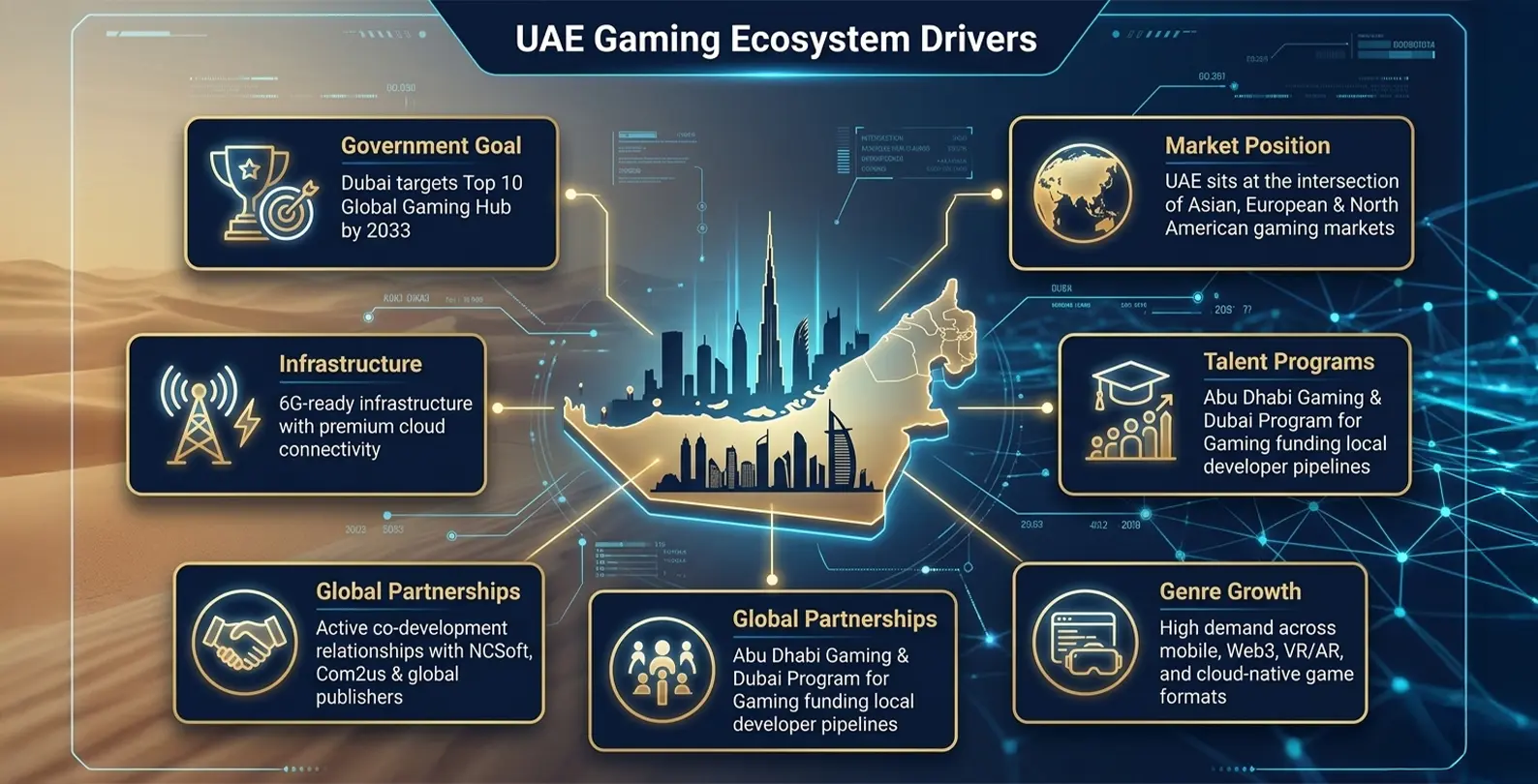
Why the UAE Is on the Global Gaming Map
| Factor | Details |
| Government Ambition | Dubai aims to be a top 10 global gaming hub by 2033 |
| Strategic Location | Bridges Asia, Europe, and North America across time zones |
| Infrastructure | Premium connectivity, cloud-ready, and 6G in development |
| Market Growth | A rapid rise in popular video games in the UAE across mobile, PC, and console |
| Global Partnerships | Established ties with studios like NCSoft and Com2us |
The UAE gaming market sits at the crossroads of three of the world’s largest gaming geographies — Asia, Europe, and North America. Studios based in Dubai and Abu Dhabi can operate across time zones that are commercially convenient for publishers and platform holders in each of these regions. That geographic advantage, combined with access to a high-net-worth and tech-forward consumer base, makes the UAE not just a production hub, but a strategic relay point for global game distribution and live operations.
The rapid expansion of popular video games in the UAE — spanning mobile, console, and PC — has created domestic demand that reinforces the incentive to build local development capacity. As player expectations rise and game genres diversify, studios must scale not just their headcount but their specialization depth.
What Does Scaling Development Teams Mean in Game Production?
Scaling a development team in game production refers to the deliberate expansion and restructuring of development capacity to match the demands of increasingly complex, multi-platform, and internationally scoped projects. It is not simply a matter of hiring more staff.
What Scaling Actually Involves
- Adding the right disciplines at the right time
- Integrating external partners efficiently
- Maintaining production coherence across geographically distributed teams
- Managing simultaneous workstreams across programming, art, narrative, audio, QA, and live ops
- Coordinating remote teams with different workflows, tools, and communication norms
Modern game projects operate across multiple disciplines simultaneously — each requiring distinct expertise. As a project’s scope expands, studios must scale across all of these disciplines in parallel, often under compressed timelines. This requires production architectures that are modular, collaborative, and technologically supported.
For studios engaged in international co-development or outsourcing arrangements, scaling also involves integrating remote teams whose workflows, tools, and communication styles may differ significantly from internal teams. Managing this integration without degrading production quality or velocity is one of the defining operational challenges in modern game development — and one where UAE studios are building notable expertise.
When Should You Scale Your Game Team?
Not every studio needs to scale immediately — but missing the signals can cost months of production time. If you are evaluating whether your team has hit its ceiling, these are the clearest indicators that a scaling decision is overdue.
Signals You Need to Scale
| Signal | What It Looks Like |
| Production delays increasing | Milestones slipping despite team effort; buffer time eroding sprint over sprint |
| Internal team overloaded | Core developers context-switching across disciplines; burnout risk rising |
| Multiple platforms planned | iOS, Android, console, and PC simultaneously — each requiring platform-specific optimization |
| Art pipeline bottlenecks | Programming is ready; art assets are the blocker — a classic sign of team imbalance |
| Scope expanding mid-project | Publisher or stakeholder requirements growing faster than internal capacity |
| International release deadlines | Localization, compliance, and certification timelines requiring parallel workstreams |
The cost of scaling too late is almost always higher than the cost of scaling too early. A delayed launch in the live service era means lost player acquisition windows, missed platform featuring opportunities, and competitors filling the gap.
What poor scaling decisions actually cost:
| Failure Point | Business Consequence |
| Missed deadlines | Publisher trust loss — and in competitive markets, contract loss |
| Inconsistent art quality | Rework cycles that consume 20–40% of the art budget |
| Poor scaling decisions | Budget overruns that compound monthly as teams scramble to recover |
| Delayed platform submission | Missing certification windows by weeks can push a launch quarter back entirely |
If two or more of the above signals are present simultaneously, the case for scaling — whether through hiring, outsourcing, or co-development — is strong. The next question is which model fits your situation.
Build vs. Outsource vs. Co-Develop: Choosing the Right Scaling Model
There is no universally correct answer to how a studio should scale. The right model depends on project type, timeline, IP ownership requirements, and budget. Understanding the trade-offs clearly is the first step to making the right call.
Scaling Model Comparison
| Model | Best When | Scaling Speed | Cost Profile | Key Risk |
| In-house hiring | Building long-term IP; studio brand and culture matter | Slow (3–9 months per hire) | High fixed cost | Slow to scale down; overhead persists between projects |
| Outsourcing | Specific, well-scoped tasks — art, QA, localization | Fast (weeks) | Low–Medium variable | Integration quality; vendor dependency |
| Co-development | Full production scaling; partner shares creative responsibility | Fast–Medium | Medium–High, flexible | Requires partner maturity and aligned workflows |
| Hybrid (co-dev + in-house) | Complex multi-platform titles with evolving scope | Flexible | Scalable | Coordination overhead across multiple team types |
How to Choose
- Choose in-house when the work is core to your IP, and you plan to reuse the team across multiple titles over 3+ years.
- Choose outsourcing when the task is well-defined, deliverable-based, and does not require deep integration with your creative direction — game art outsourcing services, QA cycles, and localization are the clearest fits.
- Choose co-development when the project scope exceeds your current team’s bandwidth, and you need a partner who can own entire production modules, not just execute tasks.
- Choose hybrid when you are building a long-term studio capability while shipping a large project simultaneously.
Cost of Scaling Game Development Teams in the UAE
Cost is one of the most searched-for topics in game development outsourcing — yet it is rarely discussed transparently. The ranges below reflect general market positioning rather than fixed rates, as actual costs vary significantly based on seniority, specialization, and engagement model.
Cost Ranges by Scaling Model
| Scaling Approach | Estimated Monthly Cost | Rate Breakdown | Notes |
| Senior in-house developer (UAE) | $8,000–$15,000+/month | Salary + visa + benefits + workspace | High fixed overhead; persists between projects |
| Mid-level in-house developer (UAE) | $4,000–$8,000/month | Salary + benefits | Significant recurring commitment regardless of project load |
| Outsourcing (art, QA, animation) | $2,000–$12,000/month | $25–$80/hour depending on region & specialization | Variable; scales with deliverable volume |
| Co-development partner | $15,000–$60,000+/month | Project-based or retainer; team-level pricing | Cost scales with scope, not individual headcount |
| Distributed remote team (managed) | $3,000–$10,000/month | Lower base than UAE hire; coordination layer added | Hidden cost: production management overhead |
The Real Cost Equation
Raw hourly or monthly rates are only part of the picture. Studios that have successfully scaled factor in:
- Ramp-up time — how long before a new hire or partner is producing at full quality
- Management overhead — distributed teams require experienced production management
- Rework risk — low-cost outsourcing with poor brief quality often costs more in revisions than it saves upfront
- Opportunity cost — every month of delayed scaling is a month of reduced production output
For most studios evaluating their first major scaling decision, co-development with an experienced partner offers the best balance of speed, cost flexibility, and production quality — particularly for studios without an established outsourcing management function in-house.
How Do UAE Game Studios Scale Teams Quickly?
UAE game studios scale development teams through a combination of approaches that prioritize speed and quality in parallel — rather than treating them as trade-offs.
The Quick-Scale Toolkit
- Hybrid hiring — combining local graduates with internationally recruited specialists reduces dependency on a single talent source
- Game co-development partnerships — shared production responsibility with an experienced studio partner compresses timelines dramatically
- Game development outsourcing services — specialized tasks like art, QA, and animation can be contracted and onboarded within weeks
- Modular pipelines — parallel development across departments means no single team becomes a bottleneck for the whole project
- Cloud-based tools and AI-assisted production workflows — reduce the manual coordination burden across distributed contributors
This approach allows studios to expand capacity without long recruitment cycles — a critical advantage when working against publisher delivery windows or platform launch dates.
What Is the Fastest Way to Scale a Game Development Team?
The fastest way to scale a game development team is through a mix of co-development partnerships, targeted outsourcing, and pre-built team integration — rather than individual hiring.
Speed-to-Production Comparison
| Approach | Time to Full Productivity |
| Individual hiring (senior roles) | 3–9 months |
| Outsourcing specific pipelines | 2–6 weeks |
| Co-development with an established studio | 3–8 weeks |
| Integrating pre-built specialist teams | 1–4 weeks |
The logic is straightforward: pre-built teams at an outsourcing or co-development partner already have internal workflows, tooling, and quality standards in place. Onboarding a team is faster than assembling one from scratch. This reduces scaling timelines from months to weeks while maintaining production quality — provided the partner selection process is rigorous.
Key Strategies UAE Game Studios Use to Scale Teams
This is where theory meets practice. UAE studios are not relying on a single approach — they are deploying a layered set of strategies that combine talent, technology, and operational models.
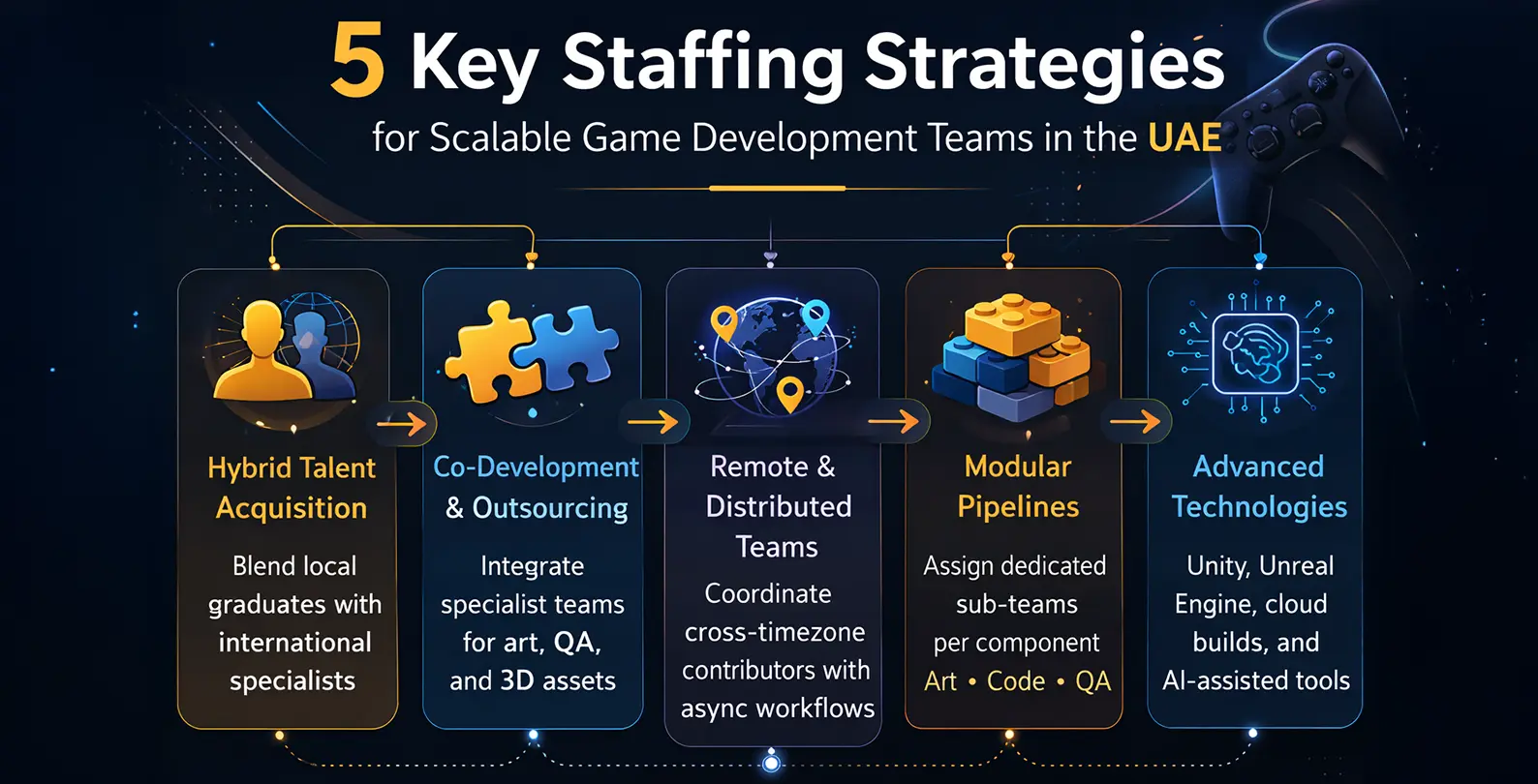
1. Hybrid Talent Acquisition: Combining Local and International Expertise
The foundation of scaling game studio teams in the UAE is a hybrid talent model that draws on both the growing pool of locally trained developers and the international expertise that the region’s open economy readily attracts.
How the hybrid model works:
| Talent Source | Best For |
| Local university programs & govt initiatives | Long-term studio builds, cultural proximity to the regional market |
| International recruitment | Immediate seniority — gameplay programmers, 3D artists, AI engineers |
| Diaspora talent returning to the region | Mid-senior roles with dual cultural fluency |
Studios in the region looking to hire game designers and other specialist roles benefit from the UAE’s status as a global talent destination. The country’s visa policies and quality of life proposition make it relatively straightforward to recruit internationally experienced developers across areas such as:
- Gameplay programming
- 3D art and animation
- AI development
- Multiplayer systems
- Level design
The decision to hire a video game developer through local universities versus international recruitment is increasingly driven by project type and timeline. For long-term studio builds, local talent pipelines are the strategic preference. For project-specific scaling, international recruitment and partnership models are more common.
2. Outsourcing and Co-Development Models
Among the most efficient tools for scaling of UAE game development teams is the co-development model, where a UAE studio partners with one or more external organizations to share production responsibilities across a project.
Why co-development works:
- Faster capacity expansion without full-time hiring overhead
- Access to specialized expertise that the internal team doesn’t yet have
- Bidirectional participation — UAE studios act as both clients and providers
- Better cost management across different project phases
Game co-development allows studios to tap into global talent pools for specific workstreams. Commonly outsourced functions include:
| Function | Why It’s Outsourced |
| Environment Art | High volume, parallelizable |
| Character Modeling & Animation | Specialized skill set, variable demand |
| Technical QA | Scale-dependent, peaks near launch |
| Localization | Language expertise, regional nuance |
| 3D Asset Creation | Time-consuming, pipeline-ready |
Game art outsourcing services and specialist vendors augment delivery capacity, giving UAE studios a production flexibility that fully internal teams cannot match. Game development outsourcing services accessed by UAE studios typically span environment art, character modeling, animation rigging, technical QA, and localization — all components that can be contracted independently and integrated into centralized production pipelines.
3. Remote and Distributed Development
The scaling of UAE game production teams increasingly depends on distributed development models where contributors operate across multiple geographies and time zones. The UAE’s geographic position between Asian and European time zones makes distributed collaboration both necessary and operationally advantageous.
Tools and frameworks UAE studios rely on:
- Version control systems — Git-based pipelines for code and assets
- Cloud-based asset pipelines — Real-time access across locations
- Sprint management platforms — Jira, Notion, Asana for production tracking
- Video communication infrastructure — For cross-team standups and reviews
- Async task tracking — Reduces time-zone bottlenecks
Communication discipline is equally important. UAE studios managing international contributors implement documented communication protocols, regular cross-team standups, and asynchronous task tracking to ensure production continuity is not disrupted by time zone gaps. As these practices mature, they are becoming a competitive differentiator that supports a video game development studio‘s ability to attract international publishing contracts.
4. Modular Development Pipelines
A modular development pipeline is one where distinct components of a game are developed by specialized sub-teams that operate with a degree of independence but contribute to a unified production.
How modular pipelines are structured:
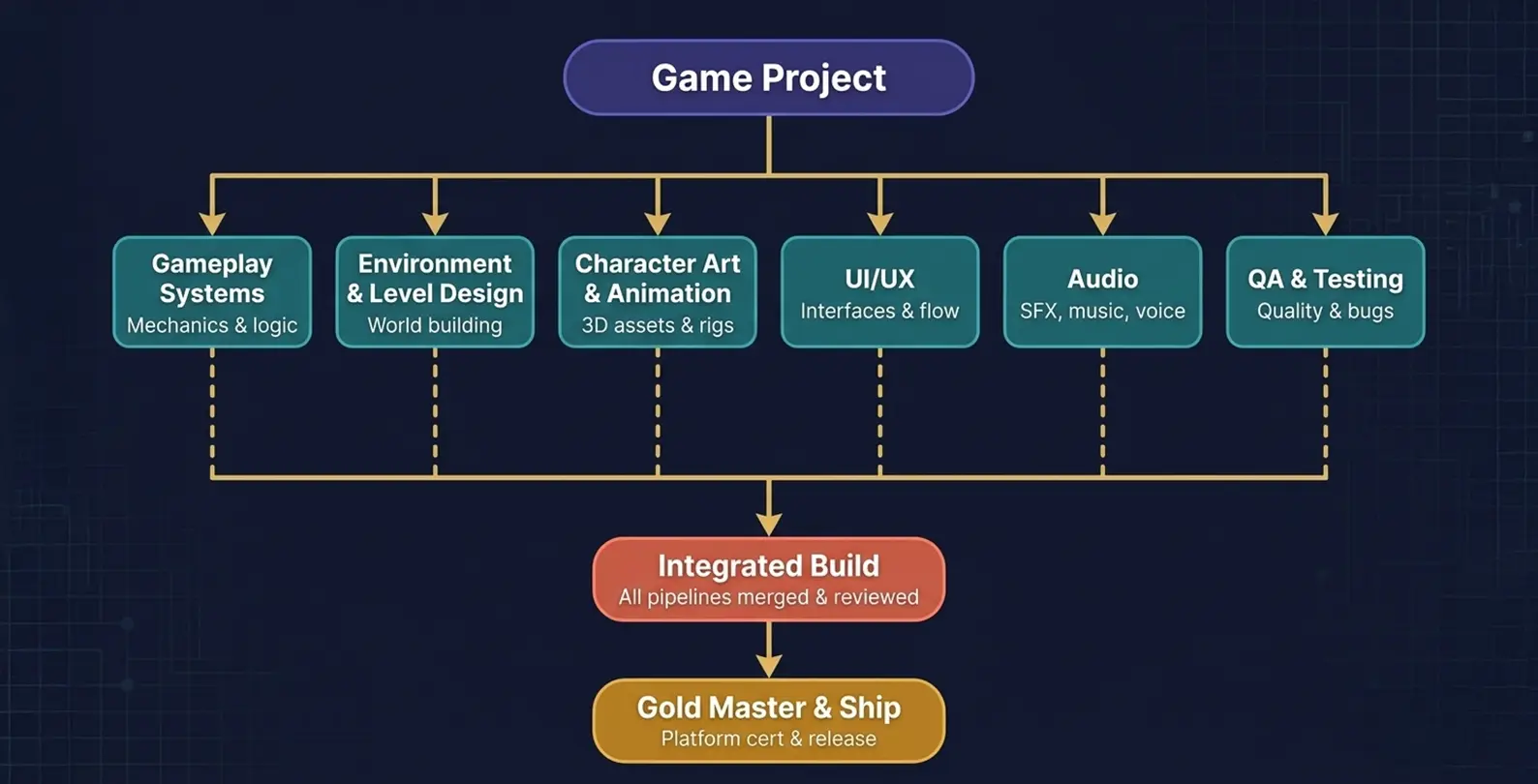
This approach is central to how the expansion of UAE game studio teams is managed for large international projects. The modular model allows studios to scale individual components without disrupting the overall production rhythm. If a publisher requires accelerated art delivery, the studio can scale up its 3D art team or engage additional outsourcing partners without impacting programming or QA operations.
Studios delivering game development services under modular frameworks also benefit from:
- Cleaner IP management
- More transparent billing structures
- Easier handover processes with publishing partners
5. Leveraging Advanced Technologies and Game Engines
The scaling of video game development teams in the UAE is inseparable from advanced production technology adoption.
Key technologies powering UAE game studio scaling:
| Technology | Role in Scaling |
| Unity & Unreal Engine | Full production ecosystems enabling real-time collaboration |
| Cloud-based Build Systems | Distributed teams work concurrently in shared environments |
| AI-assisted Asset Generation | Reduces manual labor, accelerates throughput |
| Automated QA Pipelines | Scales testing without proportional headcount increase |
| AI-driven Live Operations | Maintains player engagement across markets autonomously |
UAE studios engaged in mobile game app development, in particular, are using AI tooling to rapidly produce and test content variations for diverse global audiences. The UAE’s infrastructure is notably well-suited to support these technology stacks — cloud adoption is high, connectivity is premium-grade, and the country is actively investing in 6G readiness.
Benefits of Scalable Game Development Teams
Effective team scaling creates compounding strategic advantages for UAE studios — not just for individual projects, but for long-term competitive positioning.
| Benefit | What It Enables |
| Production Elasticity | Take on projects of varying scope without restructuring core ops |
| Cross-Platform Development | Simultaneous iOS, Android, console, and PC optimization |
| Faster Iteration | Dedicated live ops teams independent of core development |
| Publisher Confidence | Consolidated production relationships across platforms |
| Execution Risk Reduction | Lowers risk profile for investors and co-development partners |
The strategic advantages extend well beyond simple headcount growth. For a game development company in the UAE, a scalable team structure means the ability to take on projects of varying scope without restructuring core operations for each new engagement.
Cross-platform development capability is one of the most commercially significant outcomes of effective scaling. A team large enough and specialized enough to simultaneously develop for multiple platforms reduces time-to-market for global releases — a key selling point when pitching to international publishers.
For investors and publishers evaluating gaming companies in the UAE as long-term partners, team scalability is a proxy for organizational maturity. A studio that has demonstrated the ability to grow and contract its workforce efficiently, maintain quality across distributed teams, and integrate external partners into coherent production pipelines represents a substantially lower execution risk.
Why Is Team Scalability Critical for Game Studios?
Scalability is not just an operational convenience — it is increasingly a commercial prerequisite for studios competing for international publishing contracts and co-development agreements.
What Scalability Unlocks
- Take on larger, multi-platform projects — studios with proven scaling capability can bid for titles that fixed-size teams cannot realistically deliver
- Reduce time-to-market for global releases — elastic teams mean production can accelerate when needed, rather than being capped by headcount
- Maintain consistent production quality across teams — mature scaling frameworks come with quality control infrastructure built in
- Adapt quickly to changing project scope — publisher requirements evolve; scalable studios absorb scope changes without derailing the timeline
- Win international publisher confidence — for studios working with international publishers, demonstrated scalability is often a key factor in contract award decisions
A studio that can only operate at one size is, effectively, a studio that can only pursue one type of project. Scalability is what turns a capable team into a genuinely competitive production partner.
The studios that are building scalability into their operational DNA today — rather than treating it as a reactive measure — are the ones that will be best positioned to absorb the growth the UAE gaming market is generating over the next decade.
Challenges in Managing Large Development Teams
A balanced view requires acknowledging the real operational challenges that come with scaling. These are not deal-breakers — but studios that underestimate them pay for it in production delays and quality inconsistencies.
Common Scaling Challenges
-
Quality Consistency
As team size increases and geographic distribution expands, maintaining consistent quality across all production outputs becomes progressively more difficult. The risk of asset inconsistency, version conflicts, and miscommunicated design intent grows proportionally with team size — particularly when multiple external vendors are integrated into the same pipeline.
-
Cross-Cultural Collaboration
Teams in UAE studios may simultaneously include contributors from South Asia, Southeast Asia, Eastern Europe, and the Arab world. Different professional norms around feedback, iteration, and deadline management can create friction if not explicitly addressed through studio culture and onboarding practices.
-
Time Zone Management
Asynchronous workflows reduce bottlenecks but can slow decision-making when real-time alignment is needed. Studios without clear escalation protocols often find distributed teams defaulting to waiting rather than deciding — compressing delivery timelines at critical milestones.
-
Content Compliance & Regulatory Awareness
Understanding banned games in the UAE and the regulatory boundaries around content — including gambling mechanics, certain depictions of violence, or politically sensitive themes — is essential for studios developing simultaneously for local and export markets.
At a Glance: Challenges vs. Mitigation Strategies
| Challenge | Mitigation |
| Quality inconsistency | Shared style guides, centralized art direction, regular review cycles |
| Cross-cultural friction | Cultural onboarding programs, clear feedback protocols |
| Time zone delays | Async-first workflows defined decision authority at the team level |
| Content compliance | Dedicated compliance review stage in the QA pipeline |
The downstream cost of getting these wrong is not abstract:
- Missed deadlines → publisher trust loss. A studio that slips delivery once rarely gets a second large contract from the same publisher without significant relationship repair.
- Inconsistent art → rework costs. Art that does not match the style guide on first delivery typically triggers a 20–40% rework overhead on the original asset budget.
- Poor scaling decisions → budget overruns. Teams that scale reactively rather than proactively spend the back half of production in catch-up mode — the most expensive phase to staff up during.
How Juego Studios Helps Game Studios Scale
Among the studios making a tangible impact on how global and UAE-based teams scale their game production, Juego Studios stands out as a full-service co-development and outsourcing partner built precisely for this kind of work.
What Juego Studios Brings to the Table
Juego Studios operates as an end-to-end game development partner, enabling studios and publishers to scale without the delays of traditional hiring. Their model addresses the most common scaling bottlenecks directly:
| Capability | How It Supports Scaling |
| Co-development partnerships | Seamlessly integrate into existing production pipelines |
| Art & animation outsourcing | High-volume 3D assets, characters, and environments on demand |
| Full-cycle game development | From concept to launch across mobile, PC, and console |
| QA & testing services | Scalable testing capacity that peaks with project timelines |
| Web3, VR/AR development | Access to emerging tech expertise without building in-house |
| Unity & Unreal Engine teams | Engine-native developers ready to slot into any project |
Why It Matters for UAE Studios Specifically
Studios looking to scale rapidly in the UAE don’t always have the luxury of 6–12 month recruitment cycles. Juego Studios’ co-development model allows UAE-based teams to:
- Expand production capacity within weeks, not months
- Tap specialized art, animation, and QA talent without full-time commitment
- Maintain production quality through established pipelines and workflows
- Leverage global expertise while keeping creative direction in-house
Whether a studio needs to scale a specific department for a single title or build a long-term outsourcing relationship, Juego Studios provides the operational infrastructure to make that growth sustainable and quality-consistent. For gaming entrepreneurs, publishers, and investors exploring the UAE’s game development ecosystem, partnering with a studio like Juego Studios is one of the fastest paths to global production readiness.
The Future of Game Development Scaling in the UAE
The trajectory of scaling video game development teams in the UAE points toward an increasingly distributed, AI-augmented, and globally integrated future.
What to Expect in the Next 5 Years
- Deeper talent localization As academic and government-backed programs mature, the ratio of homegrown developers within UAE studios will increase — reducing dependency on expatriate hiring and strengthening independent competitiveness.
- Larger international co-development deals: Partnerships already established with global studios are signaling the institutional trust that leads to larger and more complex co-development arrangements. UAE studios will gain access to development methodologies, IP frameworks, and distribution networks that further accelerate global integration.
- AI as a force multiplier: AI-assisted art generation, automated testing, and ML-driven live operations will allow smaller teams to deliver at a quality and pace previously requiring much larger headcounts — democratizing production capacity in the UAE’s favor.
- Web3, VR/AR, and cloud-native expansion: New game format categories will open additional scaling vectors for UAE studios with the infrastructure and expertise to pursue them. The modular, tech-forward teams being built today are well-positioned for these emerging production paradigms.
As the Dubai Program for Gaming advances toward its 2033 targets, the operational frameworks being built today — hybrid talent models, modular pipelines, global co-development networks — will form the foundation of what is likely to become one of the world’s most consequential regional game development ecosystems.
Conclusion
The expansion of UAE game studio teams from local operations to globally capable development organizations is not accidental. It is the product of deliberate strategic investment — by governments, by studio founders, and by the international partners who have recognized the region’s potential as a production hub.
For publishers, investors, and companies evaluating outsourcing or co-development partnerships, the UAE’s maturing game development sector offers a compelling combination of infrastructure quality, geographic positioning, and production ambition. Scaling game development teams is, at its core, a problem of organizational design as much as recruitment or technology.
UAE studios that are solving this problem effectively — through hybrid hiring, modular pipelines, co-development integration, and advanced tooling — are positioning themselves to take on project types and scales that were out of reach just five years ago. The global game development industry should expect to hear much more from them in the years ahead.
Frequently Asked Questions
UAE studios scale by combining hybrid talent acquisition, co-development partnerships, outsourcing contracts, modular pipelines, and AI-powered production tools to efficiently manage large international projects.
The Dubai Program for Gaming and Abu Dhabi Gaming provide infrastructure, funding, and talent development support, targeting the UAE’s goal of becoming a top 10 global gaming hub by 2033.
Key challenges include maintaining consistent quality across distributed teams, managing cross-cultural collaboration, navigating time zone differences, and aligning remote contributors with centralized production standards.
Co-development lets studios rapidly expand capacity by integrating specialized external partners for art, QA, and programming — bypassing lengthy recruitment cycles while maintaining high international production standards.
Studios leverage Unity, Unreal Engine, cloud-based build systems, AI-assisted asset creation tools, and real-time collaboration platforms to scale production efficiently across geographically distributed teams.
Related Posts
Have a Game Idea but No Development Team? How to Get It Built
This guide walks you through every realistic way to get your game made, what each one really costs you in time and control, and how to pick the right one before you spend a dollar finding out the hard way.
Top 10 Game Development Companies in USA (2026 Update)
In this blog, we’ll discuss the top 10 game development companies in USA, along with how to evaluate them beyond surface-level claims, so you can identify partners who actually align with your vision, technical needs, and long-term growth goals.
Top Game Development Companies in 2026: 10 Global Leaders Compared
Most game projects don’t fail because the idea was weak. They fail because the development partner couldn’t scale, adapt, or deliver when pressure peaked.