
 Unity
 Unreal
 Godot

 Mobile
 PC
 Console

 Full-Cycle
 Co-Development
 Outstaffing


Inherited a Half-Built Unity Game? What a Code Audit Checks and What It Costs
This post explains what a code audit looks at, what it tends to turn up, and how to use it to get quotes you can actually compare.


Game development
Built for your engine & platform. Scoped to your model.
Built for your engine & platform. Scoped to your model.

Select the Categories

This post explains what a code audit looks at, what it tends to turn up, and how to use it to get quotes you can actually compare.

Unity has quietly become the backbone of modern mobile and cross-platform game production. From live-service mobile titles to scalable PC builds, it’s no longer just about using Unity. It’s about whether a studio can ship, scale, and sustain production without cracks showing later.

If you’re scoping a new Unity project this year, “which render pipeline” has become a decision with a shelf life, not a technical checkbox you tick and move past. Unity’s 2026 strategy shift narrowed the field: Built-in is being phased out, HDRP is in maintenance mode gaining only platform reach, and URP is where nearly all of Unity’s engineering investment is going.

Unity still matters in 2026 because it sits at the intersection of speed, scale, and accessibility. If you’re building for mobile, experimenting with live features, or shipping across platforms without overextending your team, Unity game development remains one of the most practical paths forward. That relevance is reflected in the broader engine economy as well.

If there’s one engine that has quietly reshaped how modern games are produced, it’s Unity. Built for both creativity and scalability, Unity enables studios to build once and deploy everywhere, reducing costs, accelerating delivery, and empowering teams to focus on innovation instead of infrastructure.

Engine selection in 2026 defines production velocity, platform reach, hiring structure, and long-term scalability. Unity 3D game development powers mobile ecosystems, cross-platform launches, hybrid 2D/3D pipelines, and LiveOps-driven roadmaps for studios operating at scale. Leading teams choose Unity because it aligns technical flexibility with production efficiency.

Shipping a game used to mean finishing levels, polishing visuals, and pushing a build live. Today, Unity Gaming Services (UGS) sits at the center of how modern titles actually operate after launch. With Unity powering over 3 billion monthly mobile game downloads and supporting more than 1.3 million monthly active creators, the conversation has clearly shifted from building a game to running a service. What keeps players returning is no longer just rendering quality, but the systems working behind the scenes.
Mobile gaming is no longer a casual experiment for studios. In 2026, competition is fierce, user expectations are unforgiving, and production mistakes are expensive. It’s no surprise that Unity mobile game development sits at the center of this shift, especially when 71% of the top 1,000 mobile games were made with Unity. That dominance is not accidental. It reflects production reliability, scalability, and ecosystem maturity.
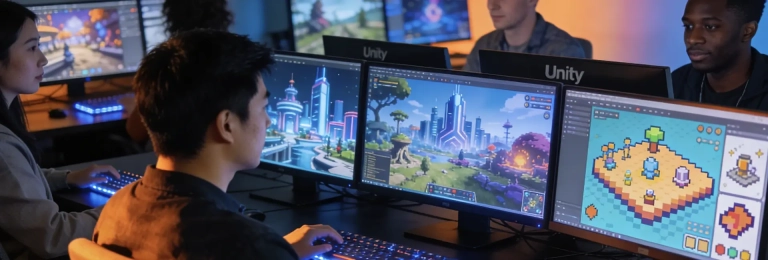
Unity dominates modern game production. Over 51% of all games released on Steam are built with Unity, which means most studios in 2026 aren’t debating engines anymore. They’re debating execution: who will build, how teams will scale, and whether hiring decisions will hold up once production pressure kicks in.

As we look to the future of gaming, Unity 6 stands out as a significant milestone in the evolution of game development. This latest iteration of the renowned game engine brings a host of new features and improvements, promising to reshape the landscape of the gaming industry.

Unity game development cost remains a key consideration for studios planning new projects as Unity continues to be one of the most reliable and flexible engines in 2026. Cross-platform capability, stable performance, and extensive asset ecosystem make game development using Unity suitable for both indie teams and large studios. The engine’s scalability allows developers to handle everything from quick prototypes to complex 3D productions within a unified workflow.

The importance of hiring skilled Unity game developers cannot be overstated, as they play a pivotal role in shaping the success and quality of any game development project.

Switching between Unity, Unreal, Git, and Perforce often feels like juggling four different workflows, and dropping any one of them can cost time, money, and sanity. At Juego Studios, we help you bring it all together into a single, streamlined pipeline.

Multiplayer games have been around for a while, but they are becoming increasingly popular today. Thanks to online gaming, friends in different locations can play the same game using different hardware like consoles, computers, and mobile devices.

In recent times, 3D modeling has become an integral part of various industries. Architecture, real estate, and even education rely on 3D modeling significantly.