


 Unity
Unity Unreal
 Godot
Godot
 Mobile
 PC
PC Console
 Full-Cycle
 Co-Development
 Outstaffing






-
 Game Design, Game Development, Video Games
 Dec 23rd, 2025
- Share:
Table of Contents
- What Is Game Localization?
- Video Game Localization vs Translation: Key Differences
- Why Is Game Localization Important for Global Success?
- The Complete Video Game Localization Process
- Game Localization Benefits for Studios and Publishers
- Common Game Localization Challenges (and How to Avoid Them)
- Practical Game Localization Tips for Better Results
- Localization at Scale: Supporting Global Growth
- Choosing the Right Partner for Game Localization
- Final Thoughts: Localization as a Competitive Advantage
Games today are launched into a global market by default, and players expect them to feel local from day one. According to CSA Research, more than 75% of consumers prefer to engage with digital content in their native language. With the global games market projected to cross $200 billion, even small gains in regional adoption can drive meaningful revenue growth.
This is where game localization becomes critical. Modern localization goes far beyond translating on-screen text. It adapts cultural references, humor, visuals, gameplay elements, and marketing assets so the experience feels native rather than imported.
Done well, localization improves immersion, ratings, and lifetime value; done poorly, it breaks immersion and damages brand trust. For studios targeting international growth, understanding why game localization is important is foundational to global success. Let’s find out how to do it right.
What Is Game Localization?
Game localization is the process of adapting a game for a specific region so it feels natural, relevant, and culturally familiar to local players.
When people ask what is video game localization, the answer extends far beyond translation. Video game localization preserves the intended player experience by aligning language, culture, visuals, and gameplay with local expectations. A well-localized game feels as though it was originally built for that audience, maintaining immersion, emotional connection, and narrative consistency across regions.
Game localization typically includes:
- UI & in-game text: Menus, tutorials, system messages, item descriptions, and subtitles adapted for readability and tone
- Dialogues & voiceovers: Translated and re-recorded dialogue that matches character personality and emotional delivery
- Visual assets and symbols: Icons, gestures, colors, and imagery adjusted to avoid cultural or regulatory issues
- Gameplay mechanics: Adjustments to rules, rewards, or progression to match regional player preferences
- Marketing & store content: Localized trailers, screenshots, app store descriptions, and promotional copy
Without proper localization, cultural mismatches, such as confusing humor or unfamiliar symbols, can instantly break immersion. When done right, localization ensures players experience the game as intended, wherever they play.
Video Game Localization vs Translation: Key Differences
Although often used interchangeably, video game localization and translation serve different roles within the video game localization process, especially for narrative-driven or live-service games.
Translation focuses on linguistic accuracy, converting text correctly from one language to another. Localization adapts the entire experience so it resonates emotionally and culturally with players.
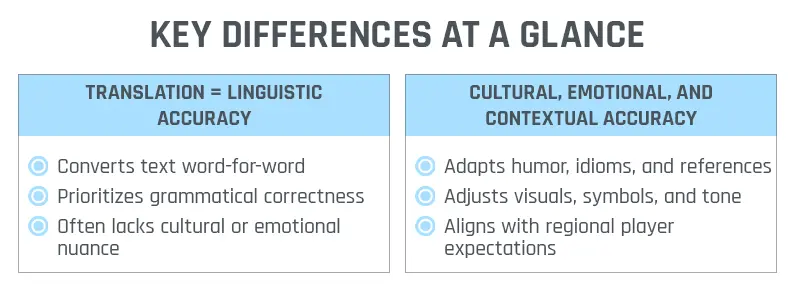 Literal translation can damage immersion in story-heavy games. Jokes lose meaning, emotional scenes fall flat, and unfamiliar references disengage players. Because games rely heavily on emotional investment, even small mismatches can disrupt narrative flow, making video game localization essential for preserving intent and immersion.
Why Is Game Localization Important for Global Success?
Understanding why game localization is important starts with recognizing that localization is a revenue and engagement driver, not an add-on. The global game localization services market is projected to grow from $1.7 billion in 2021 to over $4.4 billion by 2033, reflecting increased investment from studios and publishers.
Below are the key areas where game localization benefits developers and titles in measurable ways.
-
Expands Market Reach and Revenue
Localization removes language barriers and unlocks high-value markets. Regions such as East Asia, Europe, and Latin America represent massive gaming audiences, and markets like China require deep cultural adaptation, not just translation, for success.
-
Improves Player Immersion and Retention
Localized games feel native rather than foreign, strengthening emotional connection. This directly impacts retention, repeat play, and long-term engagement metrics such as session frequency and lifetime value.
-
Protects Brand Reputation
Cultural missteps can quickly damage a game’s reputation through reviews and social media backlash. Localization ensures imagery, narrative cues, and symbols align with local sensibilities, building long-term trust.
-
Increases Downloads, Ratings, and Monetization
Localized games often perform better on app stores due to improved visibility and relevance. Higher ratings, better reviews, and localized store assets increase conversion rates and drive sustained monetization.
The Complete Video Game Localization Process
A successful video game localization process is a structured, multi-stage workflow integrated into production, not a final-step task. Games localized early avoid costly retrofits such as UI rework and hardcoded text fixes, while late localization often causes delays, rushed revisions, and higher costs.
Localization Planning & Market Research
Planning is the foundation of effective localization. Early preparation enables glossaries, translation memory, and QA gates that reduce downstream issues.
This stage defines where and how the game will be localized, considering:
- Target regions and audiences: Language variants, player demographics, and genre preferences
- Cultural factors: Symbols, themes, humor, and character behavior
- Legal and regulatory requirements: Age ratings, censorship, and regional content laws
- Platform-specific constraints: Console certification, storefront guidelines, and UI limitations
Localization should align with the overall game development plan to avoid production bottlenecks.
Core Steps in the Video Game Localization Process
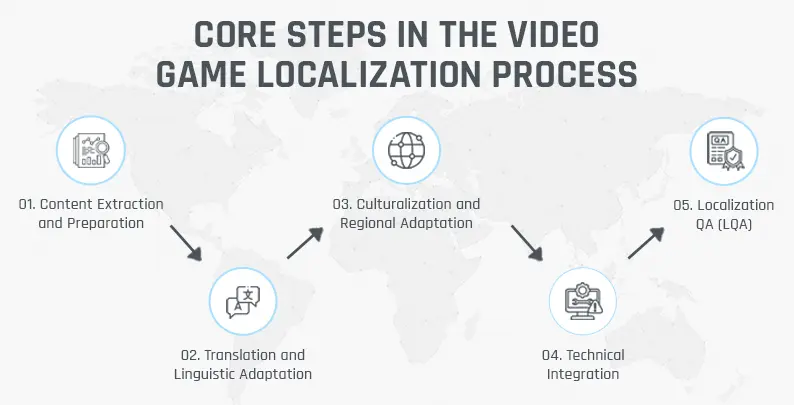
1. Content Extraction and Preparation
UI strings, dialogues, tutorials, and system messages are extracted with context notes to prevent misinterpretation.
2. Translation and Linguistic Adaptation
Translators adapt content while preserving tone, intent, and genre consistency. Narrative-heavy games often require transcreation.
3. Culturalization and Regional Adaptation
Visuals, names, symbols, and references are adjusted to match cultural norms and avoid backlash.
4. Technical Integration
Localized content is reintegrated, accounting for text expansion, font support, RTL/LTR languages, and platform constraints.
5. Localization QA (LQA)
Native-language testers validate accuracy, context, UI fit, and gameplay consistency. This often overlaps with broader video game testing services to catch issues functional QA may miss.
Following a structured video game localization process ensures games feel native in every market without compromising quality or timelines.
Game Localization Benefits for Studios and Publishers
When executed well, game localization benefits studios and publishers across revenue, growth, and brand equity. In competitive markets, video game localization often separates regional releases from global franchises.
- Higher ROI on development: Companies investing in localization are 1.8× more likely to see revenue growth and 1.5× more likely to report profit increases.
- Faster regional adoption: Localized apps and games have shown up to 128% more downloads and around 26% higher revenue in new markets.
- Stronger franchise longevity: Localization supports LiveOps, seasonal content, and long-term engagement, improving retention and monetization.
- Competitive differentiation: Localized store pages and culturally aligned experiences outperform English-only competitors in visibility and conversion.
Common Game Localization Challenges (and How to Avoid Them)
Even experienced studios run into obstacles during game localization, especially when localization is treated as a downstream task instead of a core part of production. Many of these issues surface late in the video game localization process, where fixes become costly and timelines tighten.
Understanding the most common challenges and how to prevent them can significantly improve quality and efficiency.
Key Game Localization Challenges
- Late-stage localization
Localizing after content lock often leads to UI breakage, rushed translations, and missed cultural issues. Industry localization workflows show that late localization can increase rework and QA effort by up to 40%, especially in UI-heavy or narrative-driven games.
- Missing context for translators
Without screenshots, character descriptions, or narrative context, translators may misinterpret tone, intent, or meaning. This frequently results in awkward dialogue, inconsistent terminology, and immersion-breaking errors.
- Cultural blind spots
Symbols, gestures, humor, or themes that feel harmless in one region may be confusing or even offensive in another. Cultural blind spots are a leading cause of negative reviews in localized releases, particularly in markets with strict content sensitivities.
- Technical limitations
Hardcoded text, limited font support, and poor handling of text expansion or RTL languages can cause layout issues and functional bugs once localized content is integrated.
How to Avoid These Issues
- Plan localization early
Integrating localization during pre-production reduces rework, lowers costs, and ensures cultural considerations are addressed before content is finalized.
- Use localization kits and glossaries
Providing translators with glossaries, style guides, and visual context ensures consistency and preserves narrative intent across languages.
- Run dedicated localization QA (LQA) cycles
Native-language testing helps catch linguistic, cultural, and UI issues that standard functional QA often misses.
By addressing these challenges proactively, studios can streamline the video game localization process and deliver culturally authentic experiences without sacrificing quality or launch schedules.
Practical Game Localization Tips for Better Results
Applying the right game localization tips early can significantly reduce rework, improve quality, and speed up global launches. Successful game localization is less about fixing problems later and more about designing systems that support multiple languages and cultures from the start.
Best practices to follow:
1. Design with localization in mind
Build UI layouts that can handle text expansion, multiple scripts, and different reading directions. Languages like German or Russian can take up 30–40% more space than English, while some Asian languages use fewer characters but require different font handling. Designing a flexible UI early prevents costly redesigns later.
2. Avoid hardcoded strings
Hardcoding text into UI or game logic makes localization slow and error-prone. Externalizing strings into localization files allows teams to update translations without touching core code, reducing integration bugs and build delays.
3. Work with native testers
Beyond checking grammar, native-language testers validate tone, cultural relevance, and context. This is critical for narrative-driven games, where even small phrasing issues can weaken emotional impact or confuse players.
4. Use localization-ready tools and pipelines
Modern localization platforms, automation tools, and AI-assisted workflows help manage large volumes of content across frequent updates. Advances in AI in game development are increasingly used to support translation memory, terminology consistency, and early error detection, especially in LiveOps-heavy games.
By following these game localization tips, studios can create smoother localization workflows, deliver higher-quality regional builds, and maintain immersion across every market they target.
Localization at Scale: Supporting Global Growth
Scaling a game globally requires more than adding new languages. It demands a structured approach to video game localization that can support frequent updates, multiple regions, and long-term operations. As games increasingly adopt LiveOps models, game localization must evolve from a one-time task into a continuous workflow.
Key factors in localization at scale include:
- Multi-region rollout
Launching simultaneously across regions reduces fragmentation and marketing inefficiencies. However, this requires coordinated localization pipelines that handle multiple languages, cultural requirements, and platform regulations in parallel.
- LiveOps and frequent content updates
Live events, seasonal content, and balance updates introduce constant streams of new text and assets. Scalable localization workflows help ensure updates reach all regions without delays that could disrupt player experience or monetization.
- Operational efficiency
Centralized localization systems, automation, and reuse of translation memory improve consistency and reduce turnaround times as content volume grows.
Studios looking to expand sustainably often align localization with broader production strategies, especially when scaling game development across regions and platforms. When localization scales alongside development, global growth becomes predictable rather than reactive.
Choosing the Right Partner for Game Localization
Selecting the right partner can determine the success or failure of your game localization efforts. Localization is most effective when it’s handled by teams that understand not only language, but also how games are built, updated, and tested. For complex projects, video game localization works best when integrated directly into the development pipeline.
What to look for in a localization partner:
1. Localization + development expertise
Partners with game development knowledge understand UI constraints, engine limitations, and narrative structure, reducing rework and misalignment.
2. Cultural understanding
Native linguistic expertise combined with cultural insight ensures adaptations feel authentic, not generic or risky.
3. Integrated QA
Localization QA should be part of the workflow, validating language, context, and UI behavior within real builds.
4. Live pipeline compatibility
The ability to support ongoing updates, patches, and LiveOps content is critical for modern games.
Working with a specialized game development company that offers integrated localization and QA support helps studios maintain quality while moving fast across markets.
Final Thoughts: Localization as a Competitive Advantage
At its core, game localization is about respecting players and delivering experiences that feel native across regions. Studios that invest in localization early build stronger immersion, earn better reviews, and unlock sustainable global growth, clearly reinforcing why game localization is important in today’s market.
As LiveOps and global releases become standard, localization works best when it’s integrated into development and QA pipelines rather than treated as a last-mile task.
For a game development studio like us, localization is most effective when combined with full-cycle development, testing, and LiveOps support, helping studios scale globally while maintaining consistent quality and player experience across markets. Talk to us today!
Frequently Asked Questions
Game localization should ideally begin during pre-production, alongside core design and technical planning. Starting early allows studios to:
- Design UI and UX that can handle text expansion and multiple scripts
- Externalize strings and avoid hardcoded content
- Identify cultural, legal, and platform-specific constraints upfront
For producers and technical leads, early localization planning reduces rework, minimizes QA surprises, and helps keep global release timelines predictable.
While localization introduces additional upfront effort, it typically improves ROI rather than inflating costs when planned correctly. For studios and publishers, localization helps by:
- Extending the same game across multiple revenue-generating regions
- Increasing lifetime value without rebuilding core systems
- Avoiding expensive late-stage fixes, UI rework, and rushed QA cycles
In practice, localization is most cost-effective when treated as a scaling strategy, not a post-launch add-on.
Outsourcing localization without proper development context can create quality and production risks, including:
- Truncated or broken UI due to engine or layout constraint
- Inconsistent terminology across features and updates
- Dialogue or narrative that loses emotional intent
These issues commonly arise when localization is handled separately from development and QA. Studios mitigate this risk by working with partners who understand both game development pipelines and localization workflows.
Scaling localization for LiveOps requires an operational approach, not manual workflows. Studios that scale successfully typically rely on:
- Centralized localization pipelines and translation memory
- Consistent glossaries across updates and regions
- Localization QA aligned with patch, event, and content schedules
This ensures new content ships simultaneously across markets, helping LiveOps teams maintain engagement and monetization without slowing release cycles.
Related Posts
Video Game Console Development Blueprint for 2026: Architecture, Process & Studio Guide
Video game console development in 2026 is no longer just about building a great game. It’s about building a compliant, performance-stable, submission-ready product inside a tightly regulated ecosystem. At the same time, the global console segment is projected to reach USD 143,109.2 million by 2030, growing at a CAGR of 9.4% from 2024 to 2030. The opportunity is expanding, but so is the complexity required to access it.
Best MMORPGs Right Now: The Top RPG MMO Games to Play in 2026
Looking for your next online adventure? In 2026, MMORPGs are bigger, more social, and more dynamic than ever. From the story-rich worlds of Final Fantasy XIV and the enduring legacy of World of Warcraft to sandbox-driven experiences like Black Desert Online and Albion Online, today’s top MMORPGs offer something for every playstyle. With active communities, regular expansions, cross-platform support, and fair monetization models, these games continue to evolve—making now the perfect time to dive into the best MMORPGs currently worth playing.

Video Game Development Stages: How Games Are Made
When people ask what are the stages of game development, they’re often expecting a simple checklist. In practice, it’s more about intent than labels.